

Widespread power outages remain after damaging storms slam southern Ontario
Advertisement
Read this article for free:
or
Already have an account? Log in here »
To continue reading, please subscribe:
Digital Subscription
One year of digital access for only $1.44 a week*
- Enjoy unlimited reading on winnipegfreepress.com
- Read the E-Edition, our digital replica newspaper
- Access News Break, our award-winning app
- Play interactive puzzles
*Billed as $5.77 plus GST every four weeks. After 52 weeks, price increases to the regular rate of $19.95 plus GST every four weeks. Offer available to new and qualified returning subscribers only. Cancel any time.
To continue reading, please subscribe:
Add Free Press access to your Brandon Sun subscription for only an additional
$1 for the first 4 weeks*
- Enjoy unlimited reading on winnipegfreepress.com
- Read the E-Edition, our digital replica newspaper
- Access News Break, our award-winning app
- Play interactive puzzles
*Your next Brandon Sun subscription payment will increase by $1.00 and you will be charged $17.95 plus GST for four weeks. After four weeks, your payment will increase to $24.95 plus GST every four weeks.
Read unlimited articles for free today:
or
Already have an account? Log in here »
TORONTO – Cleanup and power restoration efforts continued in Toronto on Thursday after a severe storm battered the city and surrounding areas, drenching some neighbourhoods in more than 100 millimetres of rain and knocking down trees as well as utility lines.
Toronto Hydro said it had restored power to about 90 per cent of those who lost it during the storm, with roughly 4,500 still in the dark Thursday night. The outage map of provincial power supplier Hydro One showed that around 10,000 customers, including some near Hamilton and Kitchener, remained offline late Thursday.
Localized flooding forced the closure of some major roadways, including parts of Yonge Street and the Don Valley Parkway, at the height of the storm and suspended subway service in some areas during the Wednesday afternoon rush hour.
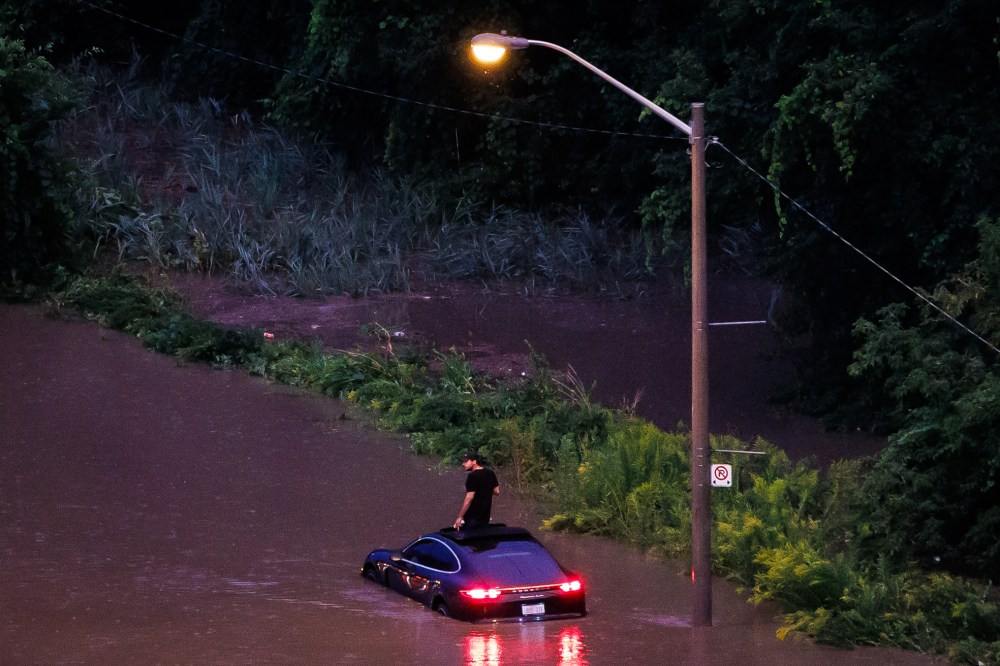
Toronto Mayor Olivia Chow praised public servants and emergency responders who fielded an “overwhelming” number of calls and reassured residents that the city had planned and co-ordinated its response ahead of the storm.
“The storm has passed and I want to assure the people of Toronto that we were prepared. Our teams were co-ordinated and we will keep working until every road is clear and every resident has power back,” she said at a news conference at city hall.
The Don Valley Parkway and the Canadian National Exhibition were open Thursday morning, and transit was running as scheduled, as were city-run summer camps, she said.
Crews will be working hard to ensure parks, outdoor pools and public beaches are safe and ready for the Labour Day long weekend, the mayor said.
“To everyone who sheltered in place, checked in on a neighbour, or stayed off flooded roads last night: thank you,” she said. “That’s what got us through this safely together.”
Toronto officials said they received roughly 1,000 requests for service, while fire officials reported just shy of 1,500 calls over a 24-hour period, which they said was their second-highest call volume in a day, after the 2013 ice storm.
City manager Paul Johnson said the storm was unique in that it dumped large amounts of rain across the city rather than in isolated areas.
“We’ve not seen an event like this that’s brought this amount of water across the city of Toronto,” he said.
“Yes, there was some wide variation, anywhere from about 11 millimetres through to 110 millimetres of rain, but wide areas of the city received large amounts of rain,” along with hail and powerful winds, he said.
“Just to put it into context, that’s what we would declare as a 100-year storm.”
A similar storm hammered the city in 2005, spurring work around flood mitigation and protection, and “those have been working,” he added.
Crews were also out in nearby Vaughan to deal with flooding, water ponding, downed trees and other storm-related issues, the city said in a statement.
“Some roads remain closed, and we ask everyone to continue to use caution and avoid affected areas,” Mayor Steven Del Duca said on social media.
The intense weather brought torrential rain, large hail and the risk of a tornado to wide swaths of southern Ontario as skies darkened over downtown Toronto and hail pummelled neighbourhoods further north.
Video on social media showed large hail falling and downpours flooding vehicles and bus stations, sending people running for cover.
The storm also caused flight delays and cancellations at Toronto’s Pearson airport, and left some serious damage to Rogers Stadium, a 50,000-capacity music venue in the city’s north end. The airport said operations were “returning to normal” Thursday morning but encouraged travellers to check with their airline.
David Sills, director of the Northern Tornadoes Project at Western University, said there was “no credible evidence” at this stage that a tornado occurred as part of Wednesday’s storms, but the organization continues to receive reports and analyze them.
A survey team was heading Thursday for the community of Brodhagen, in the municipality of West Perth about 60 kilometres north of London, Ont., where the worst damage appeared to have occurred, Sills said.
“The team will have a lot of area to cover in the next couple of days,” he wrote in an email.
A few minutes down the road from Brodhagen, Laura Leybourne said she went through a “surreal” experience driving home in the storm.
She was picking up her daughter from daycare when she saw the storm approach in her rearview mirror. Leybourne said she could feel the wind pushing her car forward as branches came down around her, ricocheting off her SUV.
“I have my four-year-old in the back seat so I’m trying to tell her, ‘It’s fine we’re gonna make it home.’ And internally I was panicking because I didn’t know what was going to happen,” she said.
As she neared her home in Rostock, Leybourne said she saw a tree come down and snap the power line running along her street.
Leybourne and her daughter got home safely, but the family’s gazebo didn’t survive the storm. Nor did their trampoline, which Leybourne said she later found about a kilometre away in a corn field.
The family’s home was still without power nearly 24 hours after the storm hit.
Leybourne said she took her daughter to have breakfast at her brother-in-law’s house Thursday morning and took stock of the destruction on the drive over.
“Seeing what that storm had done, it was an indescribable feeling,” she said.

The downed trees and power lines littering the area made her consider just how narrowly she and her daughter had avoided disaster, she said.
“It just gave me a real wake-up call to see how severe storms can really be. I always kind of liked thunderstorms, but after yesterday, I’m really not so sure anymore,” she said.
This report by The Canadian Press was first published Sept. 3, 2026.
–With files from Jordan Omstead
Note to readers:This is a corrected story. A previous version erroneously said Hydro One is a provincial Crown corporation.