

Canada Infrastructure Bank closes loan for Nunavut wind project serving gold mine
Advertisement
Read this article for free:
or
Already have an account? Log in here »
To continue reading, please subscribe:

Digital Subscription
One year of digital access for only $205*
- Enjoy unlimited reading on winnipegfreepress.com
- Read the E-Edition, our digital replica newspaper
- Access News Break, our award-winning app
- Play interactive puzzles
*First annual payment billed as $205.00 + GST for one year. This annual subscription will automatically renew at $233.00 + GST every 52 weeks (10% off the regular annual price of $259.35). Offer available to new and qualified returning subscribers only. Cancel any time.
To continue reading, please subscribe:
Add Free Press access to your Brandon Sun subscription for only an additional
$1 for the first 4 weeks*
- Enjoy unlimited reading on winnipegfreepress.com
- Read the E-Edition, our digital replica newspaper
- Access News Break, our award-winning app
- Play interactive puzzles
*Your next Brandon Sun subscription payment will increase by $1.00 and you will be charged $17.95 plus GST for four weeks. After four weeks, your payment will increase to $24.95 plus GST every four weeks.
Read unlimited articles for free today:
or
Already have an account? Log in here »
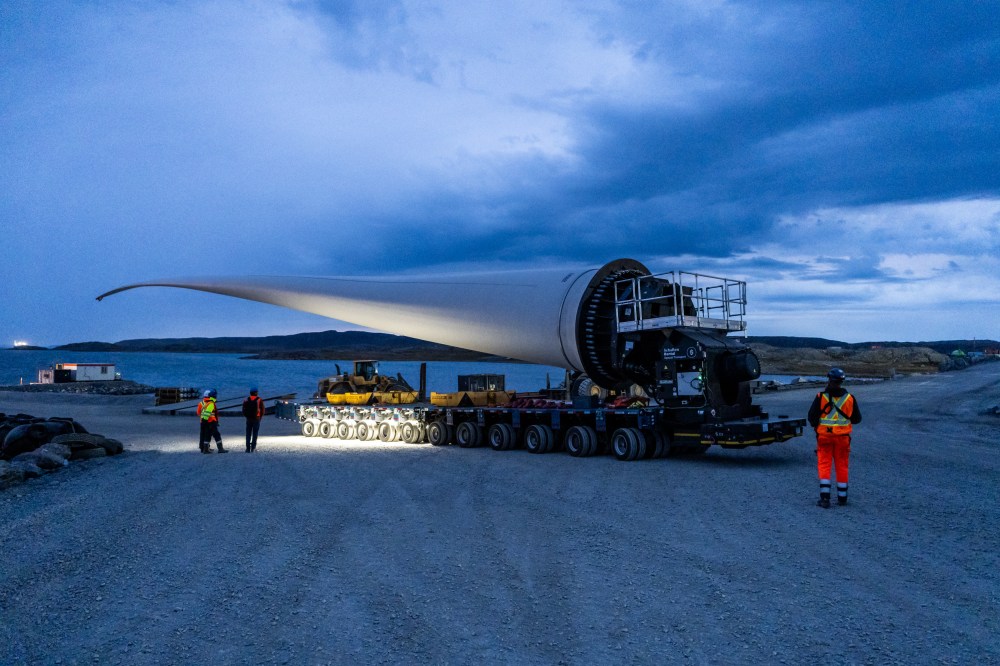
Three wind turbine blades, each almost as long as four standard semi-trucks lined up end-to-end, have completed their long, painstaking journey to the site of one of Canada’s northernmost gold mines.
The 4.2-megawatt turbine and a four-megawatt battery energy storage system will help power Agnico Eagle Mines Ltd.’s operations in Hope Bay, Nvt., helping cut its diesel use by up to three million litres and emissions by some 13,000 tonnes per year.
“To the extent that we can acquire clean energy rather than burning diesel, we’ll do that every single day of the week,” Ammar Al-Joundi, the mining company’s chief executive, said in an interview.
“It’s just the right thing to do, and it’s part of our long-term commitment to sustainability.”
The owners of the wind turbine are the Kitikmeot Inuit Association and Tugliq Energy. They’ve signed a 20-year agreement to sell the power to Agnico Eagle.
The partnership is “not only about transitioning energy use from conventional diesel to alternative wind energy,” said David Omilgoitok, head of the Kitikmeot economic development corporation.
“It is also a partnership intended to grow the Inuit labour market with new skills along with increased investment in Hope Bay and the Kitikmeot Region.”
The partnership has received a $20-million Canada Infrastructure Bank loan as well as a $25-million contribution from Natural Resources Canada’s Smart Renewables and Electrification Pathways program.
Pulling off such a project isn’t an easy sell for the private sector to take on by itself, given the harsh climate, painstaking logistics and need for Indigenous buy-in. The infrastructure bank, a Crown corporation, was set up to invest in projects that deliver on some of the federal government’s desired outcomes, but would struggle to attract traditional corporate financing.
The Hope Bay project supports clean energy by displacing diesel and generates economic development in the North, said Ehren Cory, head of the infrastructure bank.
“It really delivers across multiple of those outcomes. We sometimes call these double and triple word scores,” he said in an interview.
“We think it’s a model for a lot of the development to come in the North.”
In May, Agnico Eagle gave the official go-ahead to proceed with its Hope Bay project, an underground mine almost 700 kilometres northeast of Yellowknife, which aims to produce up to 435,000 ounces of gold over 11 years.
The company doesn’t have the option to connect to the grid, as it does in its more southerly operations, Al-Joundi said.
“That’s why this windmill is quite an exciting first,” he said.
In a part of the world where the sun disappears for much of the year, solar was not ideal. One day, small nuclear reactors might fill the North’s energy needs. But in the meantime, wind is the best option to complement diesel, Al-Joundi said.
It hasn’t been easy. The turbine parts, including its 80-metre long blades, had to make their way from Europe to Canada and then slowly travel inland by barge, which is only possible during a tight window of a few weeks. From there, it was pulled at a snail’s pace by tractor to the site, where it’s being stored. The plan is to assemble it and get it up and running in the spring.
If all goes well, Al-Joundi said it’s possible to build four more wind turbines at Hope Bay. With five, he said the mine could eventually offset an average of a third of its annual diesel power use with wind.
Agnico Eagle previously attempted to build a wind farm near another of its mines elsewhere in the territory called Meliadine, which it had been planning to expand. The proposal garnered community opposition. The Nunavut Impact Review Board recommended the extension be rejected and the company withdrew its proposal.
“It was never really a question of technical capability. It’s always a question of ‘what is it that the community wants?’ While we wanted windmills, that wasn’t on their agenda,” Al-Joundi said.
But he thinks the door isn’t shut to having wind power at Meliadine one day.
“They probably will come up and take a look at what we’re doing at Hope Bay and they may change their minds.”
At Hope Bay, the infrastructure bank said the wind project is expected to employ 15 people during peak construction and provide long-term benefits to local communities through profit-sharing.

It’s the second project in Nunavut for the federal agency, following its $6.7-million loan for a wind project in Sanikiluaq, a community on an island in Hudson Bay.
Cory said the infrastructure bank sees big potential for wind power in the North. Some opportunities will be for industrial developments, as is the case for the Hope Bay mine. Some will serve communities that currently rely on polluting and expensive diesel, like Sanikiluaq did. And some may have the ability to blend multiple uses, where industrial operations are close enough to communities.
“There is a real trend happening and it’s very much a place the (infrastructure bank) thinks we can be helpful,” Cory said.
This report by The Canadian Press was first published Sept. 9, 2026.
Companies in this story: (TSX:AEM)