

Prickly relationship with EU farm policies

Advertisement
Read this article for free:
or
Already have an account? Log in here »
To continue reading, please subscribe:

Digital Subscription
One year of digital access for only $205*
- Enjoy unlimited reading on winnipegfreepress.com
- Read the E-Edition, our digital replica newspaper
- Access News Break, our award-winning app
- Play interactive puzzles
*First annual payment billed as $205.00 + GST for one year. This annual subscription will automatically renew at $233.00 + GST every 52 weeks (10% off the regular annual price of $259.35). Offer available to new and qualified returning subscribers only. Cancel any time.
To continue reading, please subscribe:
Add Free Press access to your Brandon Sun subscription for only an additional
$1 for the first 4 weeks*
- Enjoy unlimited reading on winnipegfreepress.com
- Read the E-Edition, our digital replica newspaper
- Access News Break, our award-winning app
- Play interactive puzzles
*Your next Brandon Sun subscription payment will increase by $1.00 and you will be charged $17.95 plus GST for four weeks. After four weeks, your payment will increase to $24.95 plus GST every four weeks.
Read unlimited articles for free today:
or
Already have an account? Log in here »
Percolating beneath all those warm fuzzy headlines about Canada distancing itself from the U.S. and forging closer ties with the European Union is a deepening sense of unease across farm country.
Whether it’s an “alliance” as Prime Minister Mark Carney calls it, or “associate membership” as characterized by the European Commission President Ursula Von der Leyen, it remains unclear what will emerge from this courtship.
Agriculture is reportedly off the table, probably because it creates more opportunities for conflict than co-operation.
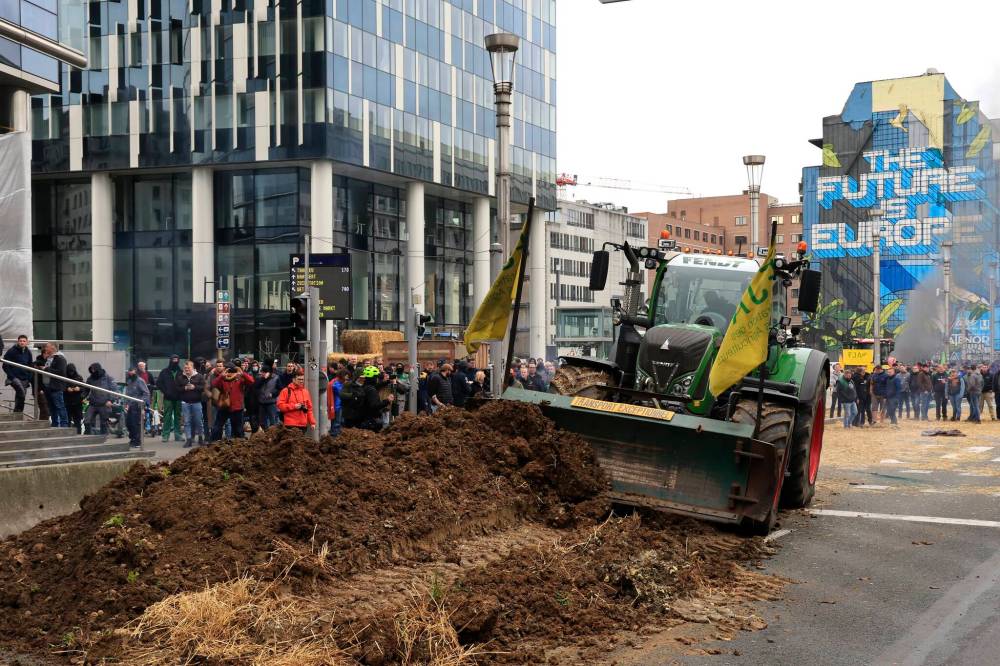
GEERT VANDEN WIJNGAERT / THE ASSOCIATED PRESS FILES
A farmer dumps manure and hay on a boulevard near the European Council building in Brussels during a agriculture sector protest in 2024.
Canadian agricultural exporters have long recognized the need to continue diversifying their markets. It’s not that they haven’t tried. Canada already exports cereals to more than 80 countries, canola to 50, beef to 58 and chicken to 45.
Canadian farmers and processors would certainly benefit from better access to another 452 million consumers in the EU.
Farm Credit Canada estimated in a report this month that building stronger ties with Europe and Asia around food could contribute another $9.4 billion to the Canadian economy, citing “strong potential growth in European markets for prepared foods, vegetable oils, sugar and confectionery, processed fruits and vegetables, and alcoholic and non-alcoholic beverages.”
However, the U.S. has emerged as the destination for 78 per cent of Canada’s agriculture and agri-food exports for reasons that extend beyond proximity and trade agreements.
The industries and bureaucrats on both sides of the border have worked diligently over the past several decades to harmonize regulatory approvals for new technologies and to streamline supply chains.
As well, consumers in the two countries share similar values and cultural preferences when it comes to what they eat, food safety and how they want their food raised. North American food culture is one of abundance, where food is a commodity and eating is more about choices and income than about availability.
EU food policy is deeply rooted in the war-induced famines of the first half of the 20th century. Food security remains sacrosanct, even though today’s population is generations removed from hunger. Farmers are plentiful, well-organized, and militant. They are not above driving farm equipment and livestock deep into urban centres to underscore grievances.
European policy makers also have what the North American industry considers unrealistic ideas about food safety, animal welfare and the environment. They’ve been reluctant to embrace technologies that make farming more productive, and many would argue more sustainable.
The EU continues to eschew genetically modified crops, which have overtaken Canadian canola, soybean and corn production. It has forced its farmers to stop using so many pesticides, including neonicotinoids, which Canadian farmers use to prevent flea beetles in their canola crops, but which also kill bees.
European farmers aren’t allowed to use bovine growth hormones, which increase growth rates and produce more beef with less feed, which in turn means less manure and methane production.
The prevailing science says these hormones are safe, but the EU banned them anyway. Any beef sold into that market must be growth hormone-free. North American producers complained to the WTO in the late 1990s and won their case.
However, the EU opted to pay fines for non-compliance rather than change its policy. So, although Canadian cattle producers now have duty-free access to the EU for 65,000 tonnes of beef a year, annual exports are less than 2,000 tonnes.

There are producers who raise their beef without hormone implants. However, Canadian processors aren’t set up to differentiate this beef through the export supply chain. The volumes and potential returns don’t justify such an investment.
From a Canadian farmer’s perspective, Europe’s track record on agricultural trade is one of talking the talk without always walking the walk. Tariff-free access isn’t worth much if non-tariff barriers make it impossible to achieve.
The risks for farmers are closer ties with the EU will result in forced alignment on environmental or ethical policies that disrupt their production practices, slow the adoption of new technology and cause further hassles with the U.S.
But if snuggling up to the EU leads to a better dialogue aimed at finding common ground while providing Canada with more leverage when dealing with its difficult next-door neighbour, it is a strategy worth pursuing.
Laura Rance-Unger is editor emeritus for Glacier FarmMedia. She can be reached at lrance@farmmedia.com
Laura Rance is editorial director at Farm Business Communications.
Our newsroom depends on a growing audience of readers to power our journalism. If you are not a paid reader, please consider becoming a subscriber.
Our newsroom depends on its audience of readers to power our journalism. Thank you for your support.
Laura Rance is editorial director at Farm Business Communications.
Our newsroom depends on a growing audience of readers to power our journalism. If you are not a paid reader, please consider becoming a subscriber.
Our newsroom depends on its audience of readers to power our journalism. Thank you for your support.
Advertisement Advertise With Us
Advertisement Advertise With Us