

Argentina’s poverty rate rises above 30% under President Milei, reversing recent decline
Advertisement
Read this article for free:
or
Already have an account? Log in here »
To continue reading, please subscribe:

Digital Subscription
One year of digital access for only $205*
- Enjoy unlimited reading on winnipegfreepress.com
- Read the E-Edition, our digital replica newspaper
- Access News Break, our award-winning app
- Play interactive puzzles
*First annual payment billed as $205.00 + GST for one year. This annual subscription will automatically renew at $233.00 + GST every 52 weeks (10% off the regular annual price of $259.35). Offer available to new and qualified returning subscribers only. Cancel any time.
To continue reading, please subscribe:
Add Free Press access to your Brandon Sun subscription for only an additional
$1 for the first 4 weeks*
- Enjoy unlimited reading on winnipegfreepress.com
- Read the E-Edition, our digital replica newspaper
- Access News Break, our award-winning app
- Play interactive puzzles
*Your next Brandon Sun subscription payment will increase by $1.00 and you will be charged $17.95 plus GST for four weeks. After four weeks, your payment will increase to $24.95 plus GST every four weeks.
Read unlimited articles for free today:
or
Already have an account? Log in here »
BUENOS AIRES, Argentina (AP) — Argentina’s poverty rate jumped to 32.3% in the first half of 2026, official data showed Thursday, as incomes failed to keep pace with the rising cost of basic goods, a setback for libertarian President Javier Milei little more than a year before he seeks reelection.
The national statistics agency, known as INDEC, reported that the share of Argentines living below the poverty line jumped four percentage points from 28.2% in the second half of 2025. Extreme poverty, or indigence, rose from 6.3% to 7.5%.
The reversal comes after Milei repeatedly touted declining poverty as evidence that his free-market economic overhaul was bearing fruit. Poverty surged to nearly 53% in the first half of 2024 after his government’s devaluation of the peso and sweeping spending cuts left most Argentines unable to afford a basket of basic goods. But the rate then fell rapidly as Milei’s austerity drive helped tame inflation, hitting an eight-year low of 28% in the second half of 2025.
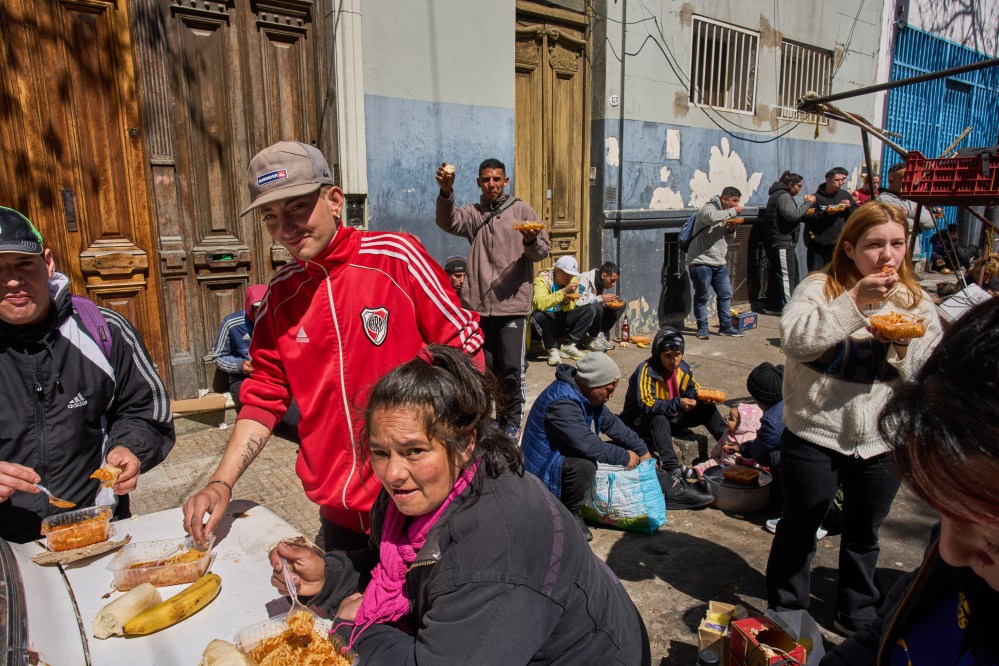
Thursday’s report suggests that progress has lost momentum as unemployment edges higher and rising prices squeeze Argentines’ purchasing power, with average salaries still below where they stood in real terms when Milei took office in December 2023. Average per-capita household income rose 11.5% from the previous six months, while the basic basket of goods used to set the poverty line increased nearly 20%, INDEC said.
Roughly 9.7 million people across the 31 urban areas surveyed by INDEC were living below the poverty line, including 2.25 million in extreme poverty. Nearly 45% of children under 15 were poor. The survey covers 30.1 million people living in major urban areas across Argentina, rather than the country’s entire population of 46 million.
Milei inherited triple-digit inflation and chronic fiscal deficits from his populist predecessors and responded with one of the most aggressive austerity programs in Argentina’s recent history, slashing public spending and subsidies while tightening monetary policy. His government argues that fiscal balance is key to stabilizing Argentina’s crisis-stricken economy and laying the groundwork for improved living standards.
But the macroeconomic stability Milei has achieved has yet to translate into stronger jobs and growth. Formal private-sector employment has fallen for 13 straight months, while economic activity dropped 2.9% in July from the previous month, INDEC reported Thursday.
“Milei persuaded people that achieving a fiscal surplus required sacrifice, and that by now those sacrifices would be paying off,” said Lucas Romero, a political analyst who heads the polling firm Synopsis Consultores. “Without tangible results — in economic activity, jobs and incomes — it will be difficult to persuade people to keep making sacrifices, especially if the government asks for further austerity.”
Milei’s critics say the poor have paid a high price for Argentina’s economic stability, with cuts to pensions and social assistance accounting for nearly a quarter of his government’s inflation-adjusted spending cuts, according to a September analysis by the Argentine Institute of Fiscal Analysis, a research organization.
Economy Minister Luis Caputo acknowledged Thursday’s increase on social media but emphasized that poverty remained far below the levels recorded during Milei’s first months in office.

“While poverty and extreme poverty increased compared with the previous semester, both rates remain sharply lower than in the first half of 2024,” he wrote.
___
Associated Press writer Isabel DeBre contributed to this report.
___
Follow AP’s coverage of Latin America and the Caribbean at https://apnews.com/hub/latin-america