

‘Zero chance’ U.S. attacks Canada, Alaska governor tells conference
Advertisement
Read this article for free:
or
Already have an account? Log in here »
To continue reading, please subscribe:

Digital Subscription
One year of digital access for only $205*
- Enjoy unlimited reading on winnipegfreepress.com
- Read the E-Edition, our digital replica newspaper
- Access News Break, our award-winning app
- Play interactive puzzles
*First annual payment billed as $205.00 + GST for one year. This annual subscription will automatically renew at $233.00 + GST every 52 weeks (10% off the regular annual price of $259.35). Offer available to new and qualified returning subscribers only. Cancel any time.
To continue reading, please subscribe:
Add Free Press access to your Brandon Sun subscription for only an additional
$1 for the first 4 weeks*
- Enjoy unlimited reading on winnipegfreepress.com
- Read the E-Edition, our digital replica newspaper
- Access News Break, our award-winning app
- Play interactive puzzles
*Your next Brandon Sun subscription payment will increase by $1.00 and you will be charged $17.95 plus GST for four weeks. After four weeks, your payment will increase to $24.95 plus GST every four weeks.
Read unlimited articles for free today:
or
Already have an account? Log in here »
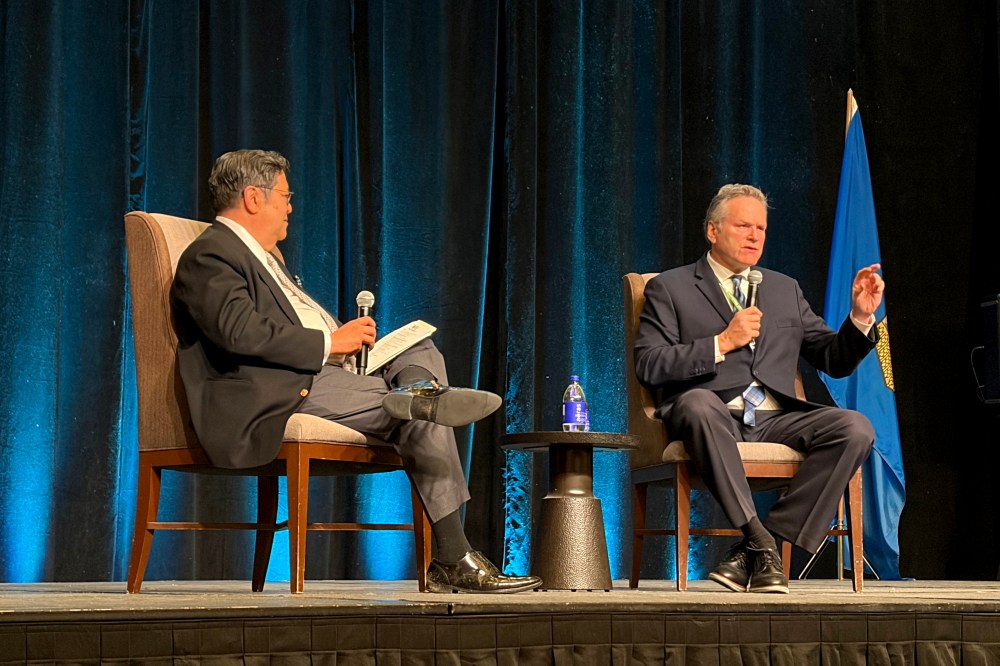
BANFF – The governor of the U.S. state that shares the longest border with Canada expressed dismay at the notion that his country would ever invade its southern neighbour.
“I’d have a better chance of sprouting wings and flying around the audience here,” Alaska Gov. Mike Dunleavy said during an onstage discussion Friday at the Global Business Forum in Banff, Alta.
Dunleavy’s remarks come days after the New York Times quoted Prime Minister Mark Carney as saying his government has studied such a possibility as an “extreme tail risk.” Federal Defence Minister David McGuinty later told reporters in Ottawa that it’s “normal” for all militaries around the world to analyze risk scenarios.
U.S. President Donald Trump has repeatedly asserted he wants to make Canada the 51st state, but has said he would do so through economic, and not military, means.
Dunleavy, a Republican who called Trump “the best president for the state of Alaska in our entire history,” said there’s “zero chance” that the United States would contemplate a military incursion, and that “Pennsylvania has a better chance of being invaded by West Virginia.”
The average American would find the idea of attacking Canada “shocking” and even feel “hurt”, Dunleavy added.
“We see you as our brothers, siblings of the same mother.”
Jody Thomas, who was national security and intelligence adviser to former prime minister Justin Trudeau, is similarly unconvinced a military incursion is on the table, calling it “improbable, slightly impossible.”
She told the forum that in such an unlikely event, negotiations would kick into high gear right away.
“Immediately, there would be calls from the Prime Minister’s Office to the White House. There would be negotiations. The diplomats — State, Global Affairs, Canada, our ambassadors — would be talking. The chief of the defence staff would be talking to the chairman of the military committee to understand what’s going on and stop it,” Thomas said.
“The United States is 10 times larger than us … There’d be maybe a few days of mobilization and movement before I think it would stop because Canada would not want harm done to our citizens. We would not want to see loss of life.”
There are other potential threats that come to mind for Thomas that originate further afield.
“We have adversaries out there and it’s not something that ever has really entered the Canadian psyche,” she said.
“North Korea is an adversary. China can be an adversary. Russia can be an adversary, the threat of terrorist attacks emanating from the Middle East.”

Thomas said national security these days can’t be separated from a country’s economic health.
“You can’t have a weak economy and be a strong country from a perspective of national security. There are opportunities for organized crime. There’s opportunities for terrorism. You can be taken advantage of if you’re not strong economically,” she said.
“If you have not invested in your armed forces, you cannot defend your country. Environmental disasters can wipe out industries, and so we have to be strong environmentally.
“We have looked at things in silos in Canada for too long and it is time for systems thinking end-to-end about the implications of where we’re spending money and why.”
This report by The Canadian Press was first published Sept. 25, 2026.