

Diesel prices surge to historic highs, hitting consumers harder than ever
Advertisement
Read this article for free:
or
Already have an account? Log in here »
To continue reading, please subscribe:

Digital Subscription
One year of digital access for only $205*
- Enjoy unlimited reading on winnipegfreepress.com
- Read the E-Edition, our digital replica newspaper
- Access News Break, our award-winning app
- Play interactive puzzles
*First annual payment billed as $205.00 + GST for one year. This annual subscription will automatically renew at $233.00 + GST every 52 weeks (10% off the regular annual price of $259.35). Offer available to new and qualified returning subscribers only. Cancel any time.
To continue reading, please subscribe:
Add Free Press access to your Brandon Sun subscription for only an additional
$1 for the first 4 weeks*
- Enjoy unlimited reading on winnipegfreepress.com
- Read the E-Edition, our digital replica newspaper
- Access News Break, our award-winning app
- Play interactive puzzles
*Your next Brandon Sun subscription payment will increase by $1.00 and you will be charged $17.95 plus GST for four weeks. After four weeks, your payment will increase to $24.95 plus GST every four weeks.
Read unlimited articles for free today:
or
Already have an account? Log in here »
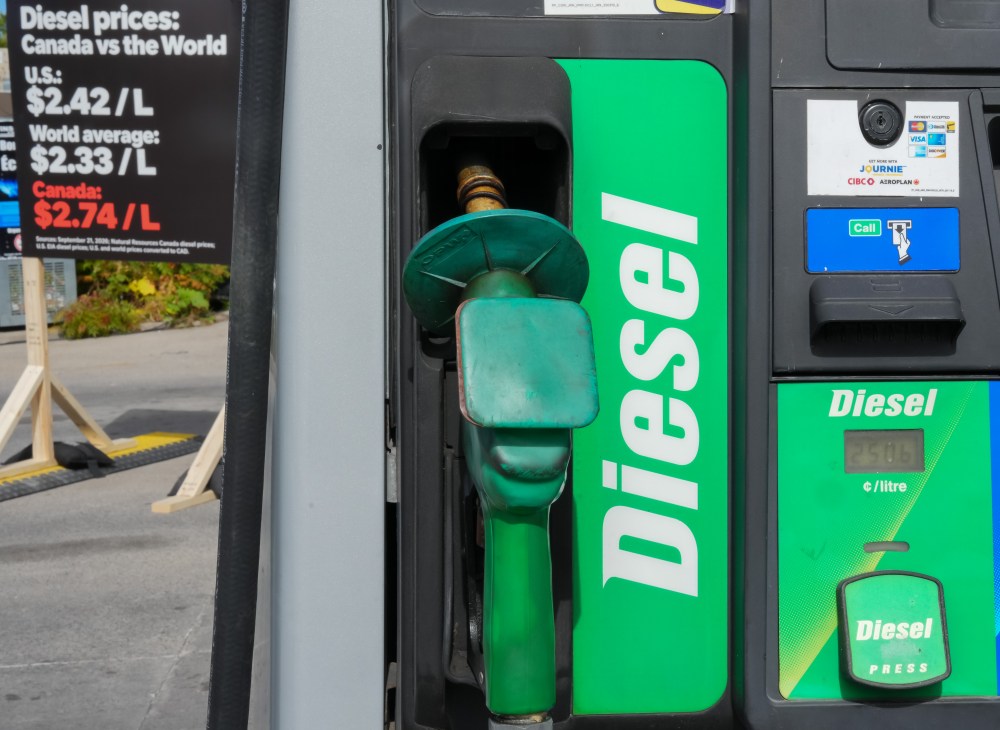
Diesel prices have risen to historic levels over the past month, filtering through to all corners of the economy as shippers and consumers struggle to absorb the blow.
The average retail price of diesel topped $2.64 per litre on average for the week ended Tuesday, up 59 per cent from right before the Iran war and 15 per cent from November 2022, when the price hit record highs unmatched until earlier this year, according to Natural Resources Canada.
Supply disruptions caused by the closure of the Strait of Hormuz have shrunk energy output for seven months and counting, with the critical waterway effectively closed and many crude refineries slashing production.
“Many refineries around the world are already stretched to capacity,” the International Energy Agency said in a newsletter last week. “This leaves few available options to prevent a further tightening of supplies and higher prices in the coming months.”
Meanwhile, Ukrainian strikes on Russian energy infrastructure have further crimped supplies. And recent advances by Houthi militants in Yemen pushed diesel futures in Europe to records this month, as the threat of more maritime attacks by the Iran-backed movement prompts shippers to steer clear of the Red Sea, where Saudi Arabia loads most of its diesel.
Experts say elevated fuel costs mean higher price tags on items ranging from food and clothing to construction materials for months to come, with diesel demand poised to go up even further as winter approaches.
The price of a round-trip haul by a semi truck between Montreal and Toronto would have cost roughly $850 on Jan. 1. Now the total would amount to $1,400, said Mike Millian, president of the Private Motor Truck Council of Canada.
“A fleet’s No. 1 expense outside of wages was always fuel. Now it’s probably fuel,” said Millian, whose group represents about 200 companies with in-house fleets including Tim Hortons, Home Hardware and Loblaw.
“It’s really dramatic. It’s tough to absorb.”
Diesel powers industries ranging from agriculture to mining and manufacturing, and the bigger expenses they face are likely to show up as higher sticker prices on consumer items.
“It hurts everybody. There’s not anybody this doesn’t affect,” said Millian.
Even if a deal to open the strait were struck tomorrow, consumers would likely wait months before prices fell.
That lag stems partly from the time needed to carry out major shifts in a creaky global supply chain, from reopening oil wells to shipping crude oil to refineries.
“It’s almost like a very slow-moving train where, when you stop it, getting going again has its own challenges,” said Ross Prentice, co-founder of Evotrux, an online platform connecting shippers and carriers.
For now, fuel surcharges remain on the rise, in tandem with diesel prices.
Freight railway fuel surcharges for October now sit up to 73 per cent above levels from early August, according to figures from Canadian National Railway Co. and Canadian Pacific Kansas City Ltd.
Truckers who haul produce, clothes and pharmaceuticals across the continent to Canadian shelves tack on surcharges as well. But the gap between the transport time and the date the weekly fuel charges are pegged to can eat into trucking earnings.
“Fuel may have jumped 10 cents since yesterday, and they’re hauling it for the same amount,” said Millian, noting a volatility that was rare just a couple years earlier.
The shippers and retailers who face transport surcharges often find they have little choice but to raise prices for shoppers.
“If you’re an independent grocer and you’re on an overall margin of two per cent and you’re getting fuel surcharges from your suppliers, you’re in a tough spot,” said Gary Sands, a senior vice-president at the Canadian Federation of Independent Grocers, which represents about 6,900 stores.
“It becomes very difficult to not pass on those fuel surcharges.”
For farmers, high diesel prices have arrived at the “worst possible time” because harvest season marks a particularly fuel-intensive period of the year, said Bruce Burrows, executive director at Grain Growers of Canada.
He said earlier this month he’d like to see the federal government offer a “targeted and temporary” per-litre rebate on fuel to help ease some of the pain.
Rural and northern residents are among the hardest hit by soaring diesel prices.
“Some of our northern communities have diesel generation for power,” said Prentice. “The cost increase to them in an already very costly situation in the North could be pretty devastating.”
Diesel prices vary widely across Canada, with the weekly retail average ranging from $2.94 per litre in Gaspé, Que., to $2.47 per litre in Grande Prairie, Alta., according to Natural Resources Canada.

Three weeks ago, Ottawa extended its suspension of the fuel excise tax, in place since April 20, through to Jan. 31. The relief measure saves drivers four cents per litre on diesel and 10 cents per litre on gasoline.
“We appreciate any help we get from the governments, but dropping some tax holidays here and there is not going fix what the big issue is,” Millian said. “It’s what’s going on around us in this world.”
This report by The Canadian Press was first published Sept. 29, 2026.
Companies in this story: (TSX:CNR, TSX:CP)
— With files from Lauren Krugel in Calgary