

Wet weather heats up feed grain availability

Advertisement
Read this article for free:
or
Already have an account? Log in here »
To continue reading, please subscribe:

Digital Subscription
One year of digital access for only $205*
- Enjoy unlimited reading on winnipegfreepress.com
- Read the E-Edition, our digital replica newspaper
- Access News Break, our award-winning app
- Play interactive puzzles
*First annual payment billed as $205.00 + GST for one year. This annual subscription will automatically renew at $233.00 + GST every 52 weeks (10% off the regular annual price of $259.35). Offer available to new and qualified returning subscribers only. Cancel any time.
To continue reading, please subscribe:
Add Free Press access to your Brandon Sun subscription for only an additional
$1 for the first 4 weeks*
- Enjoy unlimited reading on winnipegfreepress.com
- Read the E-Edition, our digital replica newspaper
- Access News Break, our award-winning app
- Play interactive puzzles
*Your next Brandon Sun subscription payment will increase by $1.00 and you will be charged $17.95 plus GST for four weeks. After four weeks, your payment will increase to $24.95 plus GST every four weeks.
Read unlimited articles for free today:
or
Already have an account? Log in here »
Other than those in another rain cloud, it’s hard to find the silver linings attached to this year’s soggy harvest.
A showery September continued to cause delays and more deterioration in both quality and yield. Plus, the costs of mitigating post-harvest losses to spoilage are rising as the delays push further into fall. It takes more heat and time to artificially dry down grain as temperatures cool.
Crops harvested in August before the weather turned warm and damp came off with good quality and average yields. But farmers in some areas, such as southwest Manitoba, had only started when the rains came. Now they are plagued with standing water and sprouting swaths of grain that might not even make feed quality.
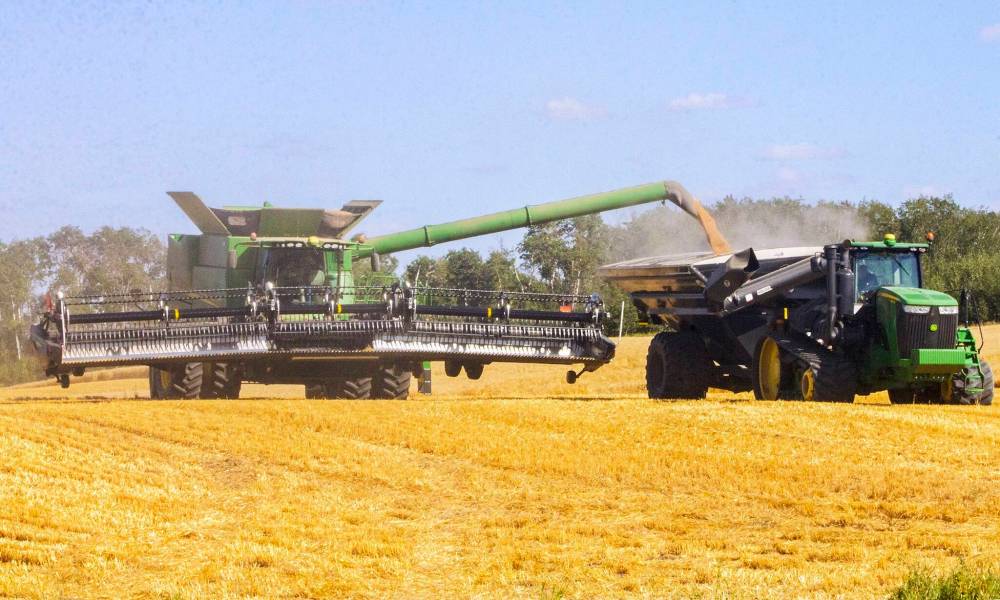
Kim Langen / Killarney Guide files
Farmers harvest a crop of wheat near Holmfield on Sept. 2. The next morning, a storm brought substantial rain to the region.
Suffice to say crop insurance adjusters are going to be busy this fall.
One crop weathering the season relatively well are soybeans, now Manitoba’s third largest in acreage behind canola and wheat. Soybeans tolerate late-season moisture well, using it to plump out their pods with the beans used for oil and meal. Yields, however, will depend on how much farmers can harvest before the pods shatter and beans drop to the ground.
The likelihood of greater feed grain availability as farmers salvage cereal grains downgraded due to bleached and sprouted kernels should add to the already buoyant price outlook for cattle.
Nearly half of Manitoba farms raise cattle as well as annual crops. Local cattle farmers are predominantly in cow-calf production, so they don’t typically feed a lot of grain. They maintain their herds on pasture and forage. However, every fall, they sell calves to livestock feeders in Alberta, Eastern Canada or the U.S., which put them on a largely grain-based diet until they reach market weight.
So, although Manitoba farmers with a weather-damaged grain crop are still going to sell it at deeply discounted prices, those losses might be offset by higher calf prices as feedlot buyers take advantage of cheaper feeds to stock their pens.
Farm Credit Canada has been forecasting a continuation of historically high cattle prices for Canadian farmers due to less supply and strong consumer demand for beef.
The Canadian cattle sector has entered a herd rebuilding phase as producers keep more of their heifers (young females) for breeding stock. There’s been a 5.7 per cent increase in the number of heifers and a 1.9 per cent increase in the number of mature cows kept in the national herd. But it takes a couple of years before decisions now will have any effect on the supply or price of beef.
Meanwhile the U.S. cattle sector, which accounts for 90 per cent of North American inventories, continues to shrink, plagued by drought and other issues, such as the Trump administration’s decision to allow the tariff-free import of 300,000 tonnes of South American beef.
As well, ICE raids have created labour shortages in the meat processing sector, which relies on foreign-born workers for about half of its workforce. The delays and disruptions are rippling through the supply chain. U.S. ranchers complain it has cost them millions.
It all adds up to an optimistic outlook for Canadian beef producers — for now.
FCC is less bullish with its outlook for the hog sector. Live hog exports to the U.S. have remained strong, but exports of pork are facing headwinds. The total export value of Canadian pork dropped 4.7 per cent last year due to lower sales to China (which still maintains an import tariff of 25 per cent on Canadian pork), Japan and the Philippines.
“Unlike cattle markets, where tight North American supplies continue to dominate price discovery, hog markets are increasingly shaped by international trade conditions,” FCC said in its September outlook.

Exports to the U.S. have grown, but given the current trade environment, it’s hard to feel confident about the future of that market.
All these factors trickle back into the local farm economy and demand for feed grains.
But first things first: the primary concern for grain farmers is getting their crop off the fields and into a sellable condition.
Then they can start shopping for someone to buy it.
Laura Rance-Unger is editor emeritus for Glacier FarmMedia. She can be reached at lrance@farmmedia.com
Laura Rance is editorial director at Farm Business Communications.
Our newsroom depends on a growing audience of readers to power our journalism. If you are not a paid reader, please consider becoming a subscriber.
Our newsroom depends on its audience of readers to power our journalism. Thank you for your support.
Laura Rance is editorial director at Farm Business Communications.
Our newsroom depends on a growing audience of readers to power our journalism. If you are not a paid reader, please consider becoming a subscriber.
Our newsroom depends on its audience of readers to power our journalism. Thank you for your support.
Advertisement Advertise With Us
Advertisement Advertise With Us