

Don’t mistake attendance at a press conference as support for a pipeline, chief says
Advertisement
Read this article for free:
or
Already have an account? Log in here »
To continue reading, please subscribe:

Digital Subscription
One year of digital access for only $205*
- Enjoy unlimited reading on winnipegfreepress.com
- Read the E-Edition, our digital replica newspaper
- Access News Break, our award-winning app
- Play interactive puzzles
*First annual payment billed as $205.00 + GST for one year. This annual subscription will automatically renew at $233.00 + GST every 52 weeks (10% off the regular annual price of $259.35). Offer available to new and qualified returning subscribers only. Cancel any time.
To continue reading, please subscribe:
Add Free Press access to your Brandon Sun subscription for only an additional
$1 for the first 4 weeks*
- Enjoy unlimited reading on winnipegfreepress.com
- Read the E-Edition, our digital replica newspaper
- Access News Break, our award-winning app
- Play interactive puzzles
*Your next Brandon Sun subscription payment will increase by $1.00 and you will be charged $17.95 plus GST for four weeks. After four weeks, your payment will increase to $24.95 plus GST every four weeks.
Read unlimited articles for free today:
or
Already have an account? Log in here »
OTTAWA – The grand chief of Treaty 8 First Nations stood behind Prime Minister Mark Carney and Alberta Premier Danielle Smith last week as they announced the Pacific Link pipeline was the first project deemed to be in the “national interest” under the Building Canada Act.
But Trevor Mercredi said his presence shouldn’t be taken as a vote of confidence.
“I want to be clear that our presence should not be interpreted as support for the project,” Mercredi told The Canadian Press.
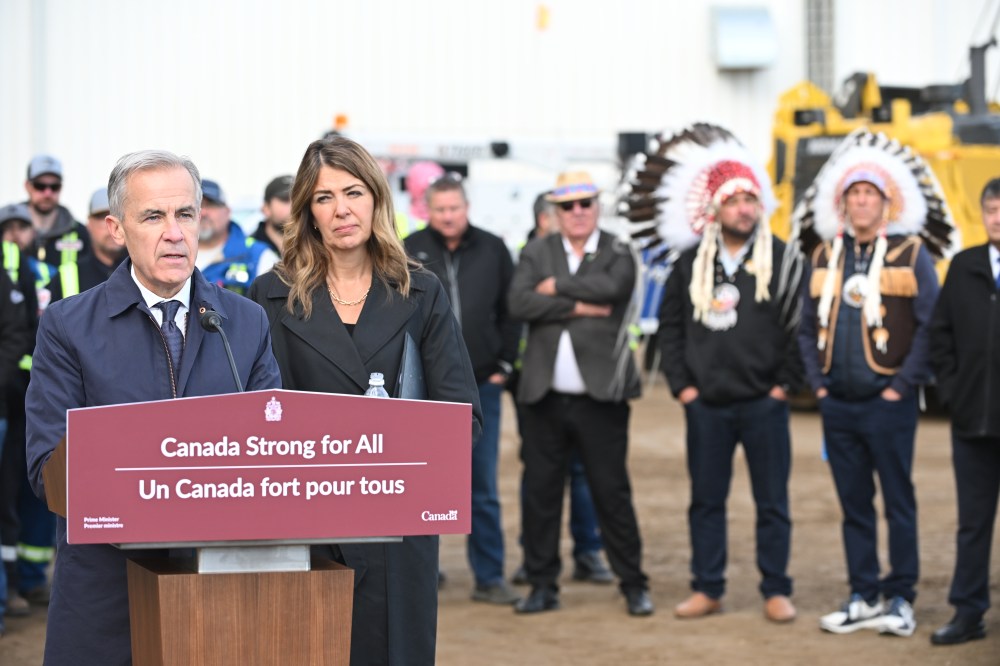
“Leadership was there to ensure our nations are not left behind. There are significant concerns that must be addressed, and it does not mean the pipeline is a done deal.”
The national interest designation under the Building Canada Act, puts the pipeline proposal in line for streamlined oversight and approvals.
The government said it will work over the coming year to complete consultations on the project itself, and to secure environmental safeguards, financing and Indigenous partnerships. It wants construction to begin in September 2027.
Some 130 Indigenous communities were given just two months for consultations on whether the pipeline should be granted a national interest designation, and that was still more than the government had planned.
A summary of those consultations posted online by the federal government says potentially impacted Indigenous groups decried a lack of information about the project, which they said prevented them from fully assessing its impact.
Indigenous leaders have warned the federal government risks violating their rights with “national interest” designations through the Major Projects Office and the controversial Building Canada Act.
Carney promised his major projects agenda would not interfere with Canada’s obligations under the United Nations Declaration on the Rights of Indigenous Peoples, nor their rights under the Constitution.
The UN declaration, which Canada adopted, states Indigenous groups must provide their free, prior and informed consent before decisions are made that could adversely affect their rights or lands.
Mercredi, who sits on the Indigenous advisory council in the Major Projects Office, said the Carney government appears to be flying the plane “as they’re building it” in a bid to strengthen the Canadian economy in the face of trade pressures with the United States.
“Sometimes when that happens you’re going to hit the ground, and that ground is our First Nations. Because regardless of any legislative changes, regardless of their processes, we still have our rights — they’re still intact,” Mercredi said.
“What they’re doing is weakening their own processes to develop the resources, which does not work in their favour if a (legal) challenge comes from a nation. They can still hold the key. That’s what people have to remember.”
It’s the same message he’s brought to the Major Projects Office. He isn’t sure if they’re listening — or if they even want to talk.
The government has been criticized by some Indigenous leaders for limited consultations, without providing much detail, about whether to designate the project under the act.
Mercredi said the Indigenous advisory council wasn’t tapped to offer feedback on if the consultation time frame was long enough or if a 10 per cent ownership stake for Indigenous groups was enough.
He said had he been asked, he would have said no to both.
“This is a concern that we have with the MPO. What is our purpose as an advisory council?” Mercredi said.
“We hear that we’re part of the process, but in instances like this it’s obvious that we are not.”
Assembly of First Nations National Chief Cindy Woodhouse Nepinak has said staff in the Major Projects Office do not understand how to work with First Nations communities and that “junior staffers” aren’t helping to build relationships.
She also said CEO Dawn Farrell has been unavailable to meet with leadership, including at Assembly of First Nations gatherings.
The Canadian Press has reached out to the Major Projects Office for comment but has not yet received a response.
Lawyer Jesse McCormick, co-chair of the Liberal party’s Indigenous Peoples’ Commission and a lawyer with Pape Salter Teillet LLP, questions how the national interest designation and eventual pipeline construction could have looked if free, prior and informed consent was woven into decision-making from the start.
Industry has advocated for starting with a “yes” for major projects, and then figuring out how to accomplish it later, as a means for bringing investments to Canada, McCormick said.
“You can make that work, but the key, missing ingredient is there should be a ‘yes’ from Indigenous partners at the outset as well,” he said. Not having that “yes” creates an additional risk for the private sector that is weighing whether or not to invest in the project, he added.
“And it creates additional risk for the broader political agenda of the government of Canada to build Canada strong.”
McCormick said the federal government will have to make a determination about what level of risk they’re willing to accept if they advance the project over the objections of Indigenous communities along the pipeline’s route.

“It would help to ensure that Indigenous Peoples have not only a say in the design of the project, but a meaningful opportunity to participate in economic benefits,” he said.
Mercredi said chiefs laid out their concerns in a meeting with Carney the day before the announcement was made, including the respect for their rights, how wastewater will be treated and how they can benefit economically from the project.
“All I know is the chiefs have put their conditions forward,” Mercredi said.
“And we’ll see if Prime Minister Carney listens.”
This report by The Canadian Press was first published Oct. 6, 2026.