

WTO raises merchandise trade growth forecast to 3.9% as AI boom offsets hit from Middle East
Advertisement
Read this article for free:
or
Already have an account? Log in here »
To continue reading, please subscribe:

Digital Subscription
One year of digital access for only $205*
- Enjoy unlimited reading on winnipegfreepress.com
- Read the E-Edition, our digital replica newspaper
- Access News Break, our award-winning app
- Play interactive puzzles
*First annual payment billed as $205.00 + GST for one year. This annual subscription will automatically renew at $233.00 + GST every 52 weeks (10% off the regular annual price of $259.35). Offer available to new and qualified returning subscribers only. Cancel any time.
To continue reading, please subscribe:
Add Free Press access to your Brandon Sun subscription for only an additional
$1 for the first 4 weeks*
- Enjoy unlimited reading on winnipegfreepress.com
- Read the E-Edition, our digital replica newspaper
- Access News Break, our award-winning app
- Play interactive puzzles
*Your next Brandon Sun subscription payment will increase by $1.00 and you will be charged $17.95 plus GST for four weeks. After four weeks, your payment will increase to $24.95 plus GST every four weeks.
Read unlimited articles for free today:
or
Already have an account? Log in here »
GENEVA (AP) — The World Trade Organization is sharply increasing its forecast for merchandise trade growth worldwide this year, more than doubling its earlier prediction to 3.9% as booming AI investments offset a hit from the war in the Middle East.
The Geneva-based trade body says global trade chugged along at a hearty pace, as supply chains adapted and AI-related spending poured in to provide “a powerful boost to goods trade.”
The revised forecast marks a big jump from an initial WTO forecast in this spring for 1.9% growth for merchandise trade. The figure excludes services trade. The trade body forecast growth next year of 4.1%, up from 2.9% predicted in March.

“The revision reflects evidence that global supply chains adapted to disruptions in energy and fertilizer markets, while strong investment in AI-related infrastructure boosted trade in AI-enabling goods,” WTO said. Trade of oil and gas and fertilizer through the Persian Gulf was shaken after the U.S.-Israeli war against Iran began in February.
WTO said merchandise trade grew 3.5% in the first half of the year, powered by the artificial intelligence market.
“Demand for AI-enabling goods such as semiconductors and servers accounted for 47% of global merchandise trade growth in the first half of 2026, and trade in these products rose by 67% year-on-year, accelerating from the already rapid expansion seen in 2024 and 2025,” WTO said.
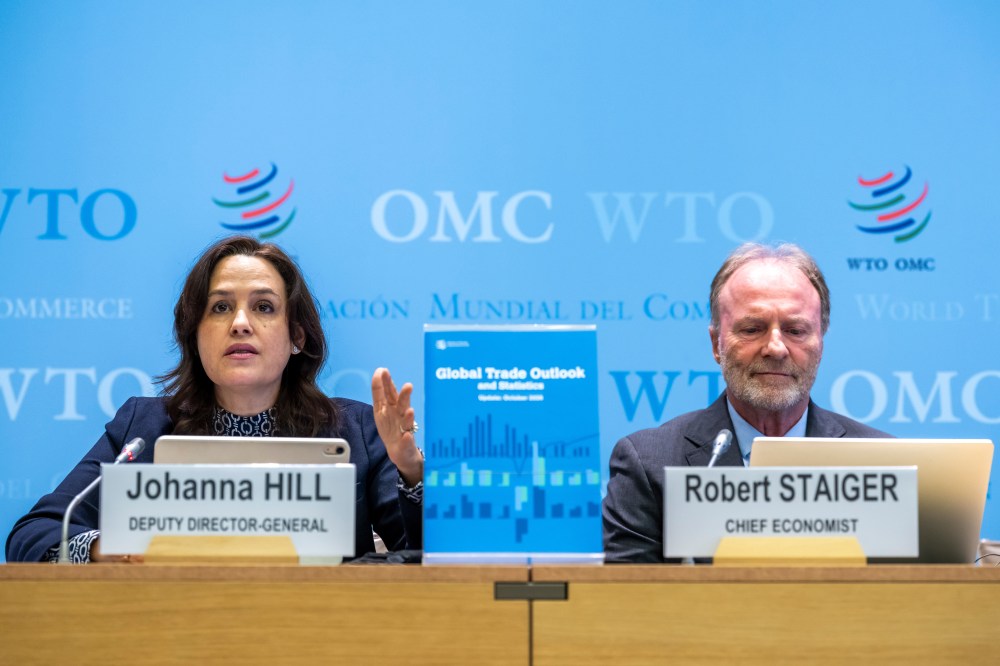
Robert Steiger, its chief economist, said WTO teams — like most forecasters — have been “surprised” at the strength of the AI investment boom. They anticipated that strong growth in AI-enabling goods like electronics and computers would moderate over time because of already-high growth last year and “market saturation” eventually.
“This actually has not happened. Trade in AI-enabling goods grew 16% in value terms in 2024. It grew 31% in value terms in 2025, and it grew an astonishing 67% in the first half of 2026,” he told reporters at WTO headquarters.

Liquefied natural gas exports from the Middle East fell by 47% in the first half of the year, while crude oil exports dropped by nearly a quarter, WTO said. But shipments from other suppliers helped limit the decline to roughly 1% for LNG and about 6% for crude.
WTO said it expects global GDP to grow 2.6% this year and 2.9% in 2027, even though it predicted that the Middle East conflict will continue to weigh on trade through higher energy prices and transport route disruptions.