

Oilpatch convinced Pacific Link will go ahead, but less certain of timing: survey
Advertisement
Read this article for free:
or
Already have an account? Log in here »
To continue reading, please subscribe:

Digital Subscription
One year of digital access for only $205*
- Enjoy unlimited reading on winnipegfreepress.com
- Read the E-Edition, our digital replica newspaper
- Access News Break, our award-winning app
- Play interactive puzzles
*First annual payment billed as $205.00 + GST for one year. This annual subscription will automatically renew at $233.00 + GST every 52 weeks (10% off the regular annual price of $259.35). Offer available to new and qualified returning subscribers only. Cancel any time.
To continue reading, please subscribe:
Add Free Press access to your Brandon Sun subscription for only an additional
$1 for the first 4 weeks*
- Enjoy unlimited reading on winnipegfreepress.com
- Read the E-Edition, our digital replica newspaper
- Access News Break, our award-winning app
- Play interactive puzzles
*Your next Brandon Sun subscription payment will increase by $1.00 and you will be charged $17.95 plus GST for four weeks. After four weeks, your payment will increase to $24.95 plus GST every four weeks.
Read unlimited articles for free today:
or
Already have an account? Log in here »
CALGARY – A survey published this week by investment firm ATB Cormark suggests more than three-quarters of oilpatch players and investors are convinced the Pacific Link pipeline to British Columbia and the Pathways carbon storage project will go ahead — eventually.
“While these projects are viewed as highly likely to be built, the timing of construction was less decisive,” the report said.
The firm polled 22 energy services companies, 27 exploration and production companies and 42 institutional investors from Sept. 14 to Sept. 28.
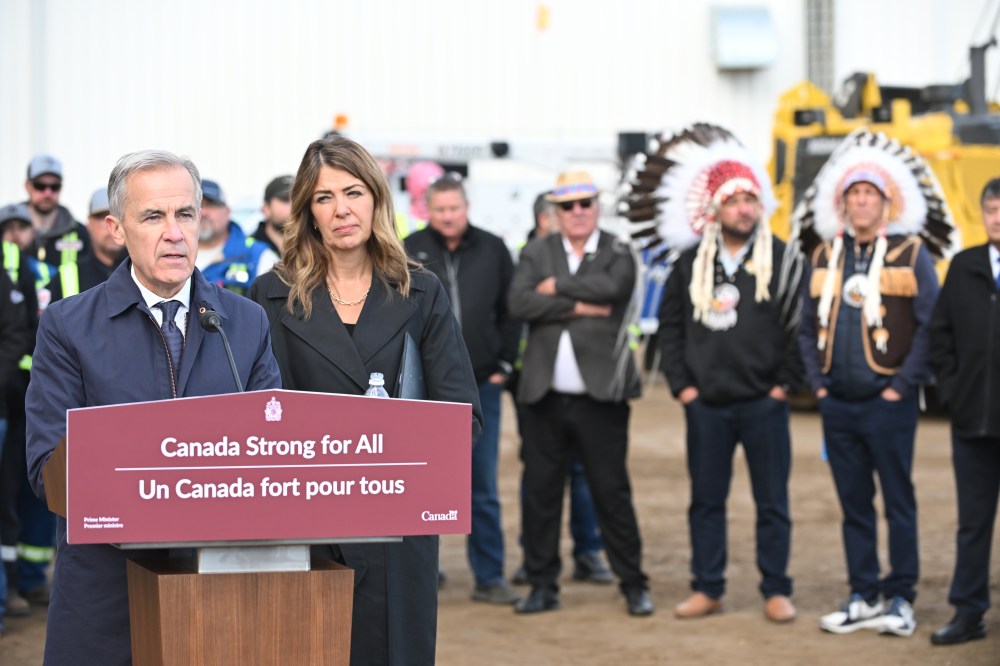
That was days before the million-barrel-a-day Pacific Link pipeline proposed by the Alberta government was deemed the first national-interest project under federal legislation passed last year, paving the way for a speedy review.
Under an energy accord signed between Ottawa and Alberta last year, the pipeline is contingent on Pathways being built to offset emissions. A firm agreement between both governments and industry players on Pathways, which would pipe carbon dioxide from various oilsands operations to an underground storage hub near Cold Lake, Alta., is expected next month.
Seventy-seven per cent of respondents said they believed the projects would receive a positive investment decision.
But 53 per cent of respondents said they believe construction would begin in 2028 or later, with 24 per cent believing that would happen next year. Alberta has targeted a Sept. 1, 2027 date for pipeline building to commence; no such timeline has been established by the five oilsands companies behind Pathways.
The national-interest designation for Pacific Link was dealt its first legal challenge on Thursday.
Lawyers for Cold Lake First Nations have filed an application for judicial review in Federal Court arguing the designation should be quashed and that the court should declare Canada has a duty to consult with the community on the pipeline. The court filing also says if the national interest designation for the pipeline stands, Ottawa will have granted pre-approval of Pathways without meaningfully consulting with Cold Lake.
The ATB Cormark survey suggested industry is skeptical of the benefits of decarbonization projects on a stand-alone basis, when it comes to the long-term competitiveness of the Canadian energy industry.
Of the respondents who expressed a view on this question (four per cent said they were uncertain or had no opinion) 26 per cent said such projects would be beneficial, while 48 per cent said they would be harmful.
Companies were also asked for their impressions of the current Canadian federal government’s approach to expanding the energy industry.
“The results showed broad-based optimism, with 89 per cent of survey takers encouraged by the federal government’s approach, just eight per cent disappointed, while two per cent believe it is ‘too early to judge,'” ATB Cormark said.
A third-quarter earnings preview report from CIBC World Markets said progress on Pacific Link was one of the most important developments for the sector during the period.

In addition to the national interest designation, analysts at the bank pointed to legislation aimed at streamlining project approvals, which is currently before Parliament. Ottawa has also recently announced a tax incentive that would allow companies to immediately deduct most investments.
“While constructive, we believe additional policy support is still required before producers materially accelerate their growth plans,” the CIBC analysts wrote. In addition to further clarity on Pathways, oilsands producers are awaiting details on Alberta’s plans for royalty incentives aimed at boosting production.
“Importantly, capital allocation priorities have not fundamentally changed. Across management teams, shareholder returns and balance sheet strength remain the primary use of free cash flow,” the report said.
“However, compared with the beginning of the quarter, discussions around production growth, brownfield expansions, project readiness and future egress requirements have become noticeably more frequent.”
This report by The Canadian Press was first published Oct. 9, 2026.