

Newfoundland and Labrador expecting windfall from soaring oil prices
Advertisement
Read this article for free:
or
Already have an account? Log in here »
To continue reading, please subscribe:

Digital Subscription
One year of digital access for only $205*
- Enjoy unlimited reading on winnipegfreepress.com
- Read the E-Edition, our digital replica newspaper
- Access News Break, our award-winning app
- Play interactive puzzles
*First annual payment billed as $205.00 + GST for one year. This annual subscription will automatically renew at $233.00 + GST every 52 weeks (10% off the regular annual price of $259.35). Offer available to new and qualified returning subscribers only. Cancel any time.
To continue reading, please subscribe:
Add Free Press access to your Brandon Sun subscription for only an additional
$1 for the first 4 weeks*
- Enjoy unlimited reading on winnipegfreepress.com
- Read the E-Edition, our digital replica newspaper
- Access News Break, our award-winning app
- Play interactive puzzles
*Your next Brandon Sun subscription payment will increase by $1.00 and you will be charged $17.95 plus GST for four weeks. After four weeks, your payment will increase to $24.95 plus GST every four weeks.
Read unlimited articles for free today:
or
Already have an account? Log in here »
ST. JOHN’S – Newfoundland and Labrador’s government is expecting a boost to the province’s revenues this year after the war in Iran sent oil prices skyrocketing across the globe.
Finance Minister Craig Pardy has previously said he anticipated additional revenues of more than $500 million, as oil prices soared. On Wednesday, the minister said that figure is even higher, though he said it was too soon to provide specific details.
However, Pardy said he agreed with Newfoundland and Labrador Premier Tony Wakeham, who promised during a state-of-the-province speech that his government would not centre its financial planning around windfalls from wars.
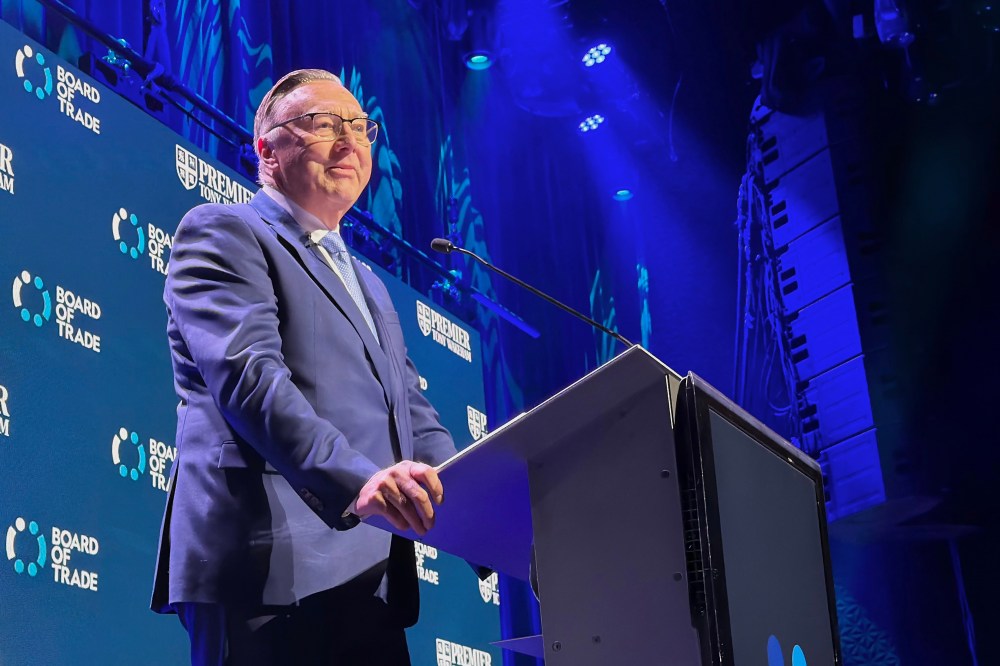
“Those same elevated oil prices are hitting Newfoundlanders and Labradorians at the pump around their home heating bills,” Wakeham said to a crowd of more than 100 at a St. John’s Board of Trade event. “We cannot, and should not, and will not be counting on artificially high oil prices in perpetuity.”
Wakeham’s address marked one year since his Progressive Conservative Party ended 10 years of Liberal governments in Canada’s easternmost province. He promised a plan to expand the province’s offshore oil and gas industry and use its proceeds to build “something that lasts.”
He spoke of the opportunity in the oil and gas industry, and of promised returns from a sweeping new energy agreement with Quebec to develop wind and hydroelectric projects along the Churchill River in Labrador. He also took several opportunities to rail against the previous Liberal government.
Though the province expects more revenue from oil prices, it is also facing towering financial burdens. Pardy’s most recent budget forecast a net debt of nearly $21 billion by the end of the current fiscal year in March. By contrast, the province’s entire budget for the year is roughly $11.5 billion.
The budget also estimated an end-of-year deficit of about $688.5 million.
Pardy promised to deliver a debt management plan for the province later in the fall, though again, he was hesitant to reveal many details.
“We want to arrest our borrowing, and then we certainly want to make sure that we minimize it, and then get that net debt paid off,” he said after Wakeham’s speech. That will be accomplished by generating more revenue and controlling expenses, he said.
In the meantime, Wakeham said his government is still considering buying a piece of Equinor’s proposed Bay du Nord offshore oil project, which would be the first deepwater oil development in the country.

The Newfoundland and Labrador government holds shares in three of four oil projects currently operating off the east coast of St. John’s.
Bay du Nord would be the fifth, if Equinor decides to proceed. The Norwegian energy company is expected to make that call early next year.
Officials said earlier this year that the Newfoundland and Labrador government was considering buying up to 10 per cent of Bay du Nord. In that case, the provincial government would make an estimated $6.4 billion from the development through royalties, taxes and the equity stake.
Wakeham said he was waiting for recommendations from his government’s Department of Energy Mines and OilCo, the province’s oil and gas corporation.
This report by The Canadian Press was first published Oct. 14, 2026.