

‘Hardly surprising’ many Alberta business leaders staying mum on separation: expert
Advertisement
Read this article for free:
or
Already have an account? Log in here »
To continue reading, please subscribe:

Digital Subscription
One year of digital access for only $205*
- Enjoy unlimited reading on winnipegfreepress.com
- Read the E-Edition, our digital replica newspaper
- Access News Break, our award-winning app
- Play interactive puzzles
*First annual payment billed as $205.00 + GST for one year. This annual subscription will automatically renew at $233.00 + GST every 52 weeks (10% off the regular annual price of $259.35). Offer available to new and qualified returning subscribers only. Cancel any time.
To continue reading, please subscribe:
Add Free Press access to your Brandon Sun subscription for only an additional
$1 for the first 4 weeks*
- Enjoy unlimited reading on winnipegfreepress.com
- Read the E-Edition, our digital replica newspaper
- Access News Break, our award-winning app
- Play interactive puzzles
*Your next Brandon Sun subscription payment will increase by $1.00 and you will be charged $17.95 plus GST for four weeks. After four weeks, your payment will increase to $24.95 plus GST every four weeks.
Read unlimited articles for free today:
or
Already have an account? Log in here »
CALGARY – Some prominent business leaders have taken a public stand on Alberta remaining a part of Canada, but many more remain on the sidelines as a provincial referendum on that question, and others, fast approaches.
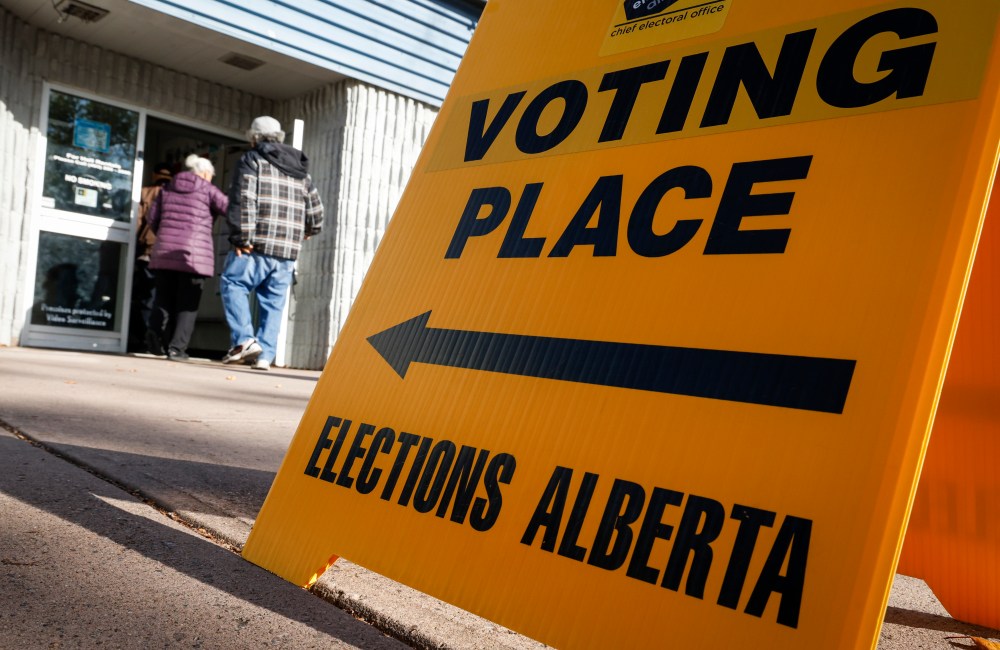
Monday’s vote includes 10 questions: one on whether should Alberta stay in Confederation or move toward a binding separation referendum; five on immigration and four on constitutional matters.
“It’s a mixed bag right now so far,” said Bob Pickard, principal at Leadership Communication Inc., a Calgary-based firm that advises executives and newsmakers on public relations.
“Some leaders have spoken out with conviction. Others have remained quiet.”
Pickard’s firm was one of more than 80 that have signed an open letter from the Calgary Chamber of Commerce warning of the economic fallout if Alberta were to break from Canada.
The chamber and other business advocacy groups have been vocal in warning of the consequences of a split, as well as measures that could make it harder to attract newcomers into the provincial workforce. But relatively few individual corporate CEOs have taken a public stand.
“It’s hardly surprising that a majority of CEOs are not speaking up,” said Richard Leblanc, a professor of governance, law and ethics at York University. “You can alienate customers. You can alienate investors, so there’s more to be lost than gained, generally, by speaking up about a political matter.”
CEOs of public companies answer to their boards of directors and shareholders, who are often loath to take on undue risks to a firm’s reputation, he added. Top executives are often limited to speaking on matters that directly affect the company itself.
“There’s a tradition in Canada of really staying in your lane,” Leblanc said.
But he said there may be times a company’s board of directors agrees that a CEO should speak out on a matter that affects the well-being of the business. Various economic analyses have flagged higher trade costs, decreased investment and reduced employment should Alberta choose to go it alone.
“Sometimes the risk of not doing something can be far greater than doing something and dealing with the blowback,” Leblanc said.
Oilpatch CEOs — many are geologists or engineers by trade — might not have it in their natures to be outspoken on politics, Pickard said. Some might not want to be seen as “showboating” or “grandstanding.”
“They don’t get the top job because of acts of risky courage,” Pickard said. “Many of them get that top job because they’re cautious careerists.”
But Pickard said the separatism issue goes beyond being a political controversy, and is a legitimate concern for every business in Alberta.
“I think we’ve seen way too much passivity here,” he said. “And what we need is candid, transparent, courageous leadership communication on this most existential of issues.”
Getting board sign-off on a CEO’s public message is no easy feat and there are likely to be divisions among directors, said Leblanc, the York governance expert.
Some corporations have former prime ministers, premiers and cabinet ministers as directors on their boards, who can advise on when and how to weigh in on politics, Leblanc noted.
Atco Ltd.’s board includes former Alberta premier Jason Kenney, who has been a fervent voice in the “stay” camp, as well as former federal cabinet minister Rona Ambrose.
Atco CEO Nancy Southern is among a handful of leaders at big, publicly traded companies to sign the Calgary Chamber’s open letter. Others include the CEOs of AltaGas Ltd., Keyera Corp. and Capital Power Corp., as well as the heads of Berkshire Hathaway Energy businesses BHE Transmission and AltaLink.
“What we kept hearing was people wanted safety in numbers to sign,” said chamber president and CEO Deborah Yedlin. “I’m not sure that safety in numbers actually materialized the way we thought it would.”
The chamber and other umbrella groups can speak on behalf of members, but Yedlin said C-suite voices can have a greater impact because there’s more skin in the game.
“At the end of the day, the chamber is not risking that capital, the companies are.”
Financial disclosures filed with Elections Alberta show Calgary-based energy infrastructure company AltaGas has donated $5,000 to the third-party advertiser group Vote to Stay.
No prominent corporations or executives can be found on the disclosures of pro-separation-referendum groups.
A few top executives have made their views known.
“We believe a strong Alberta and a strong Canada go hand in hand,” Imperial Oil chief executive John Whelan wrote on LinkedIn last month after delivering that message to a Calgary Chamber of Commerce luncheon featuring Alberta Premier Danielle Smith.
Atco’s Southern, who describes herself as a proud Albertan and Canadian, told reporters after the company’s annual meeting in May that she can’t imagine how businesses could operate efficiently if Alberta were to separate.
Cenovus Energy Inc. CEO Jon McKenzie told a conference in mid-2025 — as separatist sentiment bubbled up following the federal Liberals’ election victory — that the movement is rooted in legitimate grievances with federal policy, but is not a constructive way to address those issues. He said he expected separatism to dissipate once those concerns were addressed.

Since that time, Prime Minister Mark Carney’s government has made a number of policy moves embraced by the oilpatch. Several Trudeau-era environmental policies have been rolled back, legislation has been brought in to speed up infrastructure approvals and Ottawa has deemed a new million-barrel-per-day Alberta-to-B.C. pipeline to be in the national interest.
All this, as global geopolitical upheaval casts Canada as a reliable energy supplier.
“We could have a boom in this province that we’ve never seen before,” said Yedlin. “And we could also ruin it if we’re not careful.”
This report by The Canadian Press was first published Oct. 15, 2026.
Companies in this story: (TSX:ACO.X) (TSX:IMO) (TSX:ALA) (TSX:KEY) (TSX:CPX) (TSX:CVE)