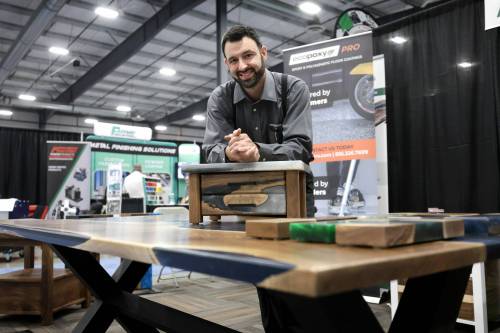
Commerce with a common voice Hutterite colonies embrace economic innovation, diversification
Read this article for free:
or
Already have an account? Log in here »
To continue reading, please subscribe:
Digital Subscription
One year of digital access for only $1.44 a week*
- Enjoy unlimited reading on winnipegfreepress.com
- Read the E-Edition, our digital replica newspaper
- Access News Break, our award-winning app
- Play interactive puzzles
*Billed as $5.77 plus GST every four weeks. After 52 weeks, price increases to the regular rate of $19.95 plus GST every four weeks. Offer available to new and qualified returning subscribers only. Cancel any time.
To continue reading, please subscribe:
Add Free Press access to your Brandon Sun subscription for only an additional
$1 for the first 4 weeks*
- Enjoy unlimited reading on winnipegfreepress.com
- Read the E-Edition, our digital replica newspaper
- Access News Break, our award-winning app
- Play interactive puzzles
*Your next Brandon Sun subscription payment will increase by $1.00 and you will be charged $17.95 plus GST for four weeks. After four weeks, your payment will increase to $24.95 plus GST every four weeks.
Read unlimited articles for free today:
or
Already have an account? Log in here »
Tucked away at Oak Bluff Hutterite Colony, past rows of communal housing and farm buildings, Aaron Maendel tinkers in a laboratory.
Black-and-white sheets smeared with grey-test formulas cover a counter. A Thermotron — a refrigerator-looking machine — is powered off but standing by to simulate any desired temperature.
Maendel moves to a worktop littered with partly full mixing cups. He pulls out a small, rectangular sample — a sheet showing the drying time of his new fixation, floor coatings.
“Very simple, actually. Very simple machine. Drags a stick through the mud,” Maendel says.
Aaron Maendel is general manager of EcoPoxy, an epoxy resin company operated by Oak Bluff Hutterite Colony.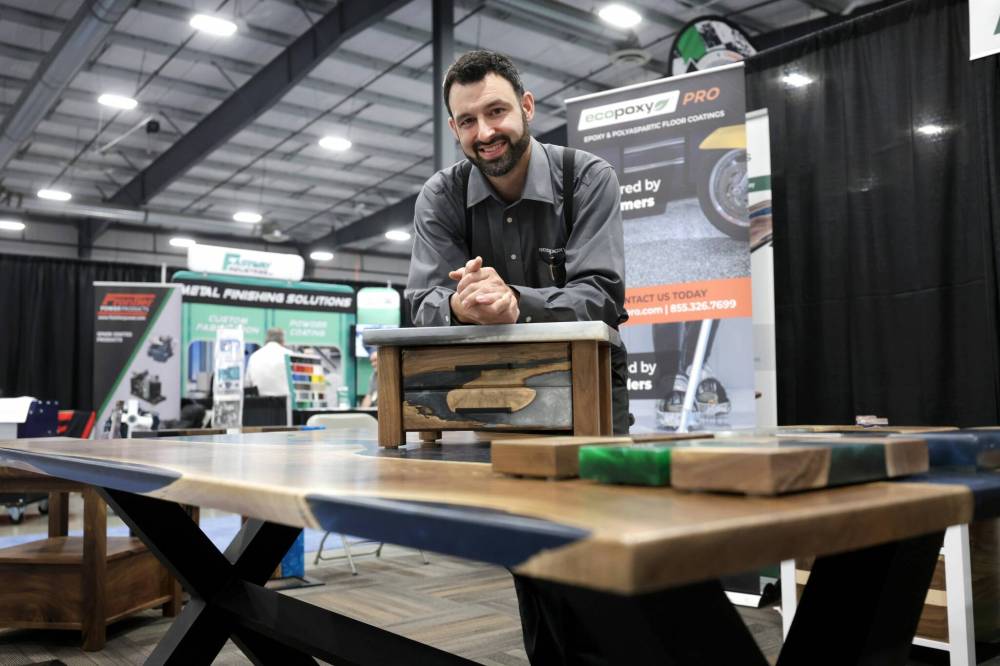
The machine in question, a drying-time recorder, pierces a fine line through his test floor coatings over the course of hours.
“I have a target I want to achieve,” Maendel says, eyeing his sample and the time it took the formula to dry — 10.5 hours.
“We have to know, and we have to have it on our literature once we release the product.”
Oak Bluff Hutterite Colony — located about 65 kilometres southeast of Winnipeg — has been selling epoxy resins within Canada and internationally since buying the company, EcoPoxy, a couple of decades ago.
It originally focused on woodworking customers and do-it-yourself aficionados who create resin tables and other pieces.
But lately, upon seeing sales stagnate following the COVID-19 pandemic, EcoPoxy’s leadership has looked to floor coating. It’s a much bigger market, says Maendel, the company’s general manager. “(Installers) go through epoxy resin every day.”
Maendel is used to pivoting.
Brian Maendel fills commercial-use pails of floor epoxy resin at Oak Bluff Colony.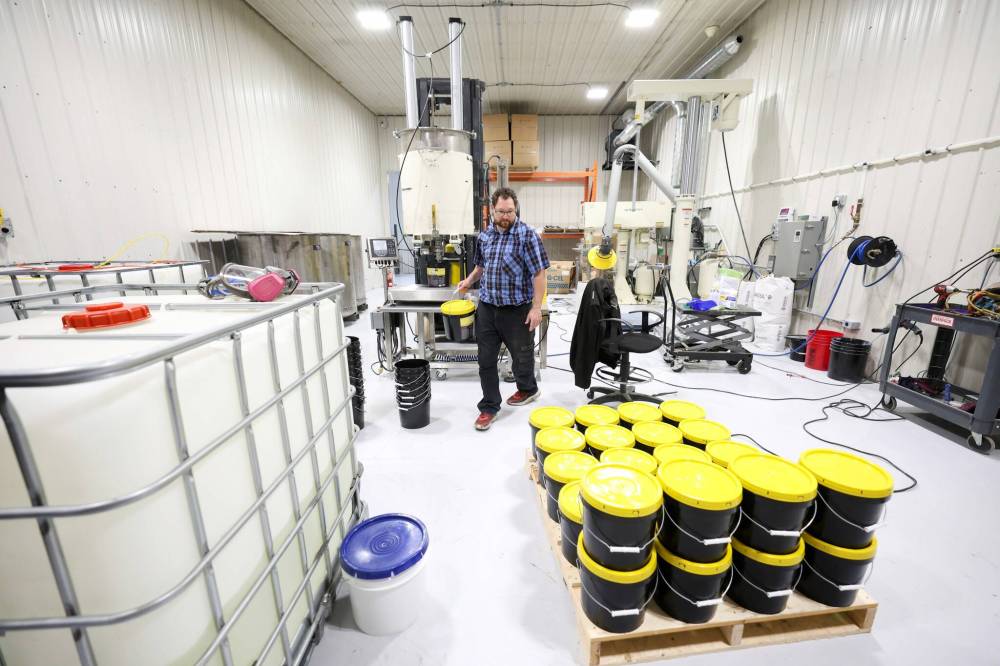
The 50,000-sq.-ft. plant where EcoPoxy staff make products was, in the 1990s, a place for beekeeping. Colony members switched to floor-truss manufacturing before landing on the current business model.
Across the province, Hutterite colonies have been augmenting farming with manufacturing to sustain themselves.
Colonies formed their own manufacturing association in 2020. At a recent expo, Hutterite firms displayed their kitchen cabinets, steel doors and lick tubs, which hold nutritional supplements for cattle and other livestock.
One colony, Green Acres in southwestern Manitoba, builds firefighting trucks, pumpers and other emergency apparatus that range in price from $300,000 to $3 million.
The trend has been growing for decades. Now, an estimated 120 Hutterite manufacturing businesses operate in Manitoba.
As colonies shift their focus, some grapple with threats to their traditional communal Anabaptist way of life, including by hiring off-colony staff. Still, it’s a movement leaders expect will continue.
“You have to be diversified,” says Clinton Hofer, the manager of Domain Laser, which sells stainless-steel doors. “It’s getting more difficult to get into farming. The costs of getting into it is way higher.”
Hofer represented the company at the Hutterite Manufacturing and Associate Expo in August. He and five other Vermillion Colony members work for the company. Diversifying into Domain Laser was a necessary financial decision, Hofer says.
In 2007, a fire destroyed much of the colony’s hog operation near Sanford, about 20 kilometres southwest of Winnipeg. At least 3,000 pigs died and three buildings were destroyed.
Colony leadership looked at hog prices. The market was “trash” then; they decided not to rebuild the barn, Hofer says.
“We thought it best to start something. We needed work for our members.”
Instead, they opted to buy a used laser cutting machine. It was the first piece of equipment added to what is now a 100,000-sq.-ft. stainless-steel door production site. Products are often installed in Prairie colony hog barns, he said.
“We thought it best to start something. We needed work for our members,” says Hofer, whose colony has about 100 members.
The colony still covers much of its expenses through grain farming, Hofer notes. It also runs Vermillion Windows and Doors.
Baker Hutterite Colony launched Better Air Manufacturing in the 1980s. At the time, there was just a handful of colonies with manufacturing enterprises — most were solely agricultural operations, says John Waldner, the general manager of Better Air.
Baker Colony, near MacGregor, began making ventilation systems for its livestock. Neighbours were interested in purchasing the systems as well, and as time progressed, the business grew, he says.
In the ’90s, the colony reached a crossroads: either expand its manufacturing capacity or its livestock operation. Colony leaders chose the former and shut down their livestock branch.
“It’s changed so much,” Waldner says of revenue sources for agriculture producers. “You think poultry — it’s all under restriction. You can’t really expand into poultry.”
“You can’t really expand into poultry.”
Poultry and dairy are among Canada’s supply-managed systems. Farmers are allotted (and buy) an amount of quota, which dictates how much they can sell.
Land values have also increased, Waldner says.
Farmland prices in Manitoba jumped 12.2 per cent in 2025 — outstripping the national average of 9.3 per cent, according to Farm Credit Canada.
Manitoba experienced the biggest increase in land prices among provinces.
Livestock and grain are still popular businesses on Hutterite colonies, says Waldner, president of the Hutterite Manufacturers’ Association. But the spike in manufacturing — especially over the last decade — prompted Waldner and colleagues to consider creating an organizational body to provide training and support.
“We saw the need to have a common voice,” says Waldner, a founding member.
“We saw the need to have a common voice.”
The association now has roughly 44 members. Waldner estimates Hutterite colonies have started as many as 120 manufacturing businesses.
There has been overlap with a number of similar operations popping up, Waldner says. “That’s been the purpose of our organization, to train people to be innovative on their own.”
The association has organized sessions on finance, leadership and strategic development, such as how best to find customers. It also works with the Canadian Manufacturers & Exporters association, with colony companies often holding membership with both organizations.
A Hutterite colony generally splits in half, and a new colony is formed once the population exceeds 150 people, Waldner explains. That division comes with complications.
“It was getting harder and harder to split livestock assets from the old community to the new one,” he says.
Hog barns weren’t profitable and it might take 10 years to pay back new dairy or chicken quotas. But splitting a manufacturing company is tricky too.
“Imagine you’re trying to run a business, and suddenly (you’re) losing half your workforce,” says Maendel, noting you can’t simply halve an operation like EcoPoxy.
Aaron Maendel preps large blending tanks that mix and store epoxy.
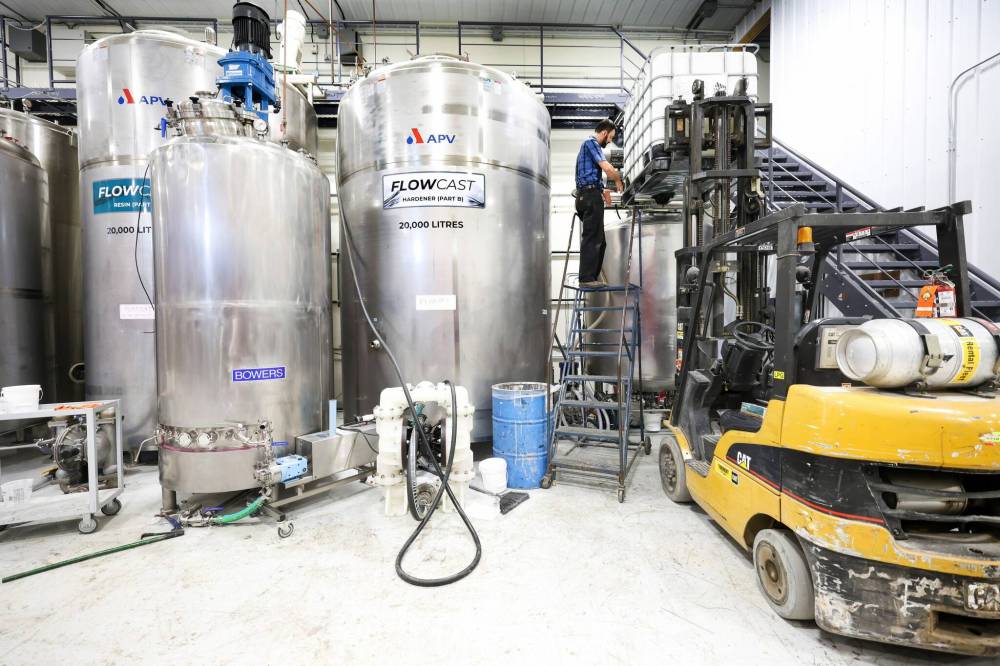
Colonies are distinct financial entities, so they can’t easily co-own a firm, he says. The resultant split colony groups also don’t reside on the same land. Sometimes, they don’t even live nearby.
“What may have to happen in the future with a company like EcoPoxy and possibly more of these manufacturing companies — just the reality of it — it may have to get sold, and the money, divide it in half,” Maendel says. “Then you restart.”
Or one colony could possibly take the manufacturing business while the other gets most of the agriculture operation, Maendel says. As an example of the scale of colony operations, Oak Bluff Hutterite Colony farms 3,500 acres of grain, corn and soybeans.
Pauly Kleinsasser figures Springfield Hutterite Colony won’t split in his or his children’s lifetime. The colony currently counts around 113 members.
“When you have leftover people — you’ve got too many men folks and not enough jobs, sitting around — you have no choice (but to) go build another colony,” Kleinsasser says.
Springfield Hutterite Colony is home to one of Manitoba’s largest cabinet-making operations.
Kleinsasser co-founded Springfield Woodworking as a carpenter with the Anola-area colony in 1999. At the start, he grew his enterprise by marketing his products at trade shows. Since then, word of mouth has been a major factor in fueling the company’s growth, he says.
Pauly Kleinsasser is general manager of Springfield Woodworking, a major cabinet manufacturer.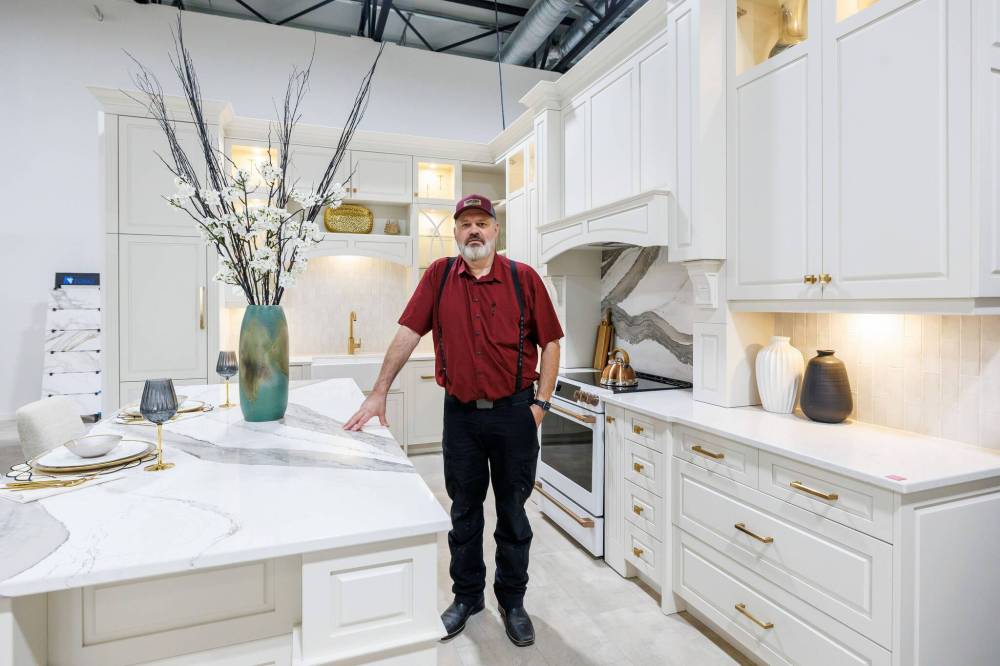
Springfield Woodworking employs about 85 people, with 65 being off-colony hires. Some work in the 80,000-sq.-ft. factory; others are employed as installers or salespeople.
Hutterite colonies traditionally don’t assign work outside of their membership, but Kleinsasser takes a different view.
“People are scared of worldly influences,” he says. “I look at it the opposite way. In the Bible it says, ‘If you take a candle and put it on a hill, and you put a bucket over it, that light goes out.’
“If they bring in bad influences, why can’t you shine for them? Maybe they’ll see a light.”
Kleinsasser hired his first off-colony staff member, a cabinet installer, in 2003. It wasn’t an issue with colony leadership, he says, noting that it wasn’t always the case for many colony companies.
Off-colony staff are paid wages as they would be at any other business. Colony members are not paid wages, and company earnings go into a colony holding company, which covers members’ daily living needs, including food and housing.
MIKE DEAL / FREE PRESS
A show kitchen at the Springfield Woodworking showroom.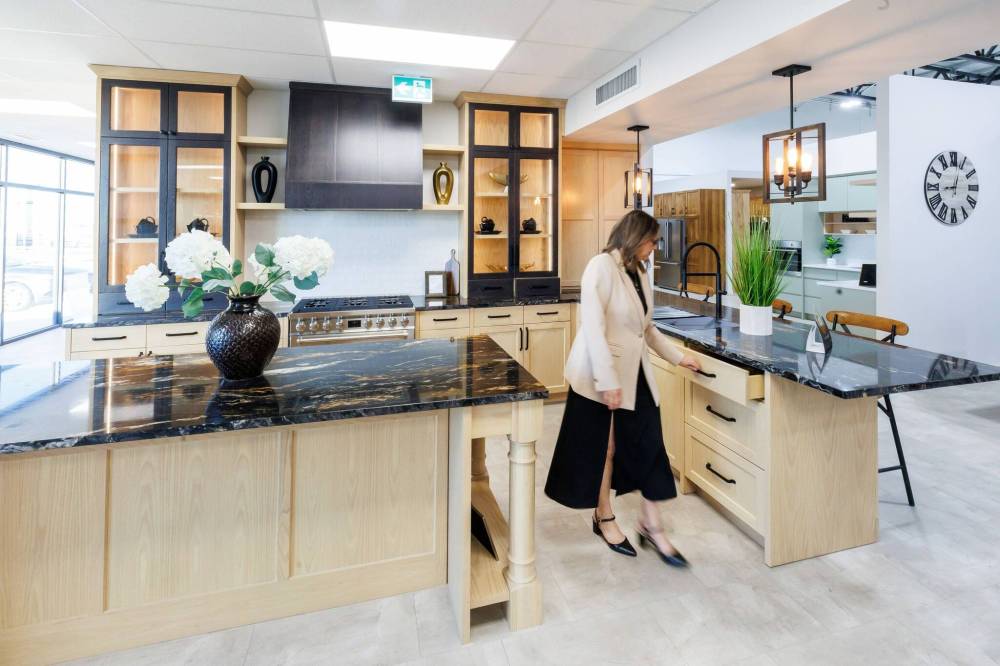
Off-colony hiring is common now, Waldner says, but some colonies are still resistant to take up the practice.
“They kind of have that idea of once all your people are busy, then (you’re) big enough,” the manufacturing association president says.
“But in business, you can’t operate that way … you’re either growing or you’re going back.”
His team had to explain to leadership that they’d risk running out of members if they didn’t look for outside help. In the past 15 years, Better Air has hired 22 outside workers.
Hutterite women often take traditional colony roles, including cooking and teaching. Some, however, have become office workers with firms such as Better Air and Springfield Woodworking.
Colony members may also attend post-secondary institutions to get certified for company-specific roles — to become an electrician or welder with a firm, for example.
EcoPoxy currently has an off-colony chemist on staff. At the time of a boom during the COVID-19 pandemic, it employed three chemists.
Darren Maendel at work in the Ecopoxy lab facility on the Oak Bluff Hutterite Colony. 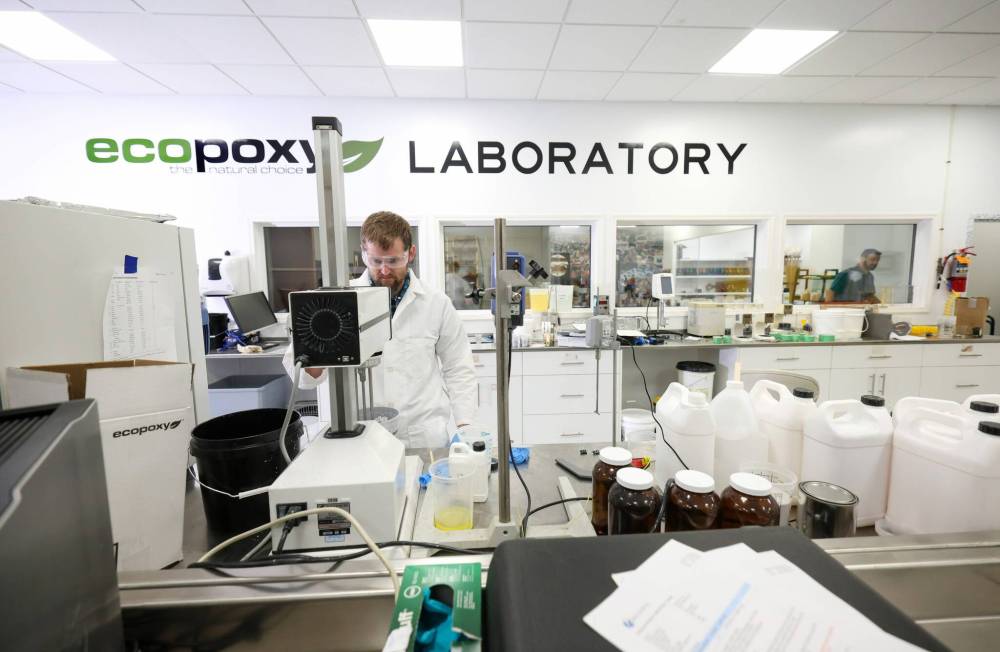
Sales and marketing positions are ideal roles for non-Hutterite hires, Maendel says: “They have to travel a lot. It’s something that Hutterites try to shy away from … being off the colony for extended periods of time.
“If somebody’s always gone, it just feels like there’s a disconnect there.”
EcoPoxy markets its products in Canada and keeps a North Dakota warehouse for its United States orders. It also ships to Japan and South America, offers its products on Amazon and Shopify, and works with online influencers.
Despite the global reach, colonies do everything they can to remain faithful to their community and religious structures and continue to speak in Hutterisch or standard High German.
“(There is) always that balance in Hutterite business and manufacturing, and the changing world and technology, and all the things like media and entertainment,” Maendel says.
“Those are all constant pressures on this thing we’re trying to preserve, which is our culture and way of life. You’re always letting go, but then you’re having to pull back. It’s unique.”
Ecopoxy custom woodworker Dean Maendel (left) and Jacob Maendel, examine reclaimed wood in the wood-shop at Oak Bluff Hutterite Colony. 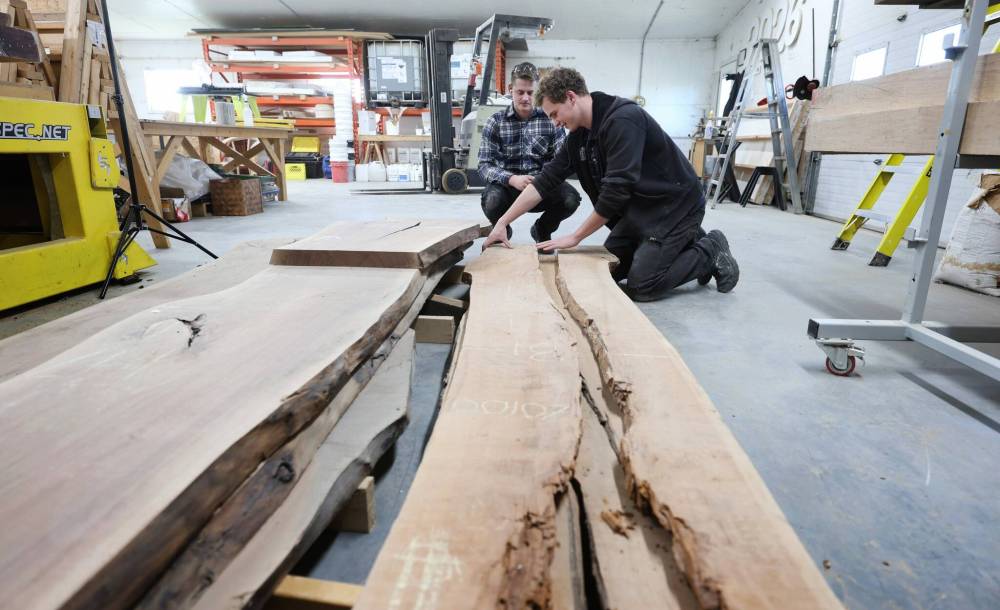
Springfield Manufacturing leans into its showroom just outside of Winnipeg, and its website and social media accounts. Eighty per cent of the firm’s sales are made within an hour’s drive from the colony, Kleinsasser says, but the company also sells into Saskatchewan, Alberta, Ontario and North Dakota.
Kleinsasser travels to the U.S. and Germany for major woodworking forums, to “bring the ideas home.”
Springfield Woodworking is planning to add a second paint line and is considering a 20,000-sq.-ft. expansion, Kleinsasser says. It also recently purchased a robotic sander as workers doing sanding by hand were experiencing carpal tunnel syndrome.
Manitoba Business Minister Jamie Moses attended a recent Hutterite Manufacturers’ Association conference and has visited both Baker and Springfield colonies.
“They play a real role in growing our economy here,” Moses says, adding the colonies’ work is “very diverse and very creative.”
Bonnie Bain perused the Hutterite Manufacturing and Associate Expo in August. She’s bought windows, doors, siding and furniture from colony enterprises.
“It’s always been really high quality,” says Bain, who grew up near Rock Lake Hutterite Colony, near Grosse Isle. “Love working with them.”
Maendel says many Manitoba customers positively perceive Hutterites as hard workers, which leads to an expectation of quality products.
“It’s always been really high quality. Love working with them.”
“Most of the time, we’ve been able to live up to that expectation,” he says. “(But) a lot of Hutterite businesses have struggled and even failed because that expectation wasn’t met.”
Most clients outside the province are not familiar with Hutterite culture, Maendel says, so EcoPoxy chooses not to explicitly advertise its colony roots.
Colonies’ shift to manufacturing can actually be seen as a return to their roots, says John Lehr, professor emeritus at the University of Winnipeg who studied Hutterite settlements.
Hutterites in the 1500s were predominantly artisans. They turned to farming when they were forced to flee Eastern Europe due to religious persecution, and relocated in various European countries and North America.
“Farming was one thing they could adapt to right away,” Lehr says.
Hutterite enterprises have been a “great fit” with the Canadian Manufacturers & Exporters peer councils, says Joey Zasitko, the CME’s director of training services for Manitoba.
He says he is not aware of any instances of conflict between Hutterian and non-Hutterian manufacturing companies in the three years he’s been with the CME.
“They play a real role in growing our economy here.”
Dealing with tariffs between Canada and the U.S. has become a much more pressing issue, though their impacts on Hutterite firms vary. Springfield Manufacturing, for example, has seen its American business slow down.
“I’m really not going after U.S. sales,” Kleinsasser says, even though the exchange rate between Canadian and American dollars can help ease the tariff pain.
Domain Laser has seen a recent increase in sales of its steel doors, Hofer says, because “our competition was basically blocked by tariffs.”
Neither EcoPoxy nor Better Air described any major tariff issues, but Maendel notes there has been an increase in paperwork at the border.
Waldner, meanwhile, is bullish about the future.
“I think the Hutterite communities are going to be a manufacturing hub in North America,” he says.
gabrielle.piche@winnipegfreepress.com

Gabrielle Piché reports on business for the Free Press. She interned at the Free Press and worked for its sister outlet, Canstar Community News, before entering the business beat in 2021. Read more about Gabrielle.
Every piece of reporting Gabrielle produces is reviewed by an editing team before it is posted online or published in print — part of the Free Press‘s tradition, since 1872, of producing reliable independent journalism. Read more about Free Press’s history and mandate, and learn how our newsroom operates.
Our newsroom depends on a growing audience of readers to power our journalism. If you are not a paid reader, please consider becoming a subscriber.
Our newsroom depends on its audience of readers to power our journalism. Thank you for your support.