After 3 tense months, Spanish volcano eruption may be over

Advertisement

Advertise with us

MADRID (AP) — Residents on the Spanish island of La Palma dared to hope Wednesday that their volcanic eruption is over after almost three months of unnerving daily explosions, earthquakes, rivers of molten rock and a huge ash plume containing toxic gases.

Read this article for free:


By clicking the button above, an account will be created and you will begin to receive some of our recommended newsletters. You may opt out of any newsletter by visiting your Email and Communication Preferences page or by clicking "unsubscribe" at the bottom of any email.

or

Already have an account? Log in here »

To continue reading, please subscribe:

Digital Subscription

One year of digital access for only $1.44 a week*

  • Enjoy unlimited reading on winnipegfreepress.com
  • Read the E-Edition, our digital replica newspaper
  • Access News Break, our award-winning app
  • Play interactive puzzles

*Billed as $5.77 plus GST every four weeks. After 52 weeks, price increases to the regular rate of $19.95 plus GST every four weeks. Offer available to new and qualified returning subscribers only. Cancel any time.

To continue reading, please subscribe:

Add Free Press access to your Brandon Sun subscription for only an additional

$1 for the first 4 weeks*

  • Enjoy unlimited reading on winnipegfreepress.com
  • Read the E-Edition, our digital replica newspaper
  • Access News Break, our award-winning app
  • Play interactive puzzles
Start now

*Your next Brandon Sun subscription payment will increase by $1.00 and you will be charged $17.95 plus GST for four weeks. After four weeks, your payment will increase to $24.95 plus GST every four weeks.

Hey there, time traveller!
This article was published 15/12/2021 (1770 days ago), so information in it may no longer be current.

MADRID (AP) — Residents on the Spanish island of La Palma dared to hope Wednesday that their volcanic eruption is over after almost three months of unnerving daily explosions, earthquakes, rivers of molten rock and a huge ash plume containing toxic gases.

The Cumbre Vieja volcano in the Canary Islands off northwest Africa fell silent on Monday evening, and scientists said its 36 hours or so of negligible activity might signal the beginning of the end of the eruption. Scientists won’t rule out a resurgence of volcanic activity, which previously abated only to return with renewed force, but say it is unlikely.

“We cannot be 100% sure, as the volcano has been playing a few tricks over the last weeks,” Valentin Troll, a geology expert with Sweden’s Uppsala University and co-author of a geology study of the Canary Islands, told The Associated Press.

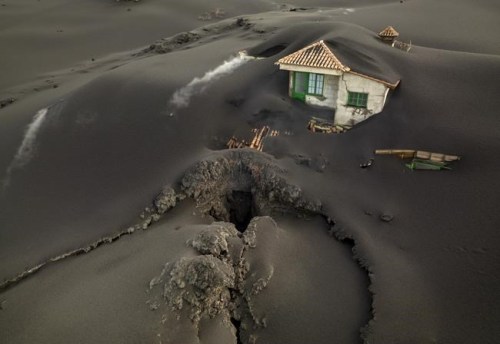
FILE - A fissure is seen next to a house covered with ash on the Canary island of La Palma, Spain, Dec. 1 2021. A volcanic eruption in Spain’s Canary Islands shows no sign of ending after 85 days. It became the island of La Palma’s longest eruption on record on Sunday, Dec. 12. (AP Photo/Emilio Morenatti, file)

“But many parameters have now subsided, and I think the volcano is indeed in decline now,” he said.

The Canary Islands government said that “volcanic activity has fallen to almost nothing.” Some wisps of white smoke floated from the crater Wednesday morning. As the eruption petered out, scientists ventured out on foot to the lip of the crater to take up-close gas readings for the first time in three months.

Low and sustained levels of activity must be observed for 10 days for scientists to formally declare the end of the eruption, María José Blanco, a volcanologist and spokeswoman for Spain’s National Geographic Institute, told reporters.

The eruption, which began on Sept. 19, is the longest on record on La Palma and has been a milestone for islanders, many of whom live from farming and tourism. The volcanic Canary Islands are a popular European vacation destination due to their mild climate.

No injuries or deaths have been directly linked to the La Palma eruption, and life has continued largely as normal on most of the island of 80,000 residents. However, several thousand people were forced to abandon their homes and farms as they were engulfed by lava and a section of La Palma’s southwestern side is severely damaged.

For some locals, relief at the weakening eruption was tempered by frustration at government promises of help they say has failed to materialize.

“Being able to see the sun properly for the first time in nearly three months, sleeping at night without tremors, totally changes the picture,” said Francisco Javier López, a 61-year-old resident of the village of Todoque. “But the future remains bleak.”

López lost his home of 30 years during the first few days of the eruption and says he is living in an overpriced rented apartment in a nearby village. The future of his paragliding business, which employed him and his wife, also evaporated as lava buried the takeoff and landing strips at the top of the Cumbre Vieja mountain range.

López complained that despite pledges of free accommodation, subsidies and financial aid from national, regional and local officials, almost nothing has actually reached the La Palma residents affected by the volcano.

“The volcano has taken away our houses, including our past and memories,” he told the AP. “But politicians are taking away our future and our hope.”

Fiery molten rock flowing from Cumbre Vieja down toward the sea has destroyed around 3,000 buildings. The fields of thick, black hardened lava have entombed banana plantations, ruined irrigation systems and cut off roads.

The hardened lava covers around 1,200 hectares (about 3,000 acres), according to the Canary Islands volcanic emergency unit, Pevolcan. Where the molten rock has poured into the Atlantic Ocean, rocky deltas have formed over 48 hectares (120 acres), Pevolcan said.

The eruption has drawn scientists from around the world to La Palma. They have been using cutting-edge technology to examine it from land, sea, air and even space.

___

Barry Hatton reported from Lisbon, Portugal.

___

Follow AP stories on volcanic eruptions at https://apnews.com/hub/volcanic-eruptions.
Report Error Submit a Tip

More Stories

After 3 tense months, Spanish volcano eruption may be over

Aritz Parra And Barry Hatton, The Associated Press 4 minute read Preview

After 3 tense months, Spanish volcano eruption may be over

Aritz Parra And Barry Hatton, The Associated Press 4 minute read Wednesday, Dec. 15, 2021

The Star reached out to 140 COVID-19 experts to ask how they were marking the holidays. Fifty responded to share their plans.

Read
Wednesday, Dec. 15, 2021

Addressing homelessness and toxic drug use

Kate Kehler and Molly McCracken 5 minute read 2:00 AM CDT

Winnipeg is facing a housing and toxic drug crisis that is not going away. Every day, we see the consequences — people living without safe homes, encampments in neighbourhoods and public spaces, increasingly toxic drugs, overdoses and emergency services stretched to their limits.

These are symptoms of a deeper crisis of inter-generational trauma related to colonization of the original peoples of these lands, compounded by a crisis in housing, income security, mental health and addictions services and the availability of community based supports.

Winnipeg’s next city council must decide whether it is prepared to invest in solutions that address the root causes.

Weaving a Better Winnipeg: The Alternative Municipal Budget 2026, proposes a five-point action plan that would put housing, outreach, human rights and Indigenous leadership at the centre of Winnipeg’s response.

Katz ‘violated public trust,’ Sheegl lacked ‘moral compass,’ police HQ inquiry commissioner concludes

Joyanne Pursaga 8 minute read Preview

Katz ‘violated public trust,’ Sheegl lacked ‘moral compass,’ police HQ inquiry commissioner concludes

Joyanne Pursaga 8 minute read Updated: Yesterday at 7:29 PM CDT

The final report from the public inquiry into the scandal-plagued Winnipeg Police Service headquarters construction project concludes that former mayor Sam Katz and former city CAO Phil Sheegl broke public trust and engaged in unethical conduct.

And the report, released Monday by inquiry commissioner Garth Smorang, says the cost of the project — transforming a downtown Canada Post office tower and warehouse into the police HQ — soared, in part, because main contractor Caspian Projects overcharged the city by more than $40 million in expenses.

The project’s initial $135-million initial price tag rose to about $209 million in the end. The city purchased the complex in 2009; construction was completed in 2016.

Smorang’s report concludes Katz “violated the public trust” and council code of conduct, and Sheegl suffered from a “complete lack of a moral compass.”

Read
Updated: Yesterday at 7:29 PM CDT

New twist in Hellebuyck saga, suspension ends Friday

Ken Wiebe 7 minute read Preview

New twist in Hellebuyck saga, suspension ends Friday

Ken Wiebe 7 minute read Saturday, Oct. 17, 2026

Connor Hellebuyck has played the reverse Uno card. What we don’t know is if he has any intention of coming back to friendly Manitoba or if this is simply the latest attempt to put the Winnipeg Jets' feet to the flames in an effort to move him to an American market.

Read
Saturday, Oct. 17, 2026

Disgraced ex-dean landed job at German university after fleeing Winnipeg

Maggie Macintosh 8 minute read Preview

Disgraced ex-dean landed job at German university after fleeing Winnipeg

Maggie Macintosh 8 minute read Friday, Oct. 16, 2026

Before he was arrested in a posh Paris suburb, the disgraced dean of Manitoba’s only law school — who fled the country following a 2020 expense scandal — kept a low profile at a German university.

Read
Friday, Oct. 16, 2026

Consumer apprehension grows as US retailers adopt AI-assisted pricing tools

Dee-ann Durbin And Anne D'innocenzio, The Associated Press 7 minute read Preview

Consumer apprehension grows as US retailers adopt AI-assisted pricing tools

Dee-ann Durbin And Anne D'innocenzio, The Associated Press 7 minute read Updated: Yesterday at 6:00 PM CDT

U.S. consumers aren't just frustrated with high prices. They're angry and confused about the increasingly high-tech ways that restaurant chains and major retailers are setting those prices.

Digital price tags are rapidly replacing paper ones in grocery aisles. Artificial intelligence tools help businesses decide what to charge by predicting how customers might respond. Terms like “dynamic pricing” and “surveillance pricing” are stirring anxiety on social media, where users wonder if different people are getting different prices for the same product.

Americans have grown accustomed to changing prices when booking flights, hotel rooms and rides, but the prospect of everyday spending shaped by algorithms they don’t understand and personal data they may not realize they’re sharing has touched a nerve.

“There are major tensions happening right now between who’s really going to have the power with some of these algorithms and usage of bots and AI: the companies or the shopper,” said Katie Thomas, who leads an internal consumer behavior think tank at the management consulting firm Kearney.

Read
Updated: Yesterday at 6:00 PM CDT