

Growing agri-food sector brings $1B in investments
New and expanded plants in Portage la Prairie will increase processing jobs to 850
Advertisement
Read this article for free:
or
Already have an account? Log in here »
To continue reading, please subscribe:

Digital Subscription
One year of digital access for only $205*
- Enjoy unlimited reading on winnipegfreepress.com
- Read the E-Edition, our digital replica newspaper
- Access News Break, our award-winning app
- Play interactive puzzles
*First annual payment billed as $205.00 + GST for one year. This annual subscription will automatically renew at $233.00 + GST every 52 weeks (10% off the regular annual price of $259.35). Offer available to new and qualified returning subscribers only. Cancel any time.
To continue reading, please subscribe:
Add Free Press access to your Brandon Sun subscription for only an additional
$1 for the first 4 weeks*
- Enjoy unlimited reading on winnipegfreepress.com
- Read the E-Edition, our digital replica newspaper
- Access News Break, our award-winning app
- Play interactive puzzles
*Your next Brandon Sun subscription payment will increase by $1.00 and you will be charged $17.95 plus GST for four weeks. After four weeks, your payment will increase to $24.95 plus GST every four weeks.
Read unlimited articles for free today:
or
Already have an account? Log in here »
Hey there, time traveller!
This article was published 17/02/2018 (3120 days ago), so information in it may no longer be current.
Brandon is dubbed the “Wheat City” but Portage la Prairie could easily lay claim as Manitoba’s “Agri-Food City.”
Two new investments will bring total jobs in the food processing sector to about 850 in the City of Portage and the RM of Portage la Prairie.
That includes the expansion of the J.R. Simplot plant for making French fries, announced on Wednesday, which will add 87 full-time food processing jobs when it opens in the fall of 2019.
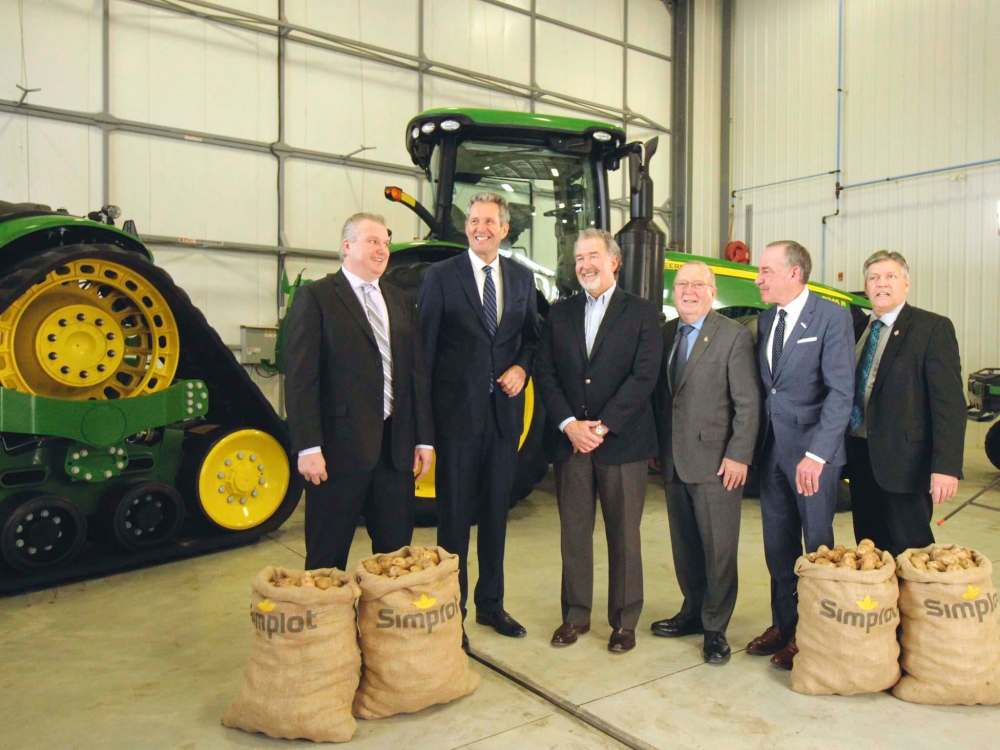
As well, the Roquette pea processing plant, currently under construction, will create 150 full-time jobs when it opens in the spring of 2019.
And that spells boom times for the region, said Portage Mayor Irvine Ferris.
The $460-million expansion by Simplot, plus the $400-million investment by French firm Roquette, plus new residential development on the east and west sides of the city, will pump over $1 billion in investment into the area.
“That is unprecedented in our history. It’s huge,” said Ferris.
Simplot’s expansion will bring the total number of people employed in just french-fry production alone to about 600 people. The McCain Foods plant there already employs about 350 people.
Other smaller food processors in the area include Richardson Milling (formerly Can-Oak Milling) and Nutri-Pea Ltd., and the Manitoba Food Development Centre, which helps entrepreneurs develop food products.
In addition, construction of the Roquette plant alone is employing 200 tradespeople for two years. The Simplot plant build concurrently will need large numbers Ferris said credit for Portage’s recent success dates back to a historic tax-sharing agreement signed back in 2001 between the city and RM, the first of its kind in Manitoba.
“Prior to that, we didn’t get along. We competed against each other,” Ferris said.
Under the tax-sharing agreement, the municipalities not only shared infrastructure costs, but commercial tax revenues. For example, both the Simplot and Roquette plants are in the RM of Portage. So the RM will receive 60 per cent of the property taxes and the city 40 per cent. But the city’s water treatment plant supplies the water.
Ferris believes that co-operation convinced Simplot to rethink its plans to invest in the State of Washington, where it already had completed the permitting process. Simplot officials were in Portage last August when local officials extolled the virtues of their co-operative approach. Simplot did a U-turn and in December entered discussions to expand in Portage, Ferris said.
“Sometimes you just get lucky,” Ferris said.
It represents an opportunity for potato growers, said Chad Berry, a potato grower near Glenboro and president of Keystone Potato Producers Association.
A study three years ago found the economic contribution from potato production was worth about $1 billion to the Manitoba economy. Keystone estimates the Simplot expansion will add another $200 million to that total.
Manitoba harvested about 63,000 acres of potatoes in 2017. It will need about 80,000 acres to meet Simplot’s demands when the expansion is completed next year.
“The time frame will be the biggest challenge,” Berry said. “That’s a lot of storage to be built, a lot of irrigation to put in place” to raise production.
Berry said Simplot’s expansion may encourage new entrants into the sector.
That hasn’t happened since the early 2000s.
There are currently 58 commercial potato growers in Manitoba, 52 for the processing market. There were over a 100 commercial potato growers going back 15 years, said Dan Sawatzky, Keystone Potato manager.
Food trends changed, including a move against carbohydrates with fads like the Atkins Diet. The french-fry industry took a hit.
The depressed market caused some Manitoba growers to leave the industry ,while others retired, Sawatzky said.
However, french fries are now enjoying a rebound.
Some of that is due to the introduction of new flavours: Sawatzky said McDonald’s Restaurants have experimented recently with a garlic and Parmesan-flavoured french fry.
“The potato has a great base to begin with and people are being more creative in how they prepare them,” he said.
Taco Bell in the United States has also added french fries to its menu.

And what about poutine? That’s where french fries are lathered in gravy and cheese curds. Many Winnipeg food outlets now have gourmet poutines on the menu and Winnipeg recently had “Poutine Week” where restaurants that don’t normally serve poutine experimented with the dish.
As well, Smoke’s Poutinerie owner, Ryan Smolkin, spoke a year ago at the Potato Expo in San Francisco. “His goal is world domination.
He’s very charismatic and enthused about bringing poutine to the planet,” Sawatzky said.
But Sawatzky thinks the impact of poutine on the potato market has been “fairly small” to date.
bill.redekop@freepress.mb.ca
History
Updated on Saturday, February 17, 2018 10:00 AM CST: Photo added.