

Alberta bill proposes regulatory ‘sandbox’ to help financial-tech companies grow
Advertisement
Read this article for free:
or
Already have an account? Log in here »
To continue reading, please subscribe:

Digital Subscription
One year of digital access for only $205*
- Enjoy unlimited reading on winnipegfreepress.com
- Read the E-Edition, our digital replica newspaper
- Access News Break, our award-winning app
- Play interactive puzzles
*First annual payment billed as $205.00 + GST for one year. This annual subscription will automatically renew at $233.00 + GST every 52 weeks (10% off the regular annual price of $259.35). Offer available to new and qualified returning subscribers only. Cancel any time.
To continue reading, please subscribe:
Add Free Press access to your Brandon Sun subscription for only an additional
$1 for the first 4 weeks*
- Enjoy unlimited reading on winnipegfreepress.com
- Read the E-Edition, our digital replica newspaper
- Access News Break, our award-winning app
- Play interactive puzzles
*Your next Brandon Sun subscription payment will increase by $1.00 and you will be charged $17.95 plus GST for four weeks. After four weeks, your payment will increase to $24.95 plus GST every four weeks.
Read unlimited articles for free today:
or
Already have an account? Log in here »
Hey there, time traveller!
This article was published 30/03/2022 (1633 days ago), so information in it may no longer be current.
EDMONTON – Alberta is proposing rules that would make it easier for entrepreneurs to test products in the emerging field of cryptocurrencies and online banking.
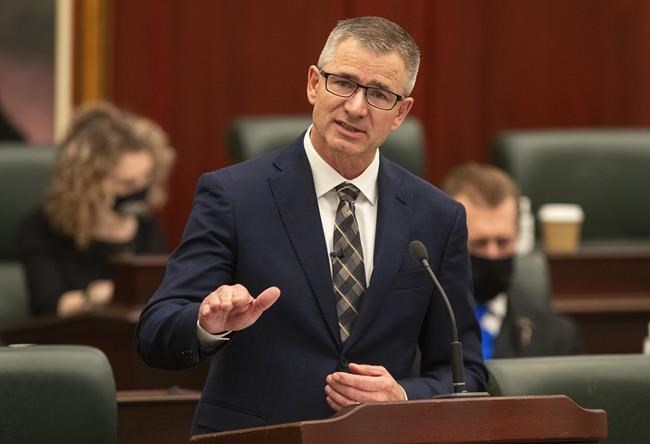
Finance Minister Travis Toews says a bill before the legislature calls for setting up what is known as a regulatory “sandbox.”
Companies would be allowed to temporarily break or ignore select financial rules and regulations under close government supervision to test new programs.
Companies would also be able to get access to Albertans’ private information, but only within strict parameters and only with that person’s permission.
Toews says the “sandbox” is being used in the United States, Australia and the United Kingdom to help create tech jobs and to keep those regions on the cutting edge of financial technology.
If the bill passes, companies could look at innovations in everything from cryptocurrencies to financial apps, security protections and real-time, multi-user financial accounting.
The government hopes to begin taking applications on July 1.
“This will be a strong incentive for fintech companies to move to Alberta and create jobs,” Toews said Wednesday before introducing the bill in the legislature.
“In turn, it will further help diversify our economy and add to our growing reputation as a hub for world-class financial services.”
The government says the legislation would make Alberta the first such “sandbox” jurisdiction in Canada.
Companies would have to have some physical presence in the province, such as an office or senior staff.
They would be offered certificates granting them permission to perform tests or functions normally declared out of bounds under the Loan and Trust Corporations Act, the Credit Union Act and other related rules governing finance.
The companies would have their names, details and programs on a public website.
The government would be free to change the rules to adjust to changing circumstances during testing.
Alberta’s information and privacy commissioner would have to sign off on exemptions.
“(The bill) is carefully designed to ensure any companies participating in the sandbox operate in a safe and sound manner,” said Toews.
Breaking the rules could result in fines up to $100,000 for a first offence and up to $200,000 for subsequent violations.

Toews said the province is seeking a higher profile and to gain benefits from the emerging fintech industry.
The province expects interest in a range of technologies, including blockchains, which are decentralized online record- keeping and authentication programs for cryptocurrency transactions.
There are also developments in software allowing apps to talk to each other and security precautions such as fingerprint and facial recognition.
There is emerging work in database accounting programs that can be shared in real time across multiple platforms.
This report by The Canadian Press was first published March 30, 2022.