AP seeks answers from US gov’t on tracking of journalists
Advertisement
Read this article for free:
or
Already have an account? Log in here »
To continue reading, please subscribe:

Digital Subscription
One year of digital access for only $205*
- Enjoy unlimited reading on winnipegfreepress.com
- Read the E-Edition, our digital replica newspaper
- Access News Break, our award-winning app
- Play interactive puzzles
*First annual payment billed as $205.00 + GST for one year. This annual subscription will automatically renew at $233.00 + GST every 52 weeks (10% off the regular annual price of $259.35). Offer available to new and qualified returning subscribers only. Cancel any time.
To continue reading, please subscribe:
Add Free Press access to your Brandon Sun subscription for only an additional
$1 for the first 4 weeks*
- Enjoy unlimited reading on winnipegfreepress.com
- Read the E-Edition, our digital replica newspaper
- Access News Break, our award-winning app
- Play interactive puzzles
*Your next Brandon Sun subscription payment will increase by $1.00 and you will be charged $17.95 plus GST for four weeks. After four weeks, your payment will increase to $24.95 plus GST every four weeks.
Read unlimited articles for free today:
or
Already have an account? Log in here »
Hey there, time traveller!
This article was published 13/12/2021 (1739 days ago), so information in it may no longer be current.
WASHINGTON (AP) — The Associated Press sought answers Monday from the Department of Homeland Security on its use of sensitive government databases for tracking international terrorists to investigate as many as 20 American journalists, including an acclaimed AP reporter.
In a letter to DHS Secretary Alejandro Mayorkas, AP Executive Editor Julie Pace urged the agency to explain why the name of Pulitzer Prize-winning investigative reporter Martha Mendoza was run through the databases and identified as a potential confidential informant during the Trump administration, as detailed in a report by Homeland Security’s inspector general.
“This is a flagrant example of a federal agency using its power to examine the contacts of journalists,” Pace wrote. “While the actions detailed in the inspector general’s report occurred under a previous administration, the practices were described as routine.”
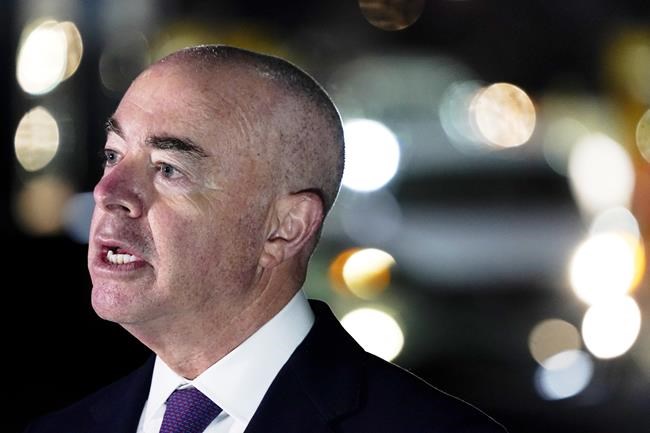
The DHS investigation of U.S. journalists, as well as congressional staff and perhaps members of Congress, which was reported by Yahoo News and AP on Saturday. It represents the latest apparent example of an agency created in the wake of the 9/11 attacks using its vast capabilities to target American citizens.
DHS prompted criticism from Congress and elsewhere in July 2020 w hen it deployed poorly or unidentified agents in military-style uniforms to sweep people off the streets of Portland, Oregon, and hustle them into unmarked cars during protests outside the federal courthouse in the city.
This latest revelation prompted Sen. Ron Wyden to call on DHS to immediately turn over the inspector general report to Congress.
“If multiple government agencies were aware of this conduct and took no action to stop it, there needs to be serious consequences for every official involved, and DHS and the Justice Department must explain what actions they are taking to prevent this unacceptable conduct in the future,” said Wyden, an Oregon Democrat who has long sought more oversight of government surveillance.
Rep. Bennie Thompson, the Mississippi Democrat who chairs the House Homeland Security Committee, said, “If true, this abuse of government surveillance powers to target journalists, elected officials and their staff is deeply disturbing.”
CBP said in a statement over the weekend that its vetting and investigative practices are “strictly governed” and that the agency doesn’t investigate without a legitimate and legal basis to do so.
A DHS spokeswoman, Marsha Espinosa, said Monday that Mayorkas is “deeply committed to ensuring the protection of First Amendment rights” and has developed policies that “reflect this priority,” thought she did not provide details.
“We do not condone the investigation of reporters in response to the exercise of First Amendment rights,” she said. “CBP and every component agency and office in the Department will ensure their practices are consistent with our values and our highest standards.”
In the AP’s letter, Pace called for “assurances that these improper practices and apparent abuse of power will not continue going forward.”
That would be in line with recent order from Attorney General Merrick Garland prohibiting the seizing of records of journalists in leak investigations. That followed an outcry over revelations that the Justice Department under former President Donald Trump had obtained records belonging to journalists, as well as Democratic members of Congress and their aide s and a former White House counsel, Don McGahn.
During the Obama administration, federal investigators secretly seized phone records for some reporters and editors at the AP. Those seizures involved office and home lines as well as cellphones.
The DHS inspector general report that revealed the most recent disclosure of investigations of journalists also stemmed from a Trump-era leak investigation.
The IG was looking into the actions of Jeffrey Rambo, a Border Patrol agent who was on temporary duty with a Customs and Border Protection unit in the Washington D.C. area in 2017 when he accessed government travel records as part of a leak investigation involving reporter Ali Watkins, who was with Politico at the time and now writes for The New York Times.
The inspector general opened its investigation after media reports exposed Rambo and his investigation of Watkins.
In the course of its investigation, the IG learned from Rambo that he had routinely run checks on journalists and others, including congressional staff, while working at the CBP unit, the Counter Network Division.
Rambo told investigators that he queried its databases about Mendoza before trying to establish a relationship with her because of her expertise in writing about forced labor, an area of concern for CBP because it enforces import restrictions. The AP reporter is a known expert on the subject who won her second Pulitzer Prize in 2016 as part of a team that reported on slave labor in the fishing industry in Southeast Asia.
The AP, in a separate statement from the Pace letter, also sought an explanation for the use of the databases to investigate Mendoza and other journalists.
“We are deeply concerned about this apparent abuse of power,” the AP said. “This appears to be an example of journalists being targeted for simply doing their jobs, which is a violation of the First Amendment.”
The inspector general referred its findings to a federal prosecutor for possible charges of misusing government databases and lying to investigators, but the Justice Department declined to prosecute Rambo and two other Homeland Security employees.