

Aviation summit takes flight
Organization hosts first international conference in Canada
Advertisement
Read this article for free:
or
Already have an account? Log in here »
To continue reading, please subscribe:
Digital Subscription
One year of digital access for only $1.44 a week*
- Enjoy unlimited reading on winnipegfreepress.com
- Read the E-Edition, our digital replica newspaper
- Access News Break, our award-winning app
- Play interactive puzzles
*Billed as $5.77 plus GST every four weeks. After 52 weeks, price increases to the regular rate of $19.95 plus GST every four weeks. Offer available to new and qualified returning subscribers only. Cancel any time.
To continue reading, please subscribe:
Add Free Press access to your Brandon Sun subscription for only an additional
$1 for the first 4 weeks*
- Enjoy unlimited reading on winnipegfreepress.com
- Read the E-Edition, our digital replica newspaper
- Access News Break, our award-winning app
- Play interactive puzzles
*Your next Brandon Sun subscription payment will increase by $1.00 and you will be charged $17.95 plus GST for four weeks. After four weeks, your payment will increase to $24.95 plus GST every four weeks.
Read unlimited articles for free today:
or
Already have an account? Log in here »
Hey there, time traveller!
This article was published 10/09/2019 (2599 days ago), so information in it may no longer be current.
About 150 senior aviation and airport officials are in town for two days of high-level policy discussions at the 2019 Canada Aviation Summit, the first time the conference has been held in Canada.
A Sydney, Australia-based international aviation industry data and conference organization, CAPA, hosts about a dozen events like this one around the world every year and it took a fair amount of lobbying over the past couple of years to land the conference.
CAPA (which used to be an acronym for Center for Asia Pacific Aviation, but has become much more global in focus) has become a trusted source of market intelligence for the aviation industry, as well airport managers around the world.
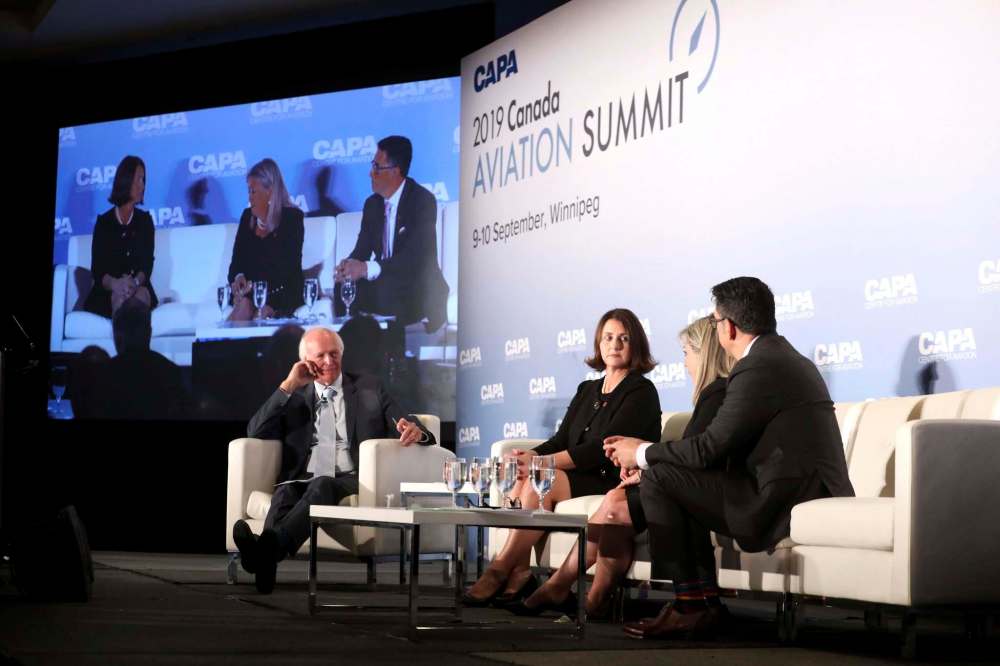
CAPA prides itself in providing airline CEOs and senior executives with nonpartisan insights on the latest trends, challenges and changes facing the industry.
Peter Harbison, who founded CAPA in 1990, has as good a perspective as any on the challenges the Canadian aviation industry faces.
For instance, he said, he believes the long-standing conservative (“I hesitate to say protectionist”) policies of the Canadian government, when it comes to international aviation regulations, has likely curtailed international air travel in Canada.
“Canadian government policy is very conservative and very protective of Air Canada,” he said. “For example… it does not allow Gulf state carriers to fly here with minor exceptions… and the total amount Chinese carriers that can fly to Canada is very limited.”
As a result of that regulatory limitation, he said, Canada has about half the number of Chinese visitors that Australia has every year. That represents about US$2.5 billion in annual tourism spending that Australia benefits from and Canada is missing. China has about 20 international carriers that could fly to Canada if they wanted to, but Air Canada represents about 35 per cent of the entire Canada-China air travel market. By comparison, Australia’s largest air carrier, Qantas Airways, has less than 10 per cent of the market between China and Australia.
Harbison said there is no doubt that air travel is particularly expensive in Canada, noting that international air travel is about 30 to 50 per cent higher out of Canada than out of the U.S. He said that reality has prompted the arrival of ultra-low-cost carriers into the Canadian market, whose success is still to be determined.
Canadian airline CEOs including WestJet’s Edward Sims, a number of very senior Air Canada officials (although not including CEO Calin Rovinescu), as well as senior executives from airports in Toronto, Edmonton, Vancouver and Montreal are all slated to speak at the event.
“This is an awesome opportunity for Winnipeg,” said Barry Rempel, the CEO of Winnipeg Airports Authority, who started talking to Harbison about holding an event like this in Canada more than two years ago.
“Where do you get a better chance in one place in your hometown to talk to senior people in the industry, to show them what we have got?” Rempel said.
It comes on the heels of Friday’s announcement of a $30.4-million investment from the government of Canada to increase air cargo capacity at the Winnipeg Richardson International Airport to help with the construction of a 13,000-square-metre cold storage cargo logistics facility.
“That will be transformative on how we will be able to be a part of the supply chain in the future,” Rempel said. “It advances that project to today. Otherwise, we would have been at risk of not being able to get in early enough and have others beat us to it.”

Lucie Guillemette, Air Canada’s executive vice-president and chief commercial officer, along with Catherine Dyer, the airline’s chief information officer, and Ferio Pugliese, the senior vice-president in charge of Air Canada Express and government relations, explained some of the airline’s strategies in negotiating the international and domestic markets.
Guillemette said that among other things, new narrow-body jets from Airbus and Boeing (before the grounding of the fleet of 737 Max planes) allow for longer-haul trips to destinations that previously would not have been economical for the airline.
“That is a game-changer for us,” she said. “With their small size and impressive range, it is almost like they were built specifically for Air Canada.”
She said that class of jetliner is allowing Air Canada to introduce new routes like Vancouver to Washington, Vancouver to Halifax, Montreal to Seattle and Toronto to San Jose, Calif.
martin.cash@freepress.mb.ca
History
Updated on Tuesday, September 10, 2019 7:00 AM CDT: Adds photo