Biden signs budget bill with Ukraine aid but no virus cash

Advertisement

Advertise with us

WASHINGTON (AP) — President Joe Biden on Tuesday signed a bill providing $13.6 billion in additional military and humanitarian aid to Ukraine as part of a $1.5 trillion government spending measure that omits COVID-19 aid the White House says is urgently needed.

Read this article for free:


or

Already have an account? Log in here »

To continue reading, please subscribe:

Subscribe and receive a limited-edition Free Press branded hat or tote.

Digital Subscription

One year of digital access for only $205*

  • Enjoy unlimited reading on winnipegfreepress.com
  • Read the E-Edition, our digital replica newspaper
  • Access News Break, our award-winning app
  • Play interactive puzzles

*First annual payment billed as $205.00 + GST for one year. This annual subscription will automatically renew at $233.00 + GST every 52 weeks (10% off the regular annual price of $259.35). Offer available to new and qualified returning subscribers only. Cancel any time.

To continue reading, please subscribe:

Add Free Press access to your Brandon Sun subscription for only an additional

$1 for the first 4 weeks*

  • Enjoy unlimited reading on winnipegfreepress.com
  • Read the E-Edition, our digital replica newspaper
  • Access News Break, our award-winning app
  • Play interactive puzzles
Start now

*Your next Brandon Sun subscription payment will increase by $1.00 and you will be charged $17.95 plus GST for four weeks. After four weeks, your payment will increase to $24.95 plus GST every four weeks.

Hey there, time traveller!
This article was published 15/03/2022 (1608 days ago), so information in it may no longer be current.

WASHINGTON (AP) — President Joe Biden on Tuesday signed a bill providing $13.6 billion in additional military and humanitarian aid to Ukraine as part of a $1.5 trillion government spending measure that omits COVID-19 aid the White House says is urgently needed.

The COVID spending was a casualty of negotiations over the larger government bill. The White House had asked for $22.5 billion for vaccines and treatment, but that was trimmed during talks to $15.6 billion and ultimately dropped altogether as rank-and-file Democrats rebelled against proposed cuts in state aid to pay for the new spending.

“We have made tremendous progress in our fight against COVID-19 but our work isn’t done,” Biden tweeted Tuesday. “We need Congress to immediately provide $22.5 billion in emergency funding to sustain our nation’s COVID-19 response.”
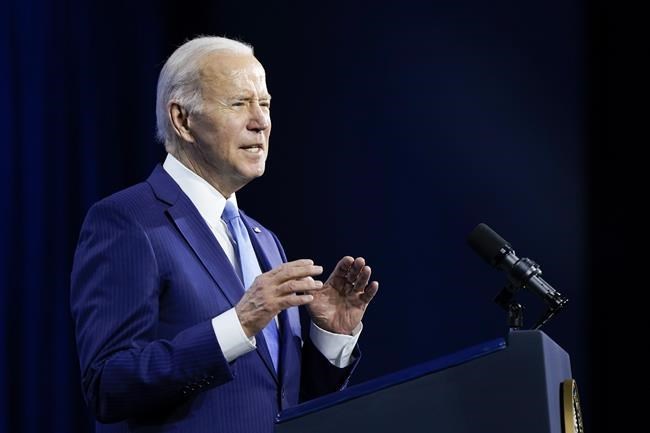
President Joe Biden speaks at the National League of Cities Congressional City Conference, Monday, March 14, 2022, in Washington. (AP Photo/Patrick Semansky)

In a Tuesday call with governors, White House COVID-19 coordinator Jeff Zients highlighted “severe consequences” that the lack of additional funding would have on the nation’s response, including federal support for states, according to an administration official.

The White House says that without additional funding, the federal government will stop accepting new claims next week for treating uninsured people for COVID-19 and that state allocations of life-saving monoclonal antibody treatments will be slashed by 30% to prolong their supply. The administration says it also needs more money to purchase more antiviral pills and prophylactic treatments for people who are immunocompromised, as well as to buy more vaccine doses in the event regulators recommend additional booster shots or a variant-specific booster, should one arise.

“With cases rising abroad, scientific and medical experts have been clear that in the next couple of months, there could be increasing cases of COVID 19 here in the United States as well,” said White House press secretary Jen Psaki. ”Waiting to provide funding until we’re in a worse spot but the virus will be too late. We need funding now.”

The $1.5 trillion bill to fund the government for the current year that runs through Sept. 30 is being enacted five months behind schedule. But the money for Ukraine to fight Russia’s invasion became a bipartisan rallying point for the measure as Congress urged Biden to take more aggressive steps against Russian President Vladimir Putin.

“Putin’s aggression against Ukraine has united people all across America, united our two parties in Congress, and united the freedom loving world,” said Biden.

Roughly half the $13.6 billion would arm Ukraine and cover the Pentagon’s costs for sending U.S. troops to other Eastern European nations that might see the war spill past their borders. Much of the rest is for humanitarian and economic assistance, strengthening regional allies’ defenses and protecting their energy supplies and cybersecurity needs.
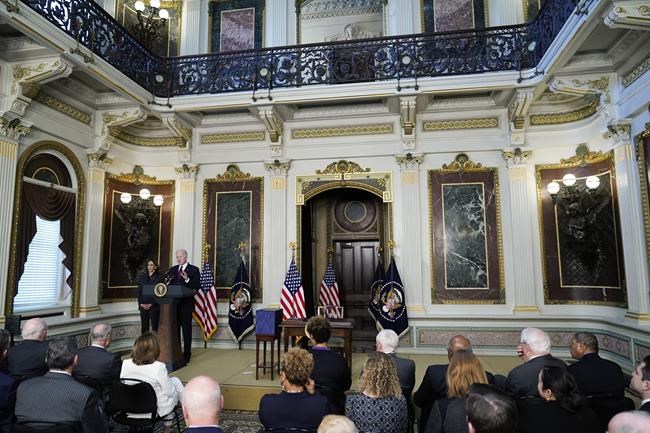
President Joe Biden speaks before signing the Consolidated Appropriations Act for Fiscal Year 2022 in the Indian Treaty Room in the Eisenhower Executive Office Building on the White House Campus in Washington, Tuesday, March 15, 2022. Vice President Kamala Harris listens at left. (AP Photo/Patrick Semansky)

The $1.5 trillion government spending bill includes a nearly 7% increase for domestic initiatives, with beefed-up spending for schools, housing, child care, renewable energy, biomedical research, law enforcement grants to communities and feeding programs. It also directs money to minority communities and historically black colleges, renews efforts aimed at preventing domestic violence against women and requires infrastructure operators to report serious hacking incidents to federal authorities.

Republicans won an almost 6% boost for defense and prevailed in retaining decades-old restrictions against using federal money to pay for nearly all abortions.

Report Error Submit a Tip

More Stories

Israel: the new political divide?

David McLaughlin 5 minute read Preview

Israel: the new political divide?

David McLaughlin 5 minute read Yesterday at 2:01 AM CDT

Abdul won and Avi is thrilled.

Federal NDP Leader Avi Lewis emerged from electoral hiding to tell us how it is “exhilarating to witness” a “wave of progressive populism” in the United States. He was referring to the upset winner of Tuesday’s heavily-watched Michigan Senate primary race, Abdul El-Sayed, who barely prevailed over his establishment opponent for the Democratic nomination.

Premier Wab Kinew’s favourite New Democrat (after himself) steadfastly hesitates to take a risk and run for a House of Commons seat in a byelection to kickstart Canada’s version of progressive populism. No hesitation, though, in Lewis immediately basking in the reflected glory of those international comrades and fellow travellers who do.

Writing about the state of Canada’s New Democrats feels like a hate crime — you hate wasting your time — and this is no exception. A better story is what’s driving this modest but undeniable political movement in U.S. politics and whether it might gain traction here in Canada.

Read
Yesterday at 2:01 AM CDT

Sending the wrong message

Andrea Charron 4 minute read Yesterday at 2:01 AM CDT

The U.S. State Department has announced plans to close five overseas diplomatic posts approved by Congress: Douala, Cameroon (a branch office); St. George’s, Grenada (an embassy); Nagoya, Japan (a consulate); Medan, Indonesia (a consulate); and Winnipeg, Canada (a consulate).

All are located in countries that are partners or allies of the United States.

It is unusual for the United States to reduce its diplomatic footprint. With the exception of some retrenchment efforts during the Trump administration, Washington has generally viewed diplomacy as a force multiplier. Diplomacy is not simply a matter of authority and leverage. It requires sustained local engagement, relationships and presence.

Consulates and branch offices are not the same as embassies. They are smaller missions, headed by consuls or consuls general rather than ambassadors and often provide a more limited range of services. Yet they play a vital political, economic and cultural role, supporting both local populations and American citizens abroad.

The view from here: Phyllis Green. Boob Tree, 1975

2 minute read Preview

The view from here: Phyllis Green. Boob Tree, 1975

2 minute read Yesterday at 2:01 AM CDT

Staycation: The Art of Being Here feautres more than 100 Manitoba-related artworks from the Winnipeg Art Gallery-Qaumajuq collection, spanning the past 50 years. These pieces reveal how the places around us are layered with memory, story and lived experience. Over the coming weeks, the Free Press will spotlight works from this eclectic exhibition, each one offering a new way of seeing home. Experience it in person and enjoy some staycation time at the gallery, on view until December.

Phyllis Green. Boob Tree, 1975

(Yarn, wood. Collection of the Winnipeg Art Gallery; Acquired with funds from the Estate of Mr. and Mrs. Bernard Naylor, funds administered by The Winnipeg Foundation, 2014-128. Photo: Ernest Mayer.)

The year 1975 was designated International Women’s Year by the United Nations, and in celebration, the WAG staged the show Images of Women, which explored how women had historically been depicted, an impressive selection but by mostly male artists. Amid pushback from the community, Sharron Zenith Corne and Marian Yeo organized a second exhibition, Woman as Viewer, which challenged those portrayals by only featuring works by women. It was called the first Canadian exhibition of feminist art. American artist Phyllis Green’s Boob Tree, a four-foot-tall crochet sculpture of a cluster of breasts, adorned the exhibit posters, which were so popular they were snatched by passersby! The sculpture is playful and unsettling, re-appropriating the objectification of women’s bodies.

Read
Yesterday at 2:01 AM CDT

Luxury and livability

Todd Lewys 5 minute read Preview

Luxury and livability

Todd Lewys 5 minute read Yesterday at 2:00 AM CDT

Those in the market for a new luxury home tend to be looking for two things.

First, the home must be unique — which is to say it possesses defining design characteristics that set it apart from other homes. Second, while the home must be different, it also must be livable.

Problem is, many home builders get too focused on fashion, which often makes for a visually arresting home that, sadly, isn’t as functional as it could be.

Fortunately, that’s not the case in Maric Homes’ stunning bungalow show home at 2 Woodland Lane in Headingley’s Forest Grove Estates.

Read
Yesterday at 2:00 AM CDT

A measure of hope a decade after senseless death, injustice

Niigaan Sinclair 5 minute read Preview

A measure of hope a decade after senseless death, injustice

Niigaan Sinclair 5 minute read Friday, Aug. 7, 2026

I’m a few hundred kilometres from the farm near Biggar, Sask. — the place where 22-year old Colten Boushie from Cree Red Pheasant First Nation was shot and killed by farmer Gerald Stanley precisely 10 years ago.

“You need to remind people about the 10-year anniversary,” a nearby, rural school principal tells me at the education conference I just finished speaking at.

“That death is a wound that continues to bleed in all of us,” a principal from Regina adds. “I hear about it from our students all the time.”

On Aug. 9, 2016, Boushie’s death entered the Canadian consciousness, representing what then-Saskatoon mayor Charlie Clark declared “a defining moment for this community and this country.”

Read
Friday, Aug. 7, 2026

Puzzles Palace

1 minute read Monday, Jul. 27, 2026

To solve our puzzles, please subscribe with this special offer: |