Canada’s new manufacturing era trades dusty factories for robotics, 3D printers
Advertisement
Read this article for free:
or
Already have an account? Log in here »
To continue reading, please subscribe:

Digital Subscription
One year of digital access for only $205*
- Enjoy unlimited reading on winnipegfreepress.com
- Read the E-Edition, our digital replica newspaper
- Access News Break, our award-winning app
- Play interactive puzzles
*First annual payment billed as $205.00 + GST for one year. This annual subscription will automatically renew at $233.00 + GST every 52 weeks (10% off the regular annual price of $259.35). Offer available to new and qualified returning subscribers only. Cancel any time.
To continue reading, please subscribe:
Add Free Press access to your Brandon Sun subscription for only an additional
$1 for the first 4 weeks*
- Enjoy unlimited reading on winnipegfreepress.com
- Read the E-Edition, our digital replica newspaper
- Access News Break, our award-winning app
- Play interactive puzzles
*Your next Brandon Sun subscription payment will increase by $1.00 and you will be charged $17.95 plus GST for four weeks. After four weeks, your payment will increase to $24.95 plus GST every four weeks.
Read unlimited articles for free today:
or
Already have an account? Log in here »
Hey there, time traveller!
This article was published 13/05/2021 (1962 days ago), so information in it may no longer be current.
When Tony Chahine’s father developed dementia, he wanted to stay connected with him while monitoring his worsening health.
Yet despite the hyper-connectivity of the world at large, Chahine realized some of the most vulnerable people were being left behind.
The former CEO of Cotton Ginny, a serial entrepreneur who more recently ran a boutique investment and consulting firm, developed a line of clothing with built-in sensors to measure everything from heart rate and body temperature to posture and location. It’s now undergoing trials in several hospitals.
“With textiles we have the ability to capture information continuously,” says Ilaria Varoli, executive vice-president of the textile computing startup Myant Inc., which Chahine founded in 2010.
“The innovation starts at the yarn level, for example with extruded yarn or metal yarn … with sensors and actuators embedded into the textiles,” she says. “The idea is to make textiles the interface, but then it’s processed through our innovative software platform.”
Myant is at the forefront of Canada’s new manufacturing era, one that trades dusty factories and assembly lines for state-of-the-art facilities, technology and research and development.
It’s an emerging field that includes robotics, 3D printing, machine vision and automation, and is expected to create thousands of jobs over the next decade.
But advanced manufacturing has an image problem, says Jayson Myers, CEO of the industry group Next Generation Manufacturing Canada or NGen.
“We have an outdated idea of what manufacturing is all about,” he says. “There’s this impression that it’s manual, repetitive work on assembly lines.”
A recent survey conducted by NGen and Abacus Data reflected that way of thinking. The survey found that most people believed jobs in advanced manufacturing are repetitive, unsafe and unfulfilling.
Those preconceived ideas have made it unattractive to pursue careers in manufacturing, creating a workforce shortage, Myers says.
But there’s hope.
“When we talk with young people about working with new technologies to address some of the world’s biggest problems like climate change, life-threatening diseases and food insecurity, they get excited about it,” says Myers, a former CEO of Canadian Manufacturers & Exporters.
“We need to do a better job explaining what advanced manufacturing is and the jobs available.”
At Myant, for example, the company now has about 130 employees, including engineers, data scientists, fashion designers, technicians and programmers.
But when Chahine came up with the idea of creating smart clothing, becoming a manufacturer wasn’t part of the equation, Varoli says.
“We didn’t really want to be in manufacturing — at least not to begin with,” she says. “But then we realized the supply chain would all be overseas.”
The company struggled to find suppliers that operated in a clean enough environment to produce Myant’s high-tech textiles, since they would ultimately serve as medical devices.
Outsourcing also means a slower turnaround of prototypes.
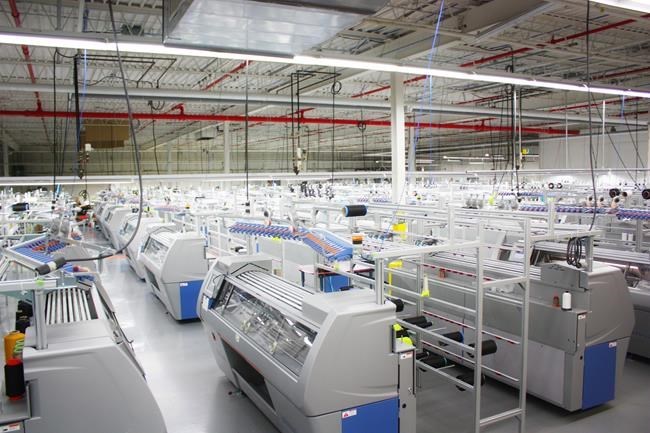
So the startup switched gears, importing 3D robotic knitting machines from Germany and Italy to its nearly 7,500-square-metre facility in Etobicoke, Ont.
“Instead of waiting a month for prototypes to come back from China or India, we could produce three prototypes in a day,” Varoli says.
The company’s in-house brand, SKIIN, is a line of smart clothing, including underwear, bras, base layers, socks, mattress covers and seat covers.
The garments collect information about a person through sensors knitted into the fabric, and a small electronic pod tucked into the band or edge of the garment sends that information to a mobile device, where it’s tracked using an app.
Myant now has clinical trials with Mayo Clinic in Rochester, Minn., Southlake Regional Health Centre in Newmarket, Ont., and SickKids in Toronto.
Yet the company has also run into challenges finding workers.
It recently partnered with Ryerson University, putting a machine at the school in the hopes of training students and developing a curriculum.
“We’re trying to democratize and standardize this new industry,” Varoli says. “Advanced manufacturing is going to be a huge component of our future.”
Another example of Canada’s new-age manufacturers is A&K Robotics.
The Vancouver-based company has invented a system that can attach on to anything with wheels and turn it into a self-driving robot.
Its “mobile autonomous navigation platforms” are used in the janitorial industry, automating floor cleaners in commercial and public spaces like airports, malls and schools — a particularly helpful technology given the demand for increased cleaning during the pandemic.
“We’ve retrofitted floor scrubbing machines to turn them into self-driving robots,” says Jessica Yip, co-founder of A&K Robotics.

The value of having a robust manufacturing sector was made clear during the pandemic, Myers says.
“It’s shown the importance of having advanced manufacturing capabilities in Canada,” he said, pointing to the production of vaccines, test kits and personal protective equipment.
NGen has developed a website, careersofthefuture.ca, to help students, parents and teachers learn more about advanced manufacturing.
It’s also launching a contest called Manufacturing the Future that will award 10 bursaries valued at $10,000 each to Canadian residents between the ages of 15 and 18 based on a 500-word essay on advanced manufacturing.
This report by The Canadian Press was first published May 13, 2021.