

Clearing the air
Winnipeg-based Price Industries has created a portable air purifier that 'could be a game-changer'
Advertisement
Read this article for free:
or
Already have an account? Log in here »
To continue reading, please subscribe:
Monthly Digital Subscription
$1 per week for 24 weeks*
- Enjoy unlimited reading on winnipegfreepress.com
- Read the E-Edition, our digital replica newspaper
- Access News Break, our award-winning app
- Play interactive puzzles
*Billed as $4.00 plus GST every four weeks. After 24 weeks, price increases to the regular rate of $19.95 plus GST every four weeks. Offer available to new and qualified returning subscribers only. Cancel any time.
Monthly Digital Subscription
$4.99/week*
- Enjoy unlimited reading on winnipegfreepress.com
- Read the E-Edition, our digital replica newspaper
- Access News Break, our award-winning app
- Play interactive puzzles
*Billed as $19.95 plus GST every four weeks. Cancel any time.
To continue reading, please subscribe:
Add Free Press access to your Brandon Sun subscription for only an additional
$1 for the first 4 weeks*
*Your next subscription payment will increase by $1.00 and you will be charged $16.99 plus GST for four weeks. After four weeks, your payment will increase to $23.99 plus GST every four weeks.
Read unlimited articles for free today:
or
Already have an account? Log in here »
Hey there, time traveller!
This article was published 05/12/2020 (1943 days ago), so information in it may no longer be current.
As one of the largest suppliers of HVAC equipment to commercial buildings in North America, the COVID epidemic has been another opportunity for Price Industries to clear the air.
Earlier this fall the Winnipeg-based manufacturer started shipping a portable room air purifier that aggregates COVID particles in the air then zaps them with ultraviolet light before sucking it through a heavy-duty filter.
Price makes hundreds of different HVAC products but it’s the company’s first-ever portable room air purifier (RAP). It was brought to market after a lightning quick prototype-to-production cycle that started with some napkin drawings in April and full production on the factory floor by September.
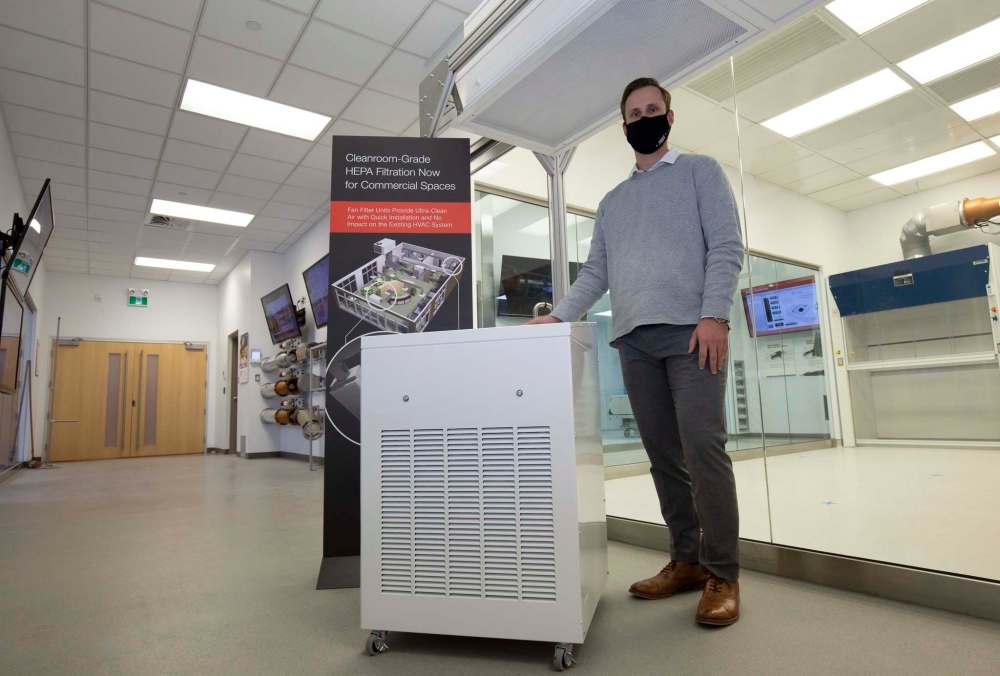
With several production facilities in Winnipeg and throughout the U.S. and several decades of expertise in the field, the company has been able to rush the RAP into production and has already started shipping.
“It is an exciting development for the company,” said Mark Mahon, air movement application engineering manager. “We have a lot of pride in all our products but we understand this one has a wider appeal to the layperson than a beautifully designed grill or a fantastic terminal unit.”
Price has done all sorts of research from its high-tech testing labs in Winnipeg, using computational fluid dynamics to figure out how to capture particles in the air that would contain the COVID-19 virus.
The RAP provides a few layers of protection: bipolar ionization technology causing COVID-19 particles to clump together and become heavier, larger, and easier to filter out of the air; high-intensity UV Light kills off about 99 per cent of the virus that passes through; and a heavy-duty HEPA filter traps 99.99 per cent of particles at a 0.3 micron size (one micron is one-millionth of a metre).
Company officials would not say how many or how much it costs but it is already in hospitals and schools and offices in Winnipeg and throughout North America and company officials said demand is “considerable”.
“It could be a game-changer,” said Mahon. “It is kind of like PPE for the classroom or for the office.”
Price has done extensive testing and both the American Society of Heating, Refrigerating and Air-Conditioning Engineers (ASHRAE) and the Centers for Disease Control have recommended that more attention be paid to air circulation in buildings for protection against the coronavirus.
William Bahnfleth, a professor of architectural engineering at Penn State University and the chair of ASHRAE’s epidemic task force that was organized back in March, has co-authored a few studies since then, including one that finally prompted the CDC to issue a statement on airborne COVID transmission and the importance of filtration and ventilation in indoor spaces.
“It is really baffling why the evidence for airborne transmission in cases where you don’t have good air quality — low ventilation and poor filtration — has not been recognized until very recently,” he said.
As for the Price RAP, he said it would be very effective, although Bahnfleth believes the UV and bipolar ionization may be overkill.
“The Price unit is based on very reliable technology. I have no doubt it works,” he said. “The only question I have is what the UV or ionization would add. But that is secondary to the fact that it is a very effective control if applied properly.”
Price has furnished HVAC solutions in thousands of hospital rooms, classrooms and offices across North America and understands how they should function properly.
Even so, the RAP is the first product the company has launched that requires no duct work or contractor to install it. It just plugs in.
It is also a different kind of marketing challenge for the company, which is very well known among contractors and the building trades, but not so much to the consumer.
“It is kind of like PPE for the classroom or for the office.”– Mark Mahon, air movement application engineering manager at Price Industries.
Greg Loeppky, Price’s vice-president of marketing said, “Often the person most excited about our product would be an engineer or contractor. This is one that strikes home to the parent of a child in the classroom or a teacher or a private sector business owner. The audience to whom we want to share the technology with is suddenly a little different, which is interesting for sure.”
Even before the launch of the RAP, Price had already beefed up its industrial fan filter units to be deployed as COVID-fighting devices for dental offices and other commercial spaces.
Dave Surminski, the general manager of Price’s critical environments, said it has been shipping a couple hundred of those units per month over and above its normal business with clean rooms and hospitals and manufacturers that require highly sanitized conditions.
“A lot of the stars aligned early for us,” Surminski said. “At the end of March there was a hot spot in Louisiana where we installed a fan filter unit in patient rooms. It was the first inkling that this was going to be a large project for us (dealing with the COVID pandemic).”
With 13 factories — seven in Canada and six in the U.S. — and about 3,500 employees including more than 1,100 in Winnipeg, Price has a resilient manufacturing infrastructure that company officials say is ready to meet the urgent need for this kind of protection for interior air quality.
“We’re ramping up for considerable uptake (for the RAP),” Loeppky said. “We’ve put in a parallel line in our Georgia plant and we’re building a second line in Winnipeg so we’ll have Made in Canada and Made in the U.S. We are aware this is the kind of equipment that can provide some advantages to people immediately so the faster we can fill the orders the better.”

Price’s accelerated production of a portable air purifier and its rapid deployment of industrial HEPA fan filter units is likely not an exercise that will end when the pandemic subsides.
“We think this is going to continue to be top of mind and that building codes will be reviewed,” Surminski said. “I think we will talk a lot about indoor air quality and reducing contaminants and pathogens within building environments and occupied spaces for years to come.”
It takes a while for regulators to agree on changes to codes but Price is already tooled up.
“Eventually we will see changes that will bring indoor air quality to the highest priority where it is not a high priority right now,” said Surminski.
martin.cash@freepress.mb.ca