Companies in race to develop sustainable jet fuel in face of climate crisis
Advertisement
Read this article for free:
or
Already have an account? Log in here »
To continue reading, please subscribe:

Digital Subscription
One year of digital access for only $205*
- Enjoy unlimited reading on winnipegfreepress.com
- Read the E-Edition, our digital replica newspaper
- Access News Break, our award-winning app
- Play interactive puzzles
*First annual payment billed as $205.00 + GST for one year. This annual subscription will automatically renew at $233.00 + GST every 52 weeks (10% off the regular annual price of $259.35). Offer available to new and qualified returning subscribers only. Cancel any time.
To continue reading, please subscribe:
Add Free Press access to your Brandon Sun subscription for only an additional
$1 for the first 4 weeks*
- Enjoy unlimited reading on winnipegfreepress.com
- Read the E-Edition, our digital replica newspaper
- Access News Break, our award-winning app
- Play interactive puzzles
*Your next Brandon Sun subscription payment will increase by $1.00 and you will be charged $17.95 plus GST for four weeks. After four weeks, your payment will increase to $24.95 plus GST every four weeks.
Read unlimited articles for free today:
or
Already have an account? Log in here »
Hey there, time traveller!
This article was published 08/12/2021 (1751 days ago), so information in it may no longer be current.
CALGARY – When United Airlines flew a plane full of passengers from Chicago to Washington, D.C. on Dec. 1, it did it with one engine 100 per cent powered by fuel made from corn sugar.
It was a historic first, according to the airline. Though other international carriers — including Air Canada — have flown using a blend of traditional and renewables-based fuels, United said its use of a 100 per cent plant-based fuel developed by Virent, a subsidiary of U.S.-based Marathon Petroleum was a first for a commercial flight.
In the face of the global climate crisis, the race is on to find a way to reduce greenhouse gas emissions from the aviation sector. Around the world, scientists, technology startups and fossil fuel giants alike are battling to become the lead suppliers of what has come to be known as “sustainable aviation fuel,” or SAF.
“It’s a bit of the Wild West. You’ve got companies trying to get going, you’ve got companies maturing technologies, you’ve got technologies trying to make the leap to commercial before they’re quite ready,” said University of Alberta professor David Bressler, whose own advanced-stage research into the production of jet fuel from waste fats and oils was awarded a nearly $3-million federal grant last year.
“But eventually you’re going to see somebody emerge in this space, I’m quite confident, who has a fundamentally strong business model.”
Air travel is responsible for two per cent of global emissions, but is considered by many experts to be one of the most difficult sectors to decarbonize, as the long distances and the immense power required don’t lend themselves easily to electrification. Hydrogen-powered aircraft, too, while technically a possibility, also remain a long way from becoming a reality.
Still, the global aviation industry itself has committed to achieve net-zero carbon emissions by 2050. And with the demand for air travel expected to grow between now and then, the International Air Transport Association estimates that a “business as usual” trajectory would result in 21.2 gigatonnes of CO2 being released into the atmosphere by the aviation sector over the next 29 years. (For perspective, total global energy-related C02 emissions in 2019 were around 33 gigatonnes.)
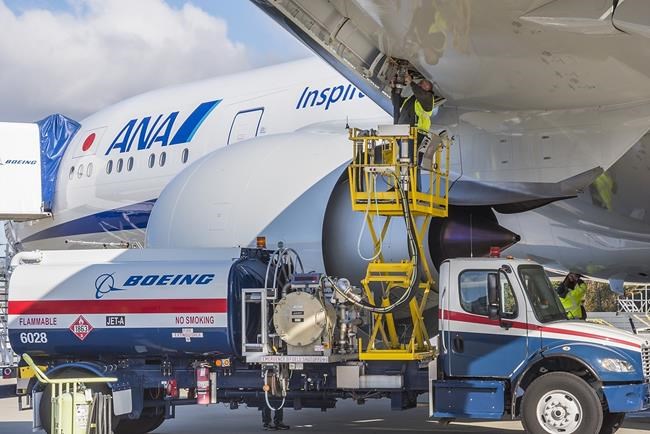
That’s why the industry is banking on SAF. Though it doesn’t eliminate emissions, it is a lower-carbon solution that instead of petroleum, is made from renewable materials such as used cooking oils, organic municipal waste or even algae.
SAF still has a small carbon footprint that varies depending on the production method and the supply chain involved in getting it to the airport. But it can reduce carbon dioxide emissions by more than 85 per cent compared to conventional jet fuel, and it’s also a “drop-in” fuel, meaning it doesn’t require changes to aircraft or any special infrastructure at airports. The industry has set a goal of 2.5 billion gallons of SAF produced by 2025.
But there are huge challenges ahead. Sustainable aviation fuel is still very much a fledgling industry, with only about 20 million gallons produced and used on a global basis last year.
“In the U.S. alone, airlines use more than 20 billion gallons of jet fuel annually,” said Jimmy Samartzis, chief executive of LanzaJet, a technology company that uses ethanol produced from corn or sugar cane as a feedstock to produce SAF. “So there’s a lot that needs to be done to achieve the industry’s goals.”
LanzaJet is a spinoff of Illinois-based LanzaTech, and it already has a demonstration facility producing sustainable aviation fuel in Georgia. The company expects to begin commercial operations there in 2022.
But the company also has a strong Canadian connection. One of its founding investors, along with Japanese trading and investment company Mitsui & Co., is Calgary-based Suncor Inc. The energy giant made a $15-million equity investment to help establish LanzaJet.
Andrea Decore, Suncor’s vice-president for low carbon fuels and offsets, said Suncor already supplies conventional jet fuel to the Denver, Vancouver, Calgary, Toronto, Ottawa and Montreal airports.
“We think sustainable aviation fuel will be in high demand some day,” she said. “We were starting to hear it from our customers.”
As a founding partner, Suncor has committed to building and operating a commercial production facility somewhere in North America for LanzaJet. Decore said the company is already in the early design and engineering phases for what will be an approximately $450 million facility, to be located in either Vancouver, Denver, Edmonton, Montreal or Sarnia.
“And if the economics support it, we may do multiple,” Decore said, adding the first plant could be up and running by 2025. “We’re looking at a 60 million gallon-per-year plant — at least one, and maybe up to five.”
However, one major sticking point is that right now, the cost of SAF remains much higher than conventional jet fuel — around US$6 a gallon, compared to less than US$2 per gallon for conventional, Decore said.
Until the industry matures and its cost of production comes down, she added, some form of government support in the form of grant programs, cost-sharing agreements or credits (such as the tax credits available under California’s low carbon fuel standard) will be necessary.

“A lot of these technologies are the first of their kind — they’re not economic, stand-alone,” Decore said. “Credits are going to be really important to make it feasible, because there’s a limit to what the flying customer will bear.”
Bressler, the U of A professor, said cost isn’t the only barrier. He said the sheer scale of the aviation industry, and the volume of fuel that will be required to make a significant dent in its emissions footprint, is daunting.
“Some of the airports are already blending in two or three per cent SAF,” Bressler said. “But 100 per cent completion? How do you scale to that quantity? This is a supply problem and a capital investment problem —it’s not a technology problem.”
This report by The Canadian Press was first published Dec. 8, 2021.
Companies in this story: (TSX:SU)