COVID supervisors on the challenges of trying to keep Canadian film and TV sets safe
Advertisement
Read this article for free:
or
Already have an account? Log in here »
To continue reading, please subscribe:

Digital Subscription
One year of digital access for only $205*
- Enjoy unlimited reading on winnipegfreepress.com
- Read the E-Edition, our digital replica newspaper
- Access News Break, our award-winning app
- Play interactive puzzles
*First annual payment billed as $205.00 + GST for one year. This annual subscription will automatically renew at $233.00 + GST every 52 weeks (10% off the regular annual price of $259.35). Offer available to new and qualified returning subscribers only. Cancel any time.
To continue reading, please subscribe:
Add Free Press access to your Brandon Sun subscription for only an additional
$1 for the first 4 weeks*
- Enjoy unlimited reading on winnipegfreepress.com
- Read the E-Edition, our digital replica newspaper
- Access News Break, our award-winning app
- Play interactive puzzles
*Your next Brandon Sun subscription payment will increase by $1.00 and you will be charged $17.95 plus GST for four weeks. After four weeks, your payment will increase to $24.95 plus GST every four weeks.
Read unlimited articles for free today:
or
Already have an account? Log in here »
Hey there, time traveller!
This article was published 09/02/2021 (2055 days ago), so information in it may no longer be current.
TORONTO – On set they called her “COVID Cathy,” or “CC” for short.
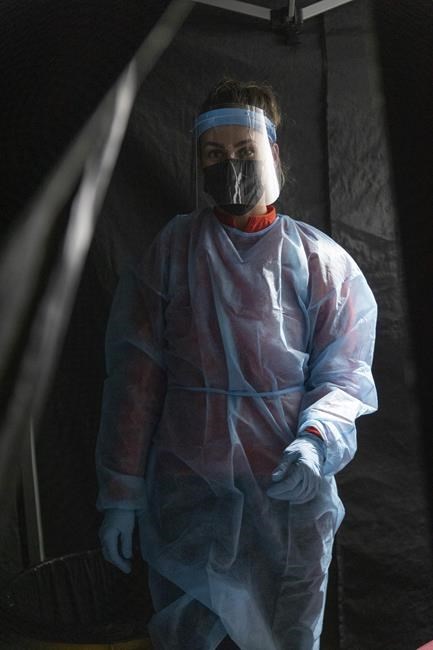
As the COVID-19 supervisor on the new Toronto-shot CBC series “Pretty Hard Cases,” Catherine Lang had to not only help develop pandemic protocols for the production, but also keep a close eye on the cast and crew to ensure they were following them.
It can be a tricky position, having to police everyone while trying to prevent positive cases, but Lang says she was determined to keep the mood upbeat.
“What I found the hardest about COVID supervising was that it’s hard to spend 100 per cent of your day worrying about people’s health. And unfortunately, I’m a bit of a worrier,” Lang says.
“Eating, breathing, sleeping — 24-7 — I couldn’t get it out of my mind. Because at the beginning all I could think was, ‘What if I do something or don’t do something and somebody gets sick?’ And that was quite a large stress for me.”
Lang’s position, which is also sometimes called a COVID compliance officer, is a now common one on Canadian film and TV sets. And it’s one she predicts will be around for another year or so.
The supervisor typically works alongside the producers and a team of medical, health and safety professionals to create COVID protocols using government guidelines and ensure they’re adhered to. Both industry and medical professionals can qualify for the position.
“They were accepted, but definitely were the sort of hall monitors of the production shoot that can frustrate people when they’re trying to do their jobs,” Alex Jordan, a producer on Global’s “Private Eyes,” says of their COVID supervising team.
“We had to be very cognizant of the mental health of everyone. To some people’s opinion, you’re not doing enough. And in some cases, people are like, ‘This is too much. You’re overkill.'”
“Kim’s Convenience” star Paul Sun-Hyung Lee says their COVID protocol officer was Cher Merlo, who has a background in film and TV production. She “worked tirelessly” on things like modifying the actors’ masks and shields to ensure they would be effective but wouldn’t disrupt their hair and makeup between takes.
“She had the hardest job on set, because her job was to be the bad guy and to remind them of the protocols and of doing things like sanitizing your hands and wearing your mask and staying two metres apart,” Lee says.
“Pretty Hard Cases” stars Adrienne C. Moore and Meredith MacNeill say they went to great lengths to help Lang not feel “like a bad guy.”
“I remember when Cathy gave her first speech at the start, Adrienne and I looked at each other and then gave her the biggest cheer. We were like ‘Cathy!'” says MacNeill.
“We used to call her COVID Cathy. We were like ‘CC, yes, in the house!’
The staff knew Lang was “only trying to help,” notesMacNeill.
“So we approached it, and the whole crew approached it, with a ‘thank you.'”
Lang had worked as an assistant producer and production manager before becoming a COVID supervisor on “Pretty Hard Cases.”
Lang says she read everything she could about the virus and “spent many hours on the phone” with producer Wanda Chaffey and executive producer Amy Cameron. The three developed protocols for every department with a consulting physician.
“As I would walk through the set, I would see people adjust their masks and pull their shields down. It was very cute,” Lang says laughing.
Of course, Lang also wore personal protective equipment, since she had to be in more spaces on set than most.
She says she “never felt unsafe” but found the thought of somebody getting sick in the workplace “horrifying” and had to learn to stop worrying about things that were out of her control.
“Eventually I had to say to myself, ‘I can’t stop this. I can control what happens in the workplace to an extent, but I can’t control what happens outside of the workplace.'”
The cast and crew were very compliant, Lang says, noting “everybody really wanted to be safe.” Chassey and Cameron were with her every step of the way.
In the end, they had no incident of anyone contracting COVID-19 at work, she says. While there were two positive cases, they were contracted outside production, caught through testing and had no community spread.
Toronto nurse Meghan McKenna became a COVID supervisor on the CBC series “Coroner” through her employer, the third-party medical consulting firm Oncidium, which provided guidance and support to the show, including a full-time nursing staff.
She hadn’t worked in film and TV before and was “on a steep learning curve” in that regard as they collaborated with producers, she says.
They held mandatory health sessions for everyone on set.
One of McKenna’s key goals was for the cast and crew to understand the uncertain nature of a pandemic, so if provincial case numbers rose and protocols changed, they would be onboard instead of feeling they were being fed misinformation.
She also taught everyone how viruses or bacteria spread through communities, so when pandemic fatigue set in, they understood how to protect themselves and why every single protocol matters.
The pressure on the job comes with not wanting to see the production fail, says McKenna. But her experiences working in hospital have taught her she “can’t control what people are doing 100 per cent.”
She also likes the idea that should someone have a medical issue on set, she’s able to guide them through it and manage it.
McKenna’s nursing background and experience in emergency rooms also helped her feel “fine with being the police” on set.
“That is such a big part of health teaching, is telling people things they don’t want to hear,” she says. “I really like the challenge of getting through to someone over time.”

While producers say “Coroner” had “a few issues” with COVID-19 cases, they weren’t on set, were easily contact-traced and had no community spread.
And no one had to be reminded of the protocols later in production, McKenna says.
“Everyone’s helping remind each other,” she says.
“The crew is all keeping each other safe,” adds “Coroner” executive producer Suzanne Colvin-Goulding. “Everybody has adopted the mentality that we are in this together.”
This report by The Canadian Press was first published Feb. 9, 2021.