

Deeply rooted for the future
Boeing Canada marks 50 years in Winnipeg, eagerly 'looking forward to continued recovery'
Advertisement
Read this article for free:
or
Already have an account? Log in here »
To continue reading, please subscribe:
Monthly Digital Subscription
$1 per week for 24 weeks*
- Enjoy unlimited reading on winnipegfreepress.com
- Read the E-Edition, our digital replica newspaper
- Access News Break, our award-winning app
- Play interactive puzzles
*Billed as $4.00 plus GST every four weeks. After 24 weeks, price increases to the regular rate of $19.95 plus GST every four weeks. Offer available to new and qualified returning subscribers only. Cancel any time.
Monthly Digital Subscription
$4.99/week*
- Enjoy unlimited reading on winnipegfreepress.com
- Read the E-Edition, our digital replica newspaper
- Access News Break, our award-winning app
- Play interactive puzzles
*Billed as $19.95 plus GST every four weeks. Cancel any time.
To continue reading, please subscribe:
Add Free Press access to your Brandon Sun subscription for only an additional
$1 for the first 4 weeks*
*Your next subscription payment will increase by $1.00 and you will be charged $16.99 plus GST for four weeks. After four weeks, your payment will increase to $23.99 plus GST every four weeks.
Read unlimited articles for free today:
or
Already have an account? Log in here »
Hey there, time traveller!
This article was published 10/09/2021 (1667 days ago), so information in it may no longer be current.
On Thursday, Boeing Canada held a tree-planting ceremony commemorating its 50th anniversary in Winnipeg.
They will plant 50 trees on the site that makes composite parts for every one of Boeing’s commercial jetliner models.
Over the years, the facility — the largest composites production facility in the country — has undergone five expansions.

The significant milestone comes during a rare time that Boeing’s Winnipeg operation is actually getting smaller, not larger.
Amy May, the general manager of the operation since the beginning of 2019, said the plant’s performance continues to be excellent. The plant maintains the authority to make more than 250 different parts packages, including large, complex engineered parts like landing gear doors and engine inlet inner barrels that muffle the noise of the engine.
May said while there are no plans to expand or change the work make-up neither has the plant lost any of its work packages.
They includes the tricky one-piece composite acoustic inner barrel on the engine inlet for the 737 Max that requires 180,000 holes drilled into each one.
In 2013, the company built its most recent 130,000-square-foot expansion specifically for the 737 Max parts.
May said Boeing Winnipeg’s work on that model that was grounded after two tragic crashes has not been altered. The only impact on Winnipeg’s operation was re-aligned reporting for the engineering team.
But Boeing Winnipeg has lost a number of jobs.
The pandemic caused about 80 per cent of the aviation industry to shut down overnight which has had an obvious impact on the aerospace industry around the world.
With airlines not flying the demand for new aircraft halted drastically, requiring Boeing to reduce the production rates of its commercial crafts commensurately.
While it still needs the Winnipeg plant to continue producing the parts, it just doesn’t need as many.
Last year the Winnipeg operation was forced to trim its workforce by about 30 per cent.
That ended more than a decade of workforce stability that had stood at about 1,600 and now numbers just over 1,000.
Unifor members, the union that represents Boeing workers, participated in the tree planting ceremony, an indication, May said, of the good working relationship that exists,
May said, “The pandemic definitely had an impact on the aerospace industry. There were lots of unanticipated changes to the business like the workforce impact. Seeing some of our teammates go in response to the lower production rate was a real challenge.”
But the tree planting ceremony was perhaps an opportunity of looking forward to a more positive future.
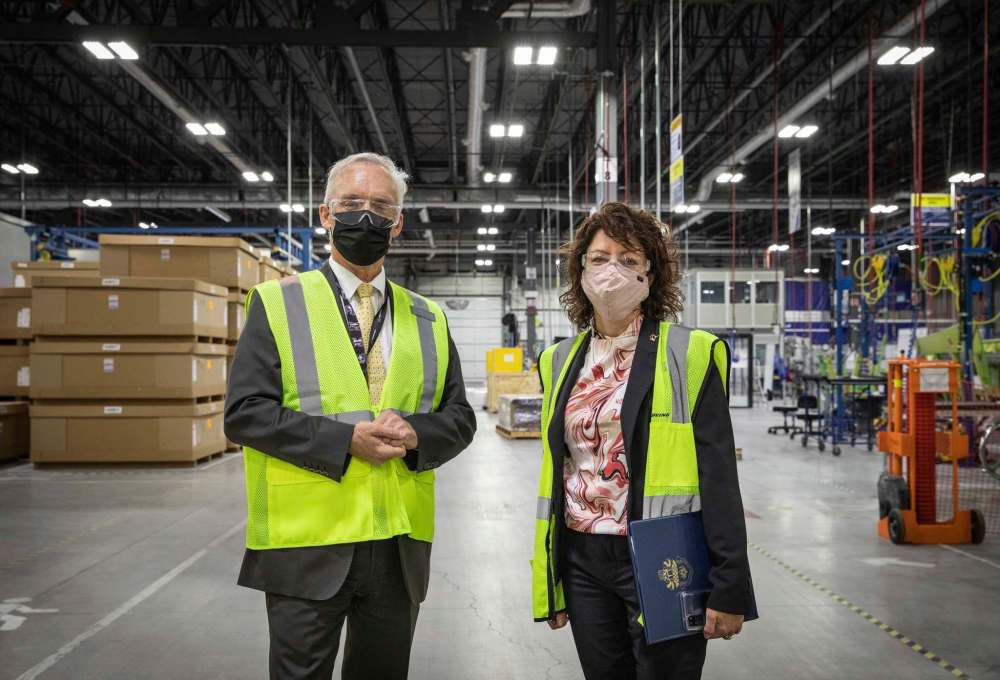
“We are in a good position at Boeing Winnipeg,” she said. “Our team here is outstanding and continues to do important and valuable work and we’re looking forward to continued recovery from the pandemic and the commercial airplane market.”
As they watch the signals for the industry’s recovery and take their cues from Boeing’s U.S. final assembly plants, May said, “Our own performance determines the true outlook.”
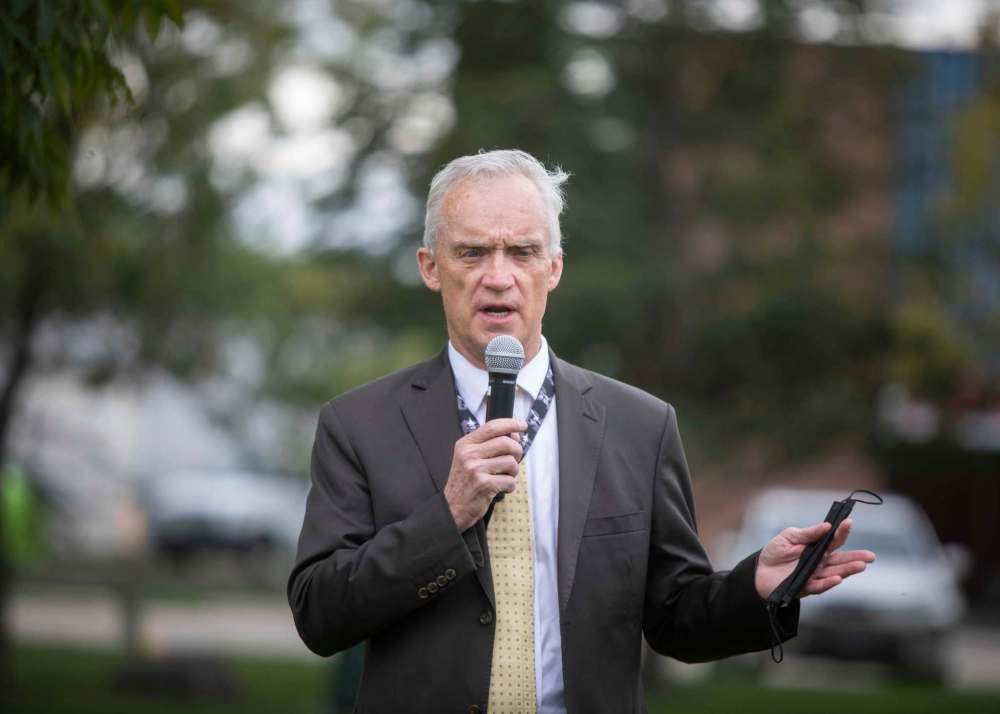
Charles (Duff) Sullivan, managing director of Boeing Canada, who is based in Ottawa, made his first trip to the Winnipeg facility since assuming that position a year ago for the event on Thursday.
He refers to the Winnipeg plant as the “jewel” of Boeing’s Canadian presence.
Sullivan hopes to have the chance to leverage that jewel if Boeing wins the Canadian defence department’s decade long search for a new jet fighter. (A decision by the government is expected in 2022.) The Boeing Block III Super Hornet is still in the race and according to Sullivan if it is selected, it will create a $61 billion economic impact and directly and indirectly create 248,000 jobs over the lifetime of the jets.
Sullivan pointed out Boeing’s unmatched track record in delivering on its industrial and technological benefits that go along with such government procurements — companies commit to reinvesting the purchase prices of the jets back into the Canadian economy.
It was just those kinds of offsets that caused Boeing to build in Winnipeg in the first place in 1971 after Air Canada, then a Crown corporation, bought some Boeing jets.

Boeing has arguably continued to live up to its end of the bargain.
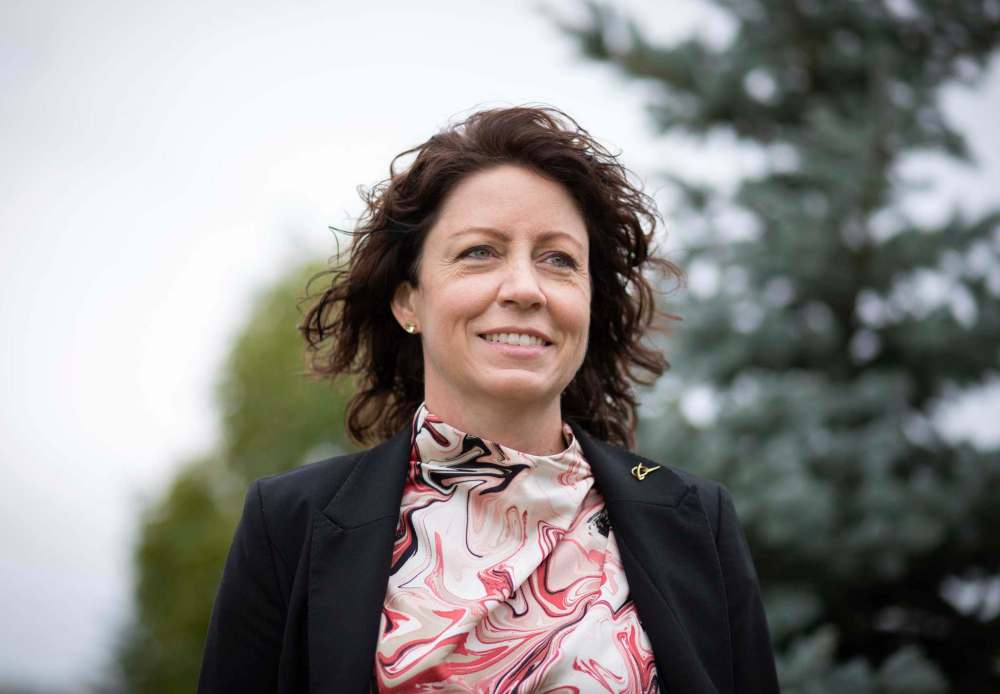
May spoke emotionally about the community service commitment that exists at the Winnipeg operation and the symbolic nature of the tree planting ceremony.
“We plant the trees knowing they will spread their roots, withstand the winds of change and usher life and breath into the community,” she said.
martin.cash@freepress.mb.ca
History
Updated on Friday, September 10, 2021 6:29 AM CDT: Adds photos