

Divest from authoritarianism
War in Ukraine a wake up call about how your investments could be supporting crimes against humanity
Advertisement
Read this article for free:
or
Already have an account? Log in here »
To continue reading, please subscribe:

Digital Subscription
One year of digital access for only $205*
- Enjoy unlimited reading on winnipegfreepress.com
- Read the E-Edition, our digital replica newspaper
- Access News Break, our award-winning app
- Play interactive puzzles
*First annual payment billed as $205.00 + GST for one year. This annual subscription will automatically renew at $233.00 + GST every 52 weeks (10% off the regular annual price of $259.35). Offer available to new and qualified returning subscribers only. Cancel any time.
To continue reading, please subscribe:
Add Free Press access to your Brandon Sun subscription for only an additional
$1 for the first 4 weeks*
- Enjoy unlimited reading on winnipegfreepress.com
- Read the E-Edition, our digital replica newspaper
- Access News Break, our award-winning app
- Play interactive puzzles
*Your next Brandon Sun subscription payment will increase by $1.00 and you will be charged $17.95 plus GST for four weeks. After four weeks, your payment will increase to $24.95 plus GST every four weeks.
Read unlimited articles for free today:
or
Already have an account? Log in here »
Hey there, time traveller!
This article was published 26/03/2022 (1649 days ago), so information in it may no longer be current.
War is hell; news headlines demonstrate hourly these days.
And so, you too may be mad as hell about what we’re witnessing in Ukraine — daily crimes against humanity perpetrated by the Russian armed forces — and wondering what you can do.
One place to look may be your portfolio and divest from companies with interests in Russia. That said many North American companies may have beat you to it.
Yale University has compiled a list of companies that have ceased or suspended operations, and those that haven’t.
Firms that have stopped, at least temporarily, are a who’s who of multinational companies from Coca-Cola to McDonald’s to Apple and Visa.
“It’s been really interesting watching the developments through this lens of divestment because we are seeing the impact of a coordinated movement the world has never seen,” says Tim Nash, founder of Good Investing in Toronto, and author of The Sustainable Economist blog.
Many of his clients have also been asking recently — often for the first time — about exposure to Russian companies.
Nash says most Canadians have minimal exposure unless they own emerging market funds.
Even then exposure would have been minimal before war broke out.
Now, their Russian allocations would likely be zero, given leading index providers like MSCI have removed Russian assets from their emerging market indices. In fact, in a recent press release, MSCI declared Russia’s stock market “uninvestable.” MSCI’s benchmark, by the way, is used by many emerging market exchange-traded funds (ETFs) and mutual funds, which are likely to follow its lead.
Even before the invasion, Russian investments made up just four per cent of MSCI’s index, falling from a 10 per cent share in 2008, the year Russia invaded Georgia.
Another tool investors can use is engagement, voicing their concerns to large Canadian and U.S. companies, says certified responsible investment specialist Stephen Whipp with Leede Jones Gable Inc. in Victoria.
“Investors have a lot of power to direct their activism and their retirement money, telling companies not to turn a blind eye to the atrocities going on in Ukraine.”
Companies these days are indeed sensitive to issues beyond revenues and profits. ESG — environmental, social and governance — issues are increasingly on the radar with most North American companies reporting annually on progress in these areas. Yet much of the focus for investors had been on the environment.
With the invasion of Ukraine, the calculus has changed. More investors are questioning how their capital could be complicit, and now just with respect to Russia.
China, India, Vietnam, South Africa and others, while not explicitly backing Vladimir Putin’s blood-soaked ambitions, have largely given their tacit approval by abstaining from a United Nations vote condemning the invasion.
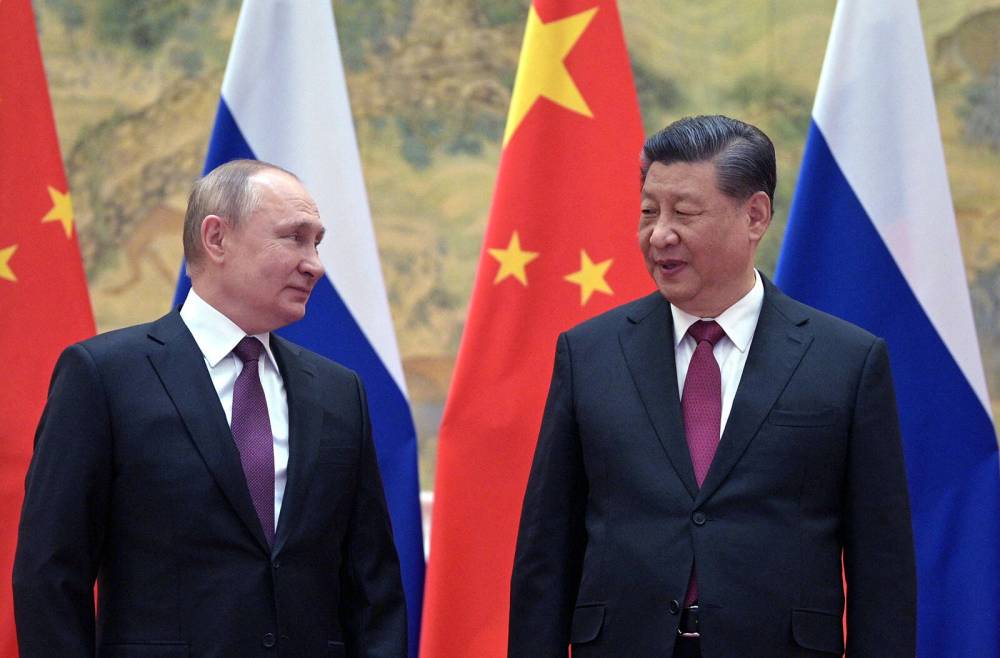
China’s support of Russia is most troubling. Chinese leader Xi Jinping and Putin met prior to the Olympics, posing for a photo-op — twinning in near identical suits and ties — and declaring their relationship had “no limits.”
At the same time, other nations like India — the world’s largest democracy — continue to trade with Russia, ignoring sanctions, buying discounted weapons and oil instead.
Their actions, or lack thereof, should give investors pause.
“There are real fundamental concerns,” says Vancouver-based Jamie Bonham, director of corporate engagement at NEI Investments — one of the largest responsible fund firms in Canada.
Human rights have long been a concern of NEI. Like many responsible investors NEI faces the dilemma between the benefits of economic engagement, and how their investments in these countries could be indirectly funding and emboldening authoritarian tendencies of their governments.
The war in Ukraine has brought this to the forefront even though these issues did not happen overnight. Hundreds of billions of dollars in foreign investment flowed into Russia over decades, according to World Bank data, enriching oligarchs and strengthening Putin’s grip on power.
Even more investment has poured into China.
The world’s second largest economy may not have the same track record of engaging in crimes against humanity as Putin’s Russia. But the Chinese government has often tossed aside human rights of Uyghurs and Tibetans, and increasingly uses cutting-edge surveillance to censor freedom of speech.
Now Chinese leadership appears to be quietly backing Russia’s war, raising fears among some observers that Xi may want to do to Taiwan what Putin has done to Ukraine.
Of course, selling emerging markets funds and similar investments is one way to express our concerns about human rights and the sovereignty of democratic nations… however infinitesimal this act may be.
Yet detangling from authoritarian regimes “is more complicated” than it seems given how economically entangled we are, Bonham explains.
“China is a question unto itself because of the important role in so many supply chains.”
For decades, the West — by no means an innocent actor in world affairs, though arguably a lot more democratic — has sought economic engagement to promote better relations with Russia, China and other emerging markets.
“It’s based on the idea that we are less likely to go to war with our trading partners,” Nash explains.
Certainly the strategy has worked until Putin literally blew it up.
Now more than ever investors should rethink this notion of economic engagement for change — for the better — in their portfolios.
“This is an opportunity to put more pressure on companies to do the right thing regarding where and how they operate,” Whipp says.

That could lead to change in how these nations’ governments behave.
Or maybe companies will move operations back to the U.S, Europe and Canada, or emerging market nations with better human rights records.
There is a choice — though not without consequence, Whipp says.
“If we’re moving businesses out of these countries and bringing operations here, the costs of goods are likely to be higher.”
Then again, maybe it’s a price worth paying for a cleaner conscience.