Dry January means less water than normal in California snow

Advertisement

Advertise with us

SACRAMENTO, Calif. (AP) — The water contained in California's mountain snow is now lower than the historical average after a January without significant rain or snow — a dramatic reversal from December that demonstrates the state's challenges in managing its water supply.

Read this article for free:


By clicking the button above, an account will be created and you will begin to receive some of our recommended newsletters. You may opt out of any newsletter by visiting your Email and Communication Preferences page or by clicking "unsubscribe" at the bottom of any email.

or

Already have an account? Log in here »

To continue reading, please subscribe:

Digital Subscription

One year of digital access for only $1.44 a week*

  • Enjoy unlimited reading on winnipegfreepress.com
  • Read the E-Edition, our digital replica newspaper
  • Access News Break, our award-winning app
  • Play interactive puzzles

*Billed as $5.77 plus GST every four weeks. After 52 weeks, price increases to the regular rate of $19.95 plus GST every four weeks. Offer available to new and qualified returning subscribers only. Cancel any time.

To continue reading, please subscribe:

Add Free Press access to your Brandon Sun subscription for only an additional

$1 for the first 4 weeks*

  • Enjoy unlimited reading on winnipegfreepress.com
  • Read the E-Edition, our digital replica newspaper
  • Access News Break, our award-winning app
  • Play interactive puzzles
Start now

*Your next Brandon Sun subscription payment will increase by $1.00 and you will be charged $17.95 plus GST for four weeks. After four weeks, your payment will increase to $24.95 plus GST every four weeks.

Hey there, time traveller!
This article was published 01/02/2022 (1718 days ago), so information in it may no longer be current.

SACRAMENTO, Calif. (AP) — The water contained in California’s mountain snow is now lower than the historical average after a January without significant rain or snow — a dramatic reversal from December that demonstrates the state’s challenges in managing its water supply.

Snow totals updated Tuesday by the state Department of Water Resources show the amount of water in the Sierra Nevada mountain’s snowpack is at 92% of what’s normal for this date. In December, heavy rain and snow left the state with 160% of its average snow water content.

“Our climate is experiencing these volatile shifts form wet to dry year after year, and even month after month,” said Sean de Guzman, manager of the department’s snow surveys and water supply forecasting section.
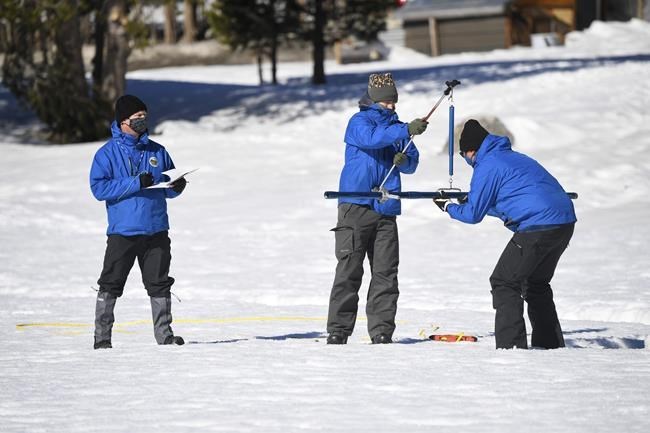
Sean de Guzman, chief of snow surveys for the California Department of Water Resources, right, places the snowpack measuring tube of a scale held by DWR's Anthony Burdock, center, as DWR's Andy Reising, left, looks on during the second snow survey of the season held at Phillips Station near Echo Summit, Calif., Tuesday, Feb. 1, 2022. The survey found the snowpack at 48.5 inches with 19 inches of snow water content. That's 109% of the historical average at this time of the year. But statewide, the water in the snowpack is 92%. (Kenneth James / California Department of Water Resources via AP)

The extremely wet December followed by a dry January was strikingly similar to previous months, which included a very wet October followed by a dry November.

De Guzman spoke from a location near Lake Tahoe where the state periodically measures snow pack. Snow totals there were slightly higher than average, indicating the varying conditions across the state. It’s one of hundreds of locations where the state manually and electronically measures snow totals and water content.

The whipsaw effects of the weather and precipitation were illustrated by the situation on the Nevada side of Lake Tahoe in Reno, which had zero precipitation the entire month of January for the first time in recorded history. That came months after the city experienced its wettest October since the National Weather Service began keeping records in 1893.

California needs a wet winter to ease the drought because much of the state’s precipitation typically falls between December and March. Most of California is now in what’s considered severe drought according to the U.S. Drought Monitor, with only a small part of the state classified as being in the more serious extreme drought. That’s a significant improvement over the situation a year ago.

Winter snow is a crucial part of California’s water supply and December through March are typically the wettest months of the year. Snow that melts in the mountains and runs down into California’s lower elevations makes up about a third of the state’s water supply.

As of now, the water content in the snow is at 57% of the April 1 average, a key measurement data that indicates how much water the state will have from runoff in the spring and summer.

“That one dry month of January basically wiped out whatever head start we had as we head towards the end of winter,” de Guzman said.
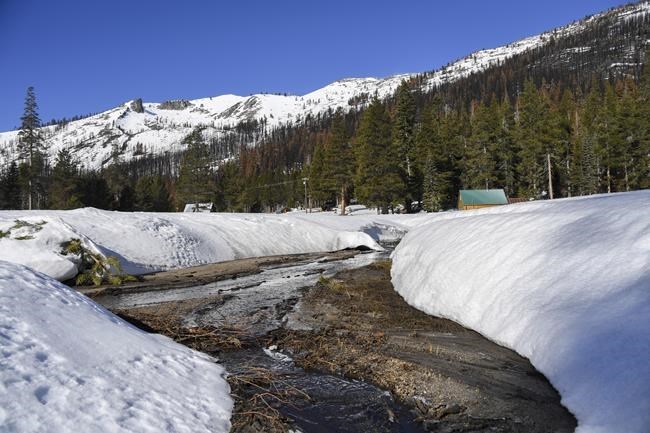
In this photo provided by the California Department of Water Resources, snow melts into a creek flowing into the South Fork American River, near the where the California Department of Water Resources held the second snow survey of the season at Phillips Station near Echo Summit, Calif., Tuesday, Feb. 1, 2022. The survey found the snowpack at 48.5 inches with 19 inches of snow water content. That's 109% of the historical average at this time of the year. But statewide, the water in the snowpack is 92%. (Kenneth James/California Department of Water Resources via AP)

Meanwhile, officials at the State Water Resources Control Board announced Tuesday that Californians met Gov. Gavin Newsom’s call for a voluntary 15% reduction in water use for the first time in December, thanks to the heavy precipitation. Overall people used 16.2% less water compared to the December before. Still, cumulative savings since Newsom made his request in July sit at just 7.4%, officials said.

E. Joaquin Esquivel, chair of the water board, called the December conservation numbers “incredibly impressive” and said they demonstrate that people are being more mindful of their water use during wet times. The state board recently adopted mandatory water restrictions including a ban on watering lawns within 48 hours of a rainstorm, but that rule wasn’t yet in effect in December.

But he stressed that continued conservation is necessary as dry conditions have returned.

“We’re looking to hopefully get a few more storms this water year, but the storm door may be closed,” he said.

Report Error Submit a Tip

More Stories

Manitoba Hydro to replace dozens of electrical substations over 20 years

Chris Kitching 5 minute read Preview

Manitoba Hydro to replace dozens of electrical substations over 20 years

Chris Kitching 5 minute read Updated: 4:33 PM CDT

Manitoba Hydro is promising fewer power outages in Winnipeg once it replaces or converts 41 electrical substations in a project the utility says will last up to 20 years and cost as much as $1.2 billion.

Spokesman Peter Chura said upgrades to the electrical distribution system will improve safety, reliability and resiliency, and reduce maintenance costs.

“We’ve been clear for a few years now that aging infrastructure is a challenge for the province going forward, so our programs like this are solving that problem incrementally,” he said Friday.

Many substations in Winnipeg are nearing the end of their service life or operating close to capacity. The upgrades will increase capacity, said Craig Sambrooke, Hydro’s construction community liaison.

Read
Updated: 4:33 PM CDT

Federal data on Winnipeg's number of homeless people inaccurate, advocates say

Scott Billeck 5 minute read Preview

Federal data on Winnipeg's number of homeless people inaccurate, advocates say

Scott Billeck 5 minute read Updated: 1:02 PM CDT

The head of End Homelessness Winnipeg says she has no confidence in data about the city’s homeless population due to problems with the federal system that tracks those numbers.

Read
Updated: 1:02 PM CDT

Nurses call for national strategy on seniors’ health care

Carol Sanders 4 minute read Preview

Nurses call for national strategy on seniors’ health care

Carol Sanders 4 minute read 1:57 PM CDT

Canada’s nurses are calling for a national strategy that ensures seniors have access to care while reducing the impact on the public health system.

“Nurses and health-care workers are stretched too thinly, and Canada’s population is aging,” Canadian Federation of Nurses Unions (CFNU) president Linda Silas said in a news release Friday after meeting with provincial and territorial health ministers in Winnipeg.

“It’s time to act.”

The federation called for a national human resources plan to help address staffing challenges, pointing to a Canadian Institute for Health Information report showing more than three million overtime hours clocked by long-term care workers over a one-year period — the equivalent of 1,500 full-time providers.

Read
1:57 PM CDT

Mayoral candidates share faves, test knowledge in Free Press culture quiz

Conrad Sweatman 5 minute read Preview

Mayoral candidates share faves, test knowledge in Free Press culture quiz

Conrad Sweatman 5 minute read Wednesday, Oct. 14, 2026

It’s been said that politics is downwind of culture. However true that is, where politicians stand on hot-button cultural debates such as artificial intelligence, whether they prefer sports over arts and what local restaurants they patronize can offer a window into their sensibilities and outlooks.

The Free Press invited the four leading mayoral candidates among decided voters — according to a recent Abacus poll — to take part in a cultural quiz. (Kevin Klein, who was polling second, did not respond.) While most of the questions are lighthearted, they speak to some of the personalities behind the heated rivalries over budgets, buses, business taxation and beyond.

What was the last book you finished?

● Scott Gillingham: I’m almost done Winnipeg author Paul Vincent Jacuzzi’s book Blind Eyes. It’s a Dalton Drake novel.

Read
Wednesday, Oct. 14, 2026

Violence directed at Winnipeg School Division support staff surges, union reports

Maggie Macintosh 5 minute read Preview

Violence directed at Winnipeg School Division support staff surges, union reports

Maggie Macintosh 5 minute read Updated: 5:00 PM CDT

Kicking, biting and other types of student aggression toward educational assistants in Winnipeg has surged 118 per cent since 2022-23.

Read
Updated: 5:00 PM CDT

Manitoba declares 20-month measles outbreak over

Nicole Buffie 2 minute read Preview

Manitoba declares 20-month measles outbreak over

Nicole Buffie 2 minute read 3:59 PM CDT

After once leading the country in reported cases, the province has declared the measles outbreak in Manitoba to be over.

Public health officials announced Friday the last laboratory-confirmed case was identified in August.

Since the outbreak was first reported in February 2025, a total of 1,038 measles cases have been reported in Manitoba, including 931 confirmed cases and 107 probable cases. Of all reported cases, 87 per cent were either not immunized or had an unknown immunization status, the province said in a news release.

In May, Manitoba was leading the country in cases for 2026. At the time, the province had more than 600 confirmed and probable cases, making up nearly two-thirds of all reported Canadian cases, Doctors Manitoba had said.

Read
3:59 PM CDT