

EU sues UK over move to rewrite post-Brexit trade rules
Advertisement
Read this article for free:
or
Already have an account? Log in here »
To continue reading, please subscribe:

Digital Subscription
One year of digital access for only $205*
- Enjoy unlimited reading on winnipegfreepress.com
- Read the E-Edition, our digital replica newspaper
- Access News Break, our award-winning app
- Play interactive puzzles
*First annual payment billed as $205.00 + GST for one year. This annual subscription will automatically renew at $233.00 + GST every 52 weeks (10% off the regular annual price of $259.35). Offer available to new and qualified returning subscribers only. Cancel any time.
To continue reading, please subscribe:
Add Free Press access to your Brandon Sun subscription for only an additional
$1 for the first 4 weeks*
- Enjoy unlimited reading on winnipegfreepress.com
- Read the E-Edition, our digital replica newspaper
- Access News Break, our award-winning app
- Play interactive puzzles
*Your next Brandon Sun subscription payment will increase by $1.00 and you will be charged $17.95 plus GST for four weeks. After four weeks, your payment will increase to $24.95 plus GST every four weeks.
Read unlimited articles for free today:
or
Already have an account? Log in here »
Hey there, time traveller!
This article was published 15/06/2022 (1564 days ago), so information in it may no longer be current.
BRUSSELS (AP) — The European Union sued Britain on Wednesday over its move to rewrite the trade rules agreed to when the country left the EU two years ago, ratcheting up tensions between the major economic partners.
Earlier this week, British Prime Minister Boris Johnson’s government proposed legislation that would remove customs checks on some goods entering Northern Ireland from the rest of the U.K. Those checks were imposed as part of a hard-fought compromise when Britain left the EU and its borderless free-trade zone — but have caused both economic and political problems in Northern Ireland, where some say they undermine the region’s place in the United Kingdom.
The EU has decried Britain’s effort to rip up part of the deal.
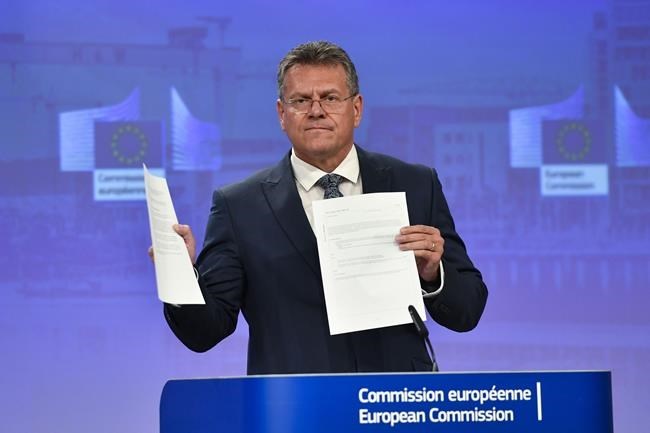
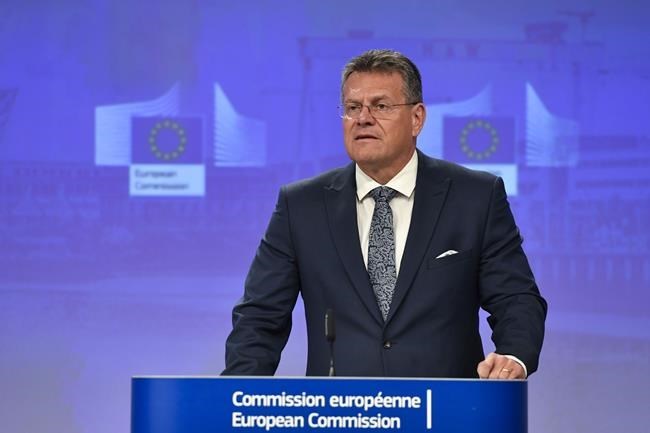
“Let’s call a spade a spade: This is illegal,” European Commission Vice President Maroš Šefčovič told a news conference in Brussels on Wednesday.
The EU’s decision to pursue legal action raises the possibility that either or both sides could impose punishing tariffs on the other. Šefčovič refused to rule out such a move Wednesday. But the prospect of trade war still seemed a distant possibility since both would suffer and have said they want to find a solution outside of the courts.
According to the latest EU figures, the 27-nation bloc is the U.K.’s biggest trading partner, while the U.K. is the EU’s third-biggest trading after the U.S. and China.
At the heart of the dispute — and the whole reason a compromise was needed in the first place — are concerns about stability in Northern Ireland, which is the only part of the U.K. that shares a border with an EU country, namely Ireland. The checks were imposed in order to keep that border open because that is a key pillar of the peace process that ended decades of violence in Northern Ireland.
But British unionists in Northern Ireland say the new checks have put a burden on businesses and frayed the bonds between the region and the rest of the U.K. The rules have also led to a political crisis in Northern Ireland, where the main unionist party blocked the formation of a new power-sharing government in Belfast, saying it won’t take part until the Brexit trade rules are scrapped.
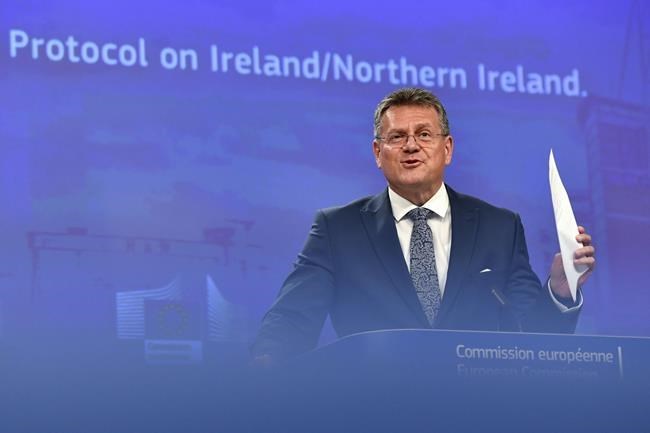
Šefčovič, the EU commission official, said he’s willing to keep talks going with the U.K. — but insisted solutions should be found within the original agreement, called the Northern Ireland Protocol.
The British government called the EU’s move “disappointing.”
“The U.K.’s preference remains for a negotiated solution but the proposals set out by the EU today are the same proposals we have been discussing for months,” it said.
It added that it had to act because the protocol was undermining Northern Ireland’s peace accord by “disrupting trade and leading to people in Northern Ireland being treated differently to the rest of the U.K.”
While there are serious disagreements between the two sides, the events of this week also reflect maneuvering as each tries to wrangle the best deal from the other.
The legislation the British government proposed will take months to wind its way through Parliament, and officials appear to be hoping they will get a new deal with the EU in the meantime.
That seems unlikely. Officials in the EU and member country governments are incensed at what they see as the U.K.’s intention to break international law. Johnson’s government insists its unilateral move is lawful, but many lawyers and lawmakers — including some in his governing Conservative Party — disagree.
The so-called infringement procedure that the EU renewed Wednesday likewise will take months to unfold. The action was originally launched against the U.K. government last year but was put on hold in as both parties tried to find a solution.
The EU says it reopened the case out of frustration with those talks. The EU Commission added that if the British government does not reply within two months, it will consider taking the U.K. to the European Court of Justice.
“There have been only new and new demands coming from the U.K. government,” Šefčovič said.

The EU also opened two other legal actions that accuse the U.K. of ignoring two other parts of the post-Brexit agreement.
The U.K. government said its proposed measures ease the burden on businesses and customers, including by reducing paperwork for goods coming from Britain into Northern Ireland and that are staying there. Goods continuing on to Ireland or elsewhere in the EU would continue to be checked at Northern Ireland ports.
Šefčovič said the EU would flesh out proposals made previously for facilitating the movement of goods from Britain to Northern Ireland while drastically reducing paperwork. But the EU worries lax border checks are letting smuggled goods enter Ireland, a threat to the bloc’s borderless single market.
___
Lawless reported from London.