

Farmers Edge putting down roots worldwide
Advertisement
Read this article for free:
or
Already have an account? Log in here »
To continue reading, please subscribe:
Digital Subscription
One year of digital access for only $1.44 a week*
- Enjoy unlimited reading on winnipegfreepress.com
- Read the E-Edition, our digital replica newspaper
- Access News Break, our award-winning app
- Play interactive puzzles
*Billed as $5.77 plus GST every four weeks. After 52 weeks, price increases to the regular rate of $19.95 plus GST every four weeks. Offer available to new and qualified returning subscribers only. Cancel any time.
To continue reading, please subscribe:
Add Free Press access to your Brandon Sun subscription for only an additional
$1 for the first 4 weeks*
- Enjoy unlimited reading on winnipegfreepress.com
- Read the E-Edition, our digital replica newspaper
- Access News Break, our award-winning app
- Play interactive puzzles
*Your next Brandon Sun subscription payment will increase by $1.00 and you will be charged $17.95 plus GST for four weeks. After four weeks, your payment will increase to $24.95 plus GST every four weeks.
Read unlimited articles for free today:
or
Already have an account? Log in here »
Hey there, time traveller!
This article was published 30/03/2016 (3716 days ago), so information in it may no longer be current.
At an investment forum in Winnipeg last fall, a handful of agri-tech venture capital investors from across North America knowingly nudged each other and agreed out loud precision-farming technologies was just too crowded and competitive to be a comfortable fit for them to invest in.
Wade Barnes, CEO of Winnipeg-based Farmers Edge, is up to the challenge of showing them how ill-advised that position will be for them.
Farmers Edge has been around since 2005 and has grown with the precision agriculture and independent data-management business to be able to refer to itself as a global leader.
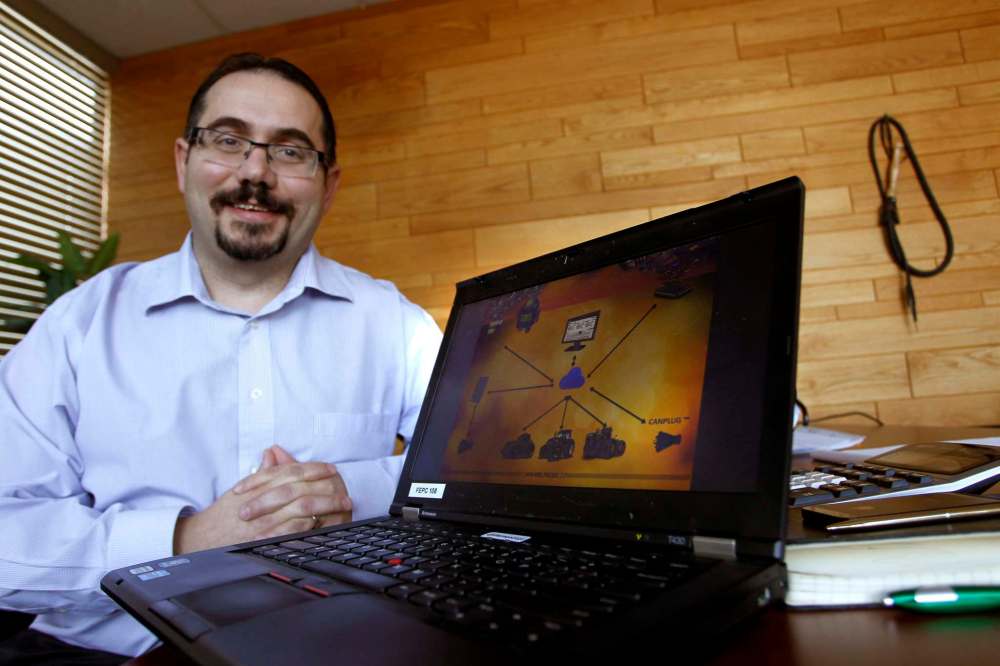
Since the fall, Farmers Edge announced another round of venture capital investment totalling $58 million, with add-on investments from its initial Silicon Valley backer, Kleiner Perkins Caufield & Byers, along with the multibillion-dollar Japanese conglomerate Mitsui & Co., Ltd. and Osmington, Inc., the private investment vehicle of David Thomson, co-owner of the Winnipeg Jets and one of the richest men in the world.
Barnes, who is a mixture of down-home Prairie farm boy — he grew up on a farm near Birtle — and visionary entrepreneur, does not even try to pass himself off as a tech-industry darling. He said, only half-jokingly, he used to need one of his board members, Anita Wortzman, to translate what the VCs were saying to him and what he was saying to them.
Barnes likes to talk about how Farmers Edge can beat the likes of Monsanto and DuPont Pioneer — which he says are really the only other competitors that matter in the precision-farming industry — because at Farmers Edge, they are not afraid to get their boots dirty.
Precision farming uses big data to develop predictive modelling down to the exact field level that will let farmers make more money by becoming much more targeted in how they plant, harvest, apply fertilizer and operate their machines.
But the thing about it is the data are really not that big yet.
The business is only a few years old. That means there’s still not enough data to make the algorithms effective enough to generate the targeted predictive models that will always get the results the farmers are looking for.
But it is getting better and better.
Barnes says, “There are a lot of promises being made about the future. But the real true value will come in a year or two, when suddenly you can start doing very accurate predictive modelling like what a crop is going to yield even before it comes off the field.”
So with that being the setup, it means the more acres you have, the better your algorithms will be in generating the most accurate models and the more successful your precision-farming company will be.
Monsanto, which pole-vaulted itself into the business in 2013 with the US$930-million acquisition of startup company Climate Corp. in 2013, talks about the potential of servicing one billion acres.
Barnes says it’s like a land rush among the competitors to sign up as many acres as possible first. Farmers Edge is on pace to hit 7.5 million to eight million acres by the end of the year, putting the company at around $25 million in annual revenue. Monsanto is way ahead.
In addition to some venture capitalists, there are plenty of other farming experts who are skeptical of precision-farming’s promises.
Barnes is not unaware of that skepticism, which is why the company is using its fresh capital to expand into the U.S., Brazil, Australia and eastern Europe to sign up acres as fast as it can, likely growing its employee count to 300 by the end of the year.
Because if Farmers Edge’s promises do come true, those farmers won’t want to switch.

Playing the role of a Prairie farm boy in the ag-tech world, which requires hundreds of millions of dollars to compete in, did not seem like a good idea at first. Even Barnes’ champions at Kleiner Perkins were keen to inject some Silicon Valley smarts into the operation.
For example, Barnes said he was being encouraged to recruit a chief technology officer from the tech heartland, but Barnes liked a smart computer science professor from the University of Lethbridge: Kevin Grant, who grew up on a farm in Saskatchewan and was already doing some business with Barnes. When Netflix tried to recruit him, the Kleiner Perkins guys backed off.
Farmers are protective of their independence, and another hurdle big data has to overcome is their reluctance to let the big input companies such as Monsanto get too much of their info.
That’s another reason the Prairie farm boy profile works for Farmers Edge.
martin.cash@freepress.mb.ca