

Fasten your seatbelts
92 years ago, aviation took flight in Winnipeg and, despite current pandemic-related headwinds, continues to soar

Advertisement
Read this article for free:
or
Already have an account? Log in here »
To continue reading, please subscribe:
Monthly Digital Subscription
$1 per week for 24 weeks*
- Enjoy unlimited reading on winnipegfreepress.com
- Read the E-Edition, our digital replica newspaper
- Access News Break, our award-winning app
- Play interactive puzzles
*Billed as $4.00 plus GST every four weeks. After 24 weeks, price increases to the regular rate of $19.95 plus GST every four weeks. Offer available to new and qualified returning subscribers only. Cancel any time.
Monthly Digital Subscription
$4.99/week*
- Enjoy unlimited reading on winnipegfreepress.com
- Read the E-Edition, our digital replica newspaper
- Access News Break, our award-winning app
- Play interactive puzzles
*Billed as $19.95 plus GST every four weeks. Cancel any time.
To continue reading, please subscribe:
Add Free Press access to your Brandon Sun subscription for only an additional
$1 for the first 4 weeks*
*Your next subscription payment will increase by $1.00 and you will be charged $16.99 plus GST for four weeks. After four weeks, your payment will increase to $23.99 plus GST every four weeks.
Read unlimited articles for free today:
or
Already have an account? Log in here »
Hey there, time traveller!
This article was published 28/05/2020 (2156 days ago), so information in it may no longer be current.
In 1928, Winnipeg’s aviation future took off, but 92 years later, its flight path has run into a bit of turbulence.
The COVID-19 pandemic’s grip on business large and small has remained tighter than an airplane seatbelt. This isn’t the first time our province’s rich aviation history has faced hardship and plight — and it certainly won’t be the last.

IN THE BEGINNING
In 1928, the simple 165-acre field was christened Stevenson Aerodrome, after noted Manitoba aviator and pioneer bush pilot Capt. Fred J. Stevenson. The current Winnipeg James Armstrong Richardson International Airport, which opened in 2006, sprawls across 1,500 hectares with two runways, 28 gates, and serves about 4.5 million passengers a year.

From baggage carousels to the security line to even the number of passenger planes flying these days, the airport’s emptiness is the embodiment of government health protocols — but it also echoes its humble beginnings.
Standing on an open prairie field on May 27, 1928, some 7,000 people gathered, believing, celebrating, and soaking up a new age of transportation. It wouldn’t take long before the airport transformed aviation history, eventually becoming the first international airport in Canada.
As the airport played a pivotal role delivering mail, passengers, and even freight, it also served as the flight training headquarters for the British Commonwealth Air Training Program as the country prepared for the Second World War.

JET AGE BEGINS
In 1958, Stevenson Field was renamed Winnipeg International Airport and thanks to the period commonly known as the “Jet Age,” air travel became popularized. As the 1980s recession crept into the 1990s, some airports were feeling the implications of an unstable economy, but the Winnipeg Airports Authority began replacing runways and investing in the cargo sector and community connections.

By 1997, WAA took over airport operations from Transport Canada and began investing more into the airport campus. The WAA said jobs supported by the airport climbed to 18,500 from 7,000 and the economic impact increased to $4.3 billion from $384 million annually.
This year, that record will be broken not by an ultimate high, but by a new low. WAA projects it will serve fewer than two million people in 2020.
WHAT’S NEXT
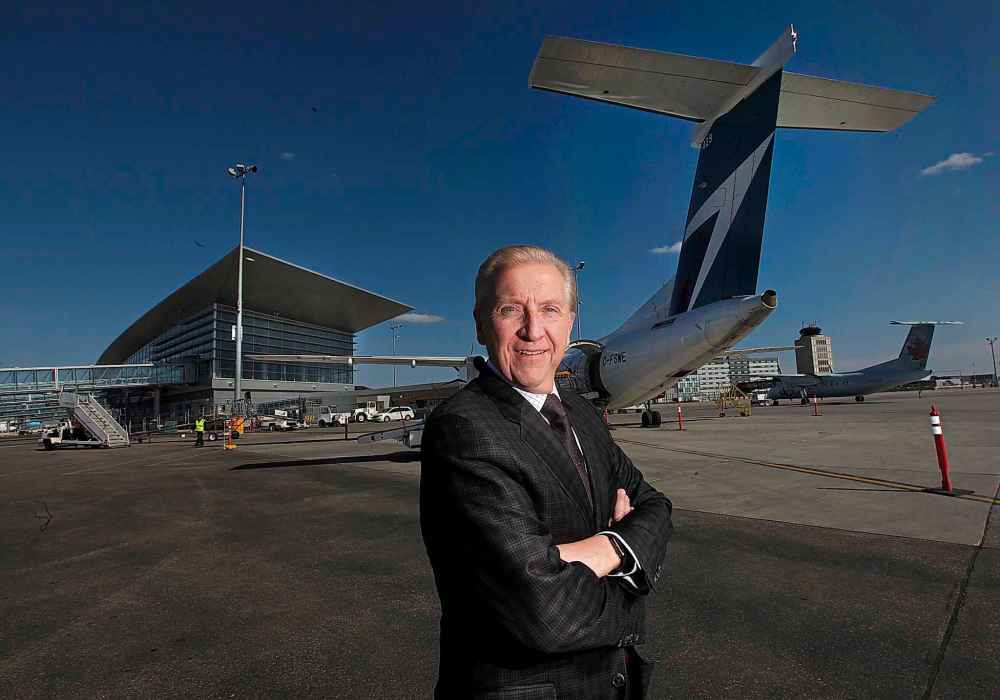
Barry Rempel became CEO of WAA in 2001, right after the 9/11 terror attacks, which ultimately transformed airport security. He says he anticipates another transformation to occur after this pandemic.
“Just after 9/11 we had a whole bunch of new security requirements that at first seemed intrusive but now everybody is used to,” said Rempel.
“I really do believe that what we will see, in the days ahead… things like temperature checks at the airport… and even now in Canada you have to be wearing a mask, some sort of facial covering if you are going through a security checkpoint or when you are boarding an aircraft.”

While Rempel remains optimistic about the airport’s future, WAA has grappled with a significant drop in passenger travel.
“On the passenger side, we’ve lost 97 per cent of our market… and since basically March 15, we’ve been well below 200 passengers departing per day. So cargos clearly are not going to make up for that kind of a volume,” said Rempel, adding he anticipates passenger travel won’t return to typical levels until 2024.
“In terms of what we are working with the air carriers on, I expect that we’ll (this summer) see a return to…probably about 25 per cent of our former capacity.”
Until then, Rempel said WAA will continue working on relationships with new and existing cargo carriers to build upon the airport’s “carrier-friendly environment.”
“What’s fascinated me about Winnipeg forever is how connected this community is to its airport… if you go back to 92 years ago today, there were 7,000 people that came out to the airport in their spring finest, to launch what was then Stevenson Field, which was basically a dirt patch. But that was a symbol to them of their connectivity to the community. From that day to today, this city more than any other that I’ve lived in or visited has a more direct connection with that access to the world than any other city.”
nadya.pankiw@freepress.mb.ca
Nadya Pankiw
Multimedia producer
Nadya Pankiw is a multimedia producer at the Free Press. Nadya holds a Bachelor of Journalism from Carleton University and a Master of Publishing from Simon Fraser University. She joined the paper in 2020. Read more about Nadya.
Nadya is part of a team that curates and publishes journalism on our websites, apps and social media. It’s part of the Free Press‘s tradition, since 1872, of producing reliable independent journalism. Read more about Free Press’s history and mandate, and learn how our newsroom operates.
Our newsroom depends on a growing audience of readers to power our journalism. If you are not a paid reader, please consider becoming a subscriber.
Our newsroom depends on its audience of readers to power our journalism. Thank you for your support.
Nadya Pankiw
Multimedia producer
Nadya Pankiw is a multimedia producer at the Free Press. Nadya holds a Bachelor of Journalism from Carleton University and a Master of Publishing from Simon Fraser University. She joined the paper in 2020. Read more about Nadya.
Nadya is part of a team that curates and publishes journalism on our websites, apps and social media. It’s part of the Free Press‘s tradition, since 1872, of producing reliable independent journalism. Read more about Free Press’s history and mandate, and learn how our newsroom operates.
Our newsroom depends on a growing audience of readers to power our journalism. If you are not a paid reader, please consider becoming a subscriber.
Our newsroom depends on its audience of readers to power our journalism. Thank you for your support.
Advertisement Advertise With Us
Advertisement Advertise With Us