

Think about taxes, even after filing
Ignoring opportunities could cost you more money
Advertisement
Read this article for free:
or
Already have an account? Log in here »
To continue reading, please subscribe:

Digital Subscription
One year of digital access for only $205*
- Enjoy unlimited reading on winnipegfreepress.com
- Read the E-Edition, our digital replica newspaper
- Access News Break, our award-winning app
- Play interactive puzzles
*First annual payment billed as $205.00 + GST for one year. This annual subscription will automatically renew at $233.00 + GST every 52 weeks (10% off the regular annual price of $259.35). Offer available to new and qualified returning subscribers only. Cancel any time.
To continue reading, please subscribe:
Add Free Press access to your Brandon Sun subscription for only an additional
$1 for the first 4 weeks*
- Enjoy unlimited reading on winnipegfreepress.com
- Read the E-Edition, our digital replica newspaper
- Access News Break, our award-winning app
- Play interactive puzzles
*Your next Brandon Sun subscription payment will increase by $1.00 and you will be charged $17.95 plus GST for four weeks. After four weeks, your payment will increase to $24.95 plus GST every four weeks.
Read unlimited articles for free today:
or
Already have an account? Log in here »
Hey there, time traveller!
This article was published 14/05/2011 (5546 days ago), so information in it may no longer be current.
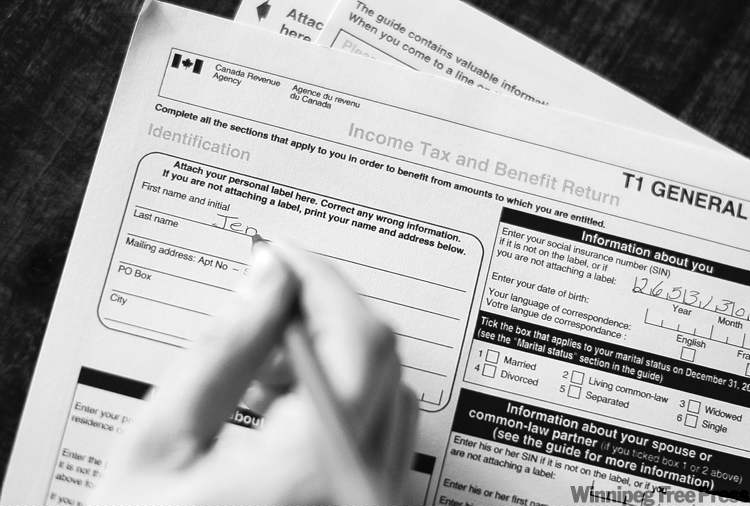
Do you simply file your tax return and then forget all about income tax for another year? If so, you will pay more tax than necessary by ignoring tax-planning opportunities that arise.
Even if you don’t read the notice of assessment that is mailed to you after your tax return has been processed by Canada Revenue Agency (CRA), give it to your financial adviser.
RRSP room
You will see an important RRSP number on your notice of assessment, which tells you how much you are allowed to deduct on your 2011 income tax return. If you received a tax refund, consider using some or all of that money to make your 2011 RRSP contribution.
Always check the second number (B) at the bottom of the page to see if you have any unused RRSP contributions not yet deducted. The difference between your 2011 deduction limit (A) and your unused RRSP contributions (B) is how much you can contribute to your RRSP.
If you belong to a group RRSP where you work, remember to take into consideration the projected total contributions that you are likely to make between March 1, 2011, and Feb. 29, 2012. In that situation, it may be prudent to delay making a top-up RRSP contribution until February 2012. That will help you avoid a possible RRSP over-contribution penalty.
TFSA room
CRA will also tell you how much unused contribution room you have available for your tax-free savings account (TFSA). We are now into the third year since TFSAs became available. A diligent saver can now have more than $15,000 generating tax-free interest, dividends and capital gains within a TFSA.
Don’t be surprised if the amount shown is much larger than what you would expect. CRA’s calculations on your 2010 Notice of Assessment are “based on available information” which does not include TFSA deposits you made after 2010.
What if you accidentally over-contribute to your TFSA? The penalty is one per cent times the excess contribution amount for each month that you are offside.
Adjustment request
What if you learn about a tax credit or a deduction that you should have claimed, but you have already filed your income tax return and received your refund? It is usually not too late to send a letter or a T1-adjustment request to claim the tax credit that you missed.
For example, suppose you have been helping to support your elderly Uncle Dan who has a very low income. You obtain form T2201 to enable Dan to apply for the disability tax credit. Suppose Dan receives a letter from CRA advising that he qualifies for the tax credit effective 2007. Assuming Dan cannot save any tax using this credit, you can write to CRA asking to transfer Dan’s disability tax credit to your tax return retroactively for the years 2007 through 2010. Ideally you will receive a refund for those prior years, with some interest.
Capital losses
In the text portion of your Notice of Assessment you may find a reminder about capital losses reported in other years. You need to look for opportunities to claim them against capital gains. If you reported capital gains for 2010, check line 253 of your tax return to see if you had applied any prior-years’ capital losses against 2010 capital gains.
Multi-year data

If you want to review all the historical capital gains and losses that you have reported in the past 10 years, consider ordering a multi-year data printout from CRA. Your accountant may discover years with capital losses that could have been applied against capital gains in other years. Adjusting tax returns for those prior years may result in more tax refunds.
Terry McBride, a member of Advocis, works with Raymond James Ltd.
— Postmedia News