

Plenty of help, yet seemingly not nearly enough
Governments have rolled out more economic support programs to fight second wave, but challenges navigating them may leave some out in the cold
Advertisement
Read this article for free:
or
Already have an account? Log in here »
To continue reading, please subscribe:
Monthly Digital Subscription
$1 per week for 24 weeks*
- Enjoy unlimited reading on winnipegfreepress.com
- Read the E-Edition, our digital replica newspaper
- Access News Break, our award-winning app
- Play interactive puzzles
*Billed as $4.00 plus GST every four weeks. After 24 weeks, price increases to the regular rate of $19.95 plus GST every four weeks. Offer available to new and qualified returning subscribers only. Cancel any time.
Monthly Digital Subscription
$4.99/week*
- Enjoy unlimited reading on winnipegfreepress.com
- Read the E-Edition, our digital replica newspaper
- Access News Break, our award-winning app
- Play interactive puzzles
*Billed as $19.95 plus GST every four weeks. Cancel any time.
To continue reading, please subscribe:
Add Free Press access to your Brandon Sun subscription for only an additional
$1 for the first 4 weeks*
*Your next subscription payment will increase by $1.00 and you will be charged $16.99 plus GST for four weeks. After four weeks, your payment will increase to $23.99 plus GST every four weeks.
Read unlimited articles for free today:
or
Already have an account? Log in here »
Hey there, time traveller!
This article was published 28/11/2020 (1953 days ago), so information in it may no longer be current.
Crystal LeMasurier is among those who can consider themselves fortunate amid the widespread hardship of 2020.
On government COVID-19 supports since April, the 30-year-old apprenticing chef only recently returned to what she and dozens of other restaurant workers consider a dream job.
Her employer, Diversity Food Services — which operates on-campus food outlets at the University of Winnipeg — had employed 120-plus workers prior to the pandemic, paying a living wage and benefits. It also provides important work experience to those often facing challenges getting it otherwise: Indigenous peoples, individuals with disabilities, newcomers and those who have spent time in the justice system.
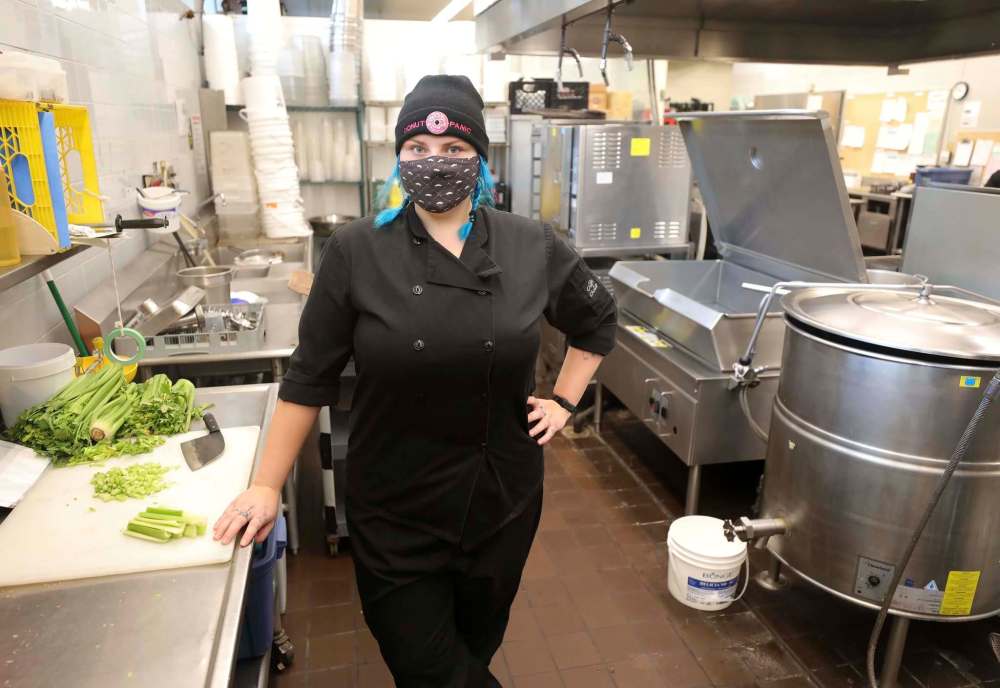
LeMasurier, 30 and single, had hoped to become a fully-fledged chef this year, but certification tests have been postponed.
“I’ve started working again a few hours a week, but it’s not sustainable,” adding she is also receiving employment insurance.
She has been laid off for six months after Diversity Foods cut operations by about 80 per cent, closing its catering business and the Buffalo Stone Café at FortWhyte Alive.
Still, LeMasurier has not seen a drop in income thanks to government supports.
Those include most notably CERB — the Canadian Emergency Response Benefit — which has since October been split into three new programs in addition to EI .
It’s likely that tens of thousands of workers and employers are again familiarizing themselves with a growing assortment of government support programs as Manitoba grapples with the pandemic’s second wave.
And navigating them can be a challenge unto itself.
What’s more, the economic supports are far from perfect; they are veritable works in progress relying on feedback from business, workers and financial institutions.
“Very clearly, what we hear from business owners is they want programs that are easy to navigate, and that are quick and simple to use,” says vice-president Heidi Nakka with RBC in Winnipeg who leads a team of business advisers for Manitoba, Saskatchewan, Nunavut and parts of Ontario.
Determining what programs are the right fit has been a challenge for many as programs are often tweaked to fit those who did not qualify under the original criteria, she says.
Of course, recently laid-off workers are also in a similar predicament, figuring out which of the four government supports replacing CERB is right one for them.
These programs, by the way, are:
● the Canada Recovery Benefit (CRB) — for workers who don’t qualify for EI;
● the Canada Recovery Sickness Benefit (CRSB) — for those sick with COVID-19 or must quarantine due to possible exposure;
● the Canada Recovery Caregiving Benefit (CRCB) for workers taking time off to take care of someone with COVID-19, or at high risk of adverse outcomes, or children due to school closures;
● and last, there’s EI.
The program length varies, but payments remain similar to the CERB, about $2,000 of taxable income per month.
For Manitoba small-business owners, affected by the most recent round of restrictions, navigating support programs is often more challenging.
“Not every business owner has time to follow everything in the news,” Nakka says.
Consequently some may be missing out, and that’s why her adviser team has been contacting clients.
“They are prioritizing those most impacted,” she says. “For example, hair salons had been relatively stable, but are now shut down again, so they go to the top of the list.”
In the last two weeks, many have applied for the new Manitoba Bridge Grant, a $5,000 payment for businesses negatively affected financially by the second wave shutdown.
The program will cost $100 million with an additional $100 million set aside for another $5,000 grant if the lockdown continues into 2021, according to a statement to the Free Press from Manitoba’s department of finance.
The program adds to other provincial initiatives including the Gap Protection Program, a $6,000 loan made available in the spring. The loan was intended to be forgivable under certain conditions, but the province recently announced it will be forgiven for all recipients.
As well, its Back to Work Manitoba wage subsidy has been extended to Dec. 31. It subsidizes up to 50 per cent of wages for rehired workers and new hires. The program also now features advanced payment up to $1,500 per eligible worker.
Diversity Foods has already applied for the Bridge grant. Its CEO Ian Vickers says the money is a “shot in the arm.”
But for a lot of small businesses, it’s unlikely to cover more than a month’s rent, he adds.
“Many business owners have ongoing expenses for credit card machines and other ongoing contracts that cost a lot more than that.”
Operating at reduced capacity, Diversity has leaned on the Canadian Emergency Wage Subsidy — CEWS — paying 75 per cent of employees’ wages. That’s allowed it to find innovative ways to bring workers back, including a partnership with Agape Table providing the charity with food “as need skyrockets.”
Ottawa also expanded the Canada Emergency Rent Subsidy to provide benefits directly to businesses for rent in addition to property owners.
Vickers adds he would like to see government do more — like assisting businesses with personal protective equipment costs. As well, an economic incentive for consumers and businesses would strengthen the recently launched #ShopLocalMB campaign.
Despite challenges, he says Diversity Foods is better positioned than most because its ownership consists of a university-owned corporation and SEED Winnipeg. Neither need to draw an income from the small business.
But other enterprises may face difficulty dealing with creditors.
For the last six months financial institutions provided debt payment deferrals. But those are now provided on a more case-by-case basis, Nakka says about RBC’s approach.
Many businesses have also accessed the Canada Emergency Business Account (CEBA), a $40,000 loan of which $10,000 is forgivable. That loan sum increases to $60,000 in December, Nakka adds.
As well the number of businesses qualifying is growing.
“At first the government focused on being what’s called ‘quick to the market’ with programs, and we provided feedback,” she says.
“So for example, very small businesses with owners using personal accounts couldn’t quality at first.”
Business owners wondering what programs they can access should contact their financial institution for help, she adds.
Workers should do the same, given navigating supports can be difficult.
“It can feel like the system is inaccessible,” says LeMasurier, who has dyslexia.

That’s especially true for individuals for whom English is not their mother tongue.
She explains how a co-worker, a newcomer in his late 70s, missed out on months of CERB while struggling to pay bills because he had no internet access in addition to a language barrier.
LeMasurier — who spent a “significant part of my life homeless” — sees a more straightforward alternative to the CERB and subsequent programs costing more than $80 billion so far.
“Universal basic income would fix every hole in the system,” she says.
“From my standpoint, $100 is more useful to the economy in a poor person’s pocket than in a rich person’s bank account.”
Related Articles
Groups warn of CERB clawbacks on vulnerable youth
Advertisement Advertise With Us
Advertisement Advertise With Us