Food prices soar to record levels on Ukraine war disruptions

Advertisement

Advertise with us

ROME (AP) — Prices for food commodities like grains and vegetable oils reached their highest levels ever last month largely because of Russia's war in Ukraine and the “massive supply disruptions” it is causing, threatening millions of people in Africa, the Middle East and elsewhere with hunger and malnourishment, the United Nations said Friday.

Read this article for free:


or

Already have an account? Log in here »

To continue reading, please subscribe:

Subscribe and receive a limited-edition Free Press branded hat or tote.

Digital Subscription

One year of digital access for only $205*

  • Enjoy unlimited reading on winnipegfreepress.com
  • Read the E-Edition, our digital replica newspaper
  • Access News Break, our award-winning app
  • Play interactive puzzles

*First annual payment billed as $205.00 + GST for one year. This annual subscription will automatically renew at $233.00 + GST every 52 weeks (10% off the regular annual price of $259.35). Offer available to new and qualified returning subscribers only. Cancel any time.

To continue reading, please subscribe:

Add Free Press access to your Brandon Sun subscription for only an additional

$1 for the first 4 weeks*

  • Enjoy unlimited reading on winnipegfreepress.com
  • Read the E-Edition, our digital replica newspaper
  • Access News Break, our award-winning app
  • Play interactive puzzles
Start now

*Your next Brandon Sun subscription payment will increase by $1.00 and you will be charged $17.95 plus GST for four weeks. After four weeks, your payment will increase to $24.95 plus GST every four weeks.

Hey there, time traveller!
This article was published 08/04/2022 (1605 days ago), so information in it may no longer be current.

ROME (AP) — Prices for food commodities like grains and vegetable oils reached their highest levels ever last month largely because of Russia’s war in Ukraine and the “massive supply disruptions” it is causing, threatening millions of people in Africa, the Middle East and elsewhere with hunger and malnourishment, the United Nations said Friday.

The U.N. Food and Agriculture Organization said its Food Price Index, which tracks monthly changes in international prices for a basket of commodities, averaged 159.3 points last month, up 12.6% from February. As it is, the February index was the highest level since its inception in 1990.

FAO said the war in Ukraine was largely responsible for the 17.1% rise in the price of grains, including wheat and others like oats, barley and corn. Together, Russia and Ukraine account for around 30% and 20% of global wheat and corn exports, respectively.
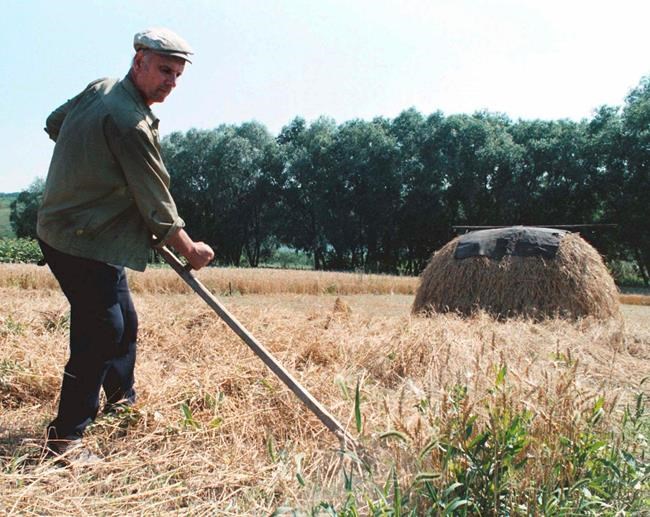
FILE--A private Ukrainian farmer Dmytro Hnatkevitch harvests wheat crop on his farm in the village of Grygorovka, 110 km south of Kiev, in August, 1996. Prices for food commodities like grains and vegetable oils reached their highest levels ever last month because of Russia's war in Ukraine and the “massive supply disruptions” it is causing, the United Nations said Friday, April 8, 2022. (AP Photo/Efrem Lukatsky)

While predictable given February’s steep rise, “this is really remarkable,” said Josef Schmidhuber, deputy director of FAO’s markets and trade division. “Clearly, these very high prices for food require urgent action.”

The biggest price increases were for vegetable oils: that price index rose 23.2%, driven by higher quotations for sunflower seed oil that is used for cooking. Ukraine is the world’s leading exporter of sunflower oil, and Russia is No. 2.

“There is, of course, a massive supply disruption, and that massive supply disruption from the Black Sea region has fueled prices for vegetable oil,” Schmidhuber told reporters in Geneva.

He said he couldn’t calculate how much the war was to blame for the record food prices, noting that poor weather conditions in the United States and China also were blamed for crop concerns. But he said “logistical factors” were playing a big role.

“Essentially, there are no exports through the Black Sea, and exports through the Baltics is practically also coming to an end,” he said.

Soaring food prices and disruption to supplies coming from Russia and Ukraine have threatened food shortages in countries in the Middle East, Africa and parts of Asia where many people already were not getting enough to eat.

Those nations rely on affordable supplies of wheat and other grains from the Black Sea region to feed millions of people who subsist on subsidized bread and bargain noodles, and they now face the possibility of further political instability.

Other large grain producers like the United States, Canada, France, Australia and Argentina are being closely watched to see if they can quickly ramp up production to fill in the gaps, but farmers face issues like climbing fuel and fertilizer costs exacerbated by the war, drought and supply chain disruptions.

In the Sahel region of Central and West Africa, the disruptions from the war have added to an already precarious food situation caused by COVID-19, conflicts, poor weather and other structural problems, said Sib Ollo, senior researcher for the World Food Program for West and Central Africa in Dakar, Senegal.

“There is a sharp deterioration of the food and nutrition security in the region,” he told reporters, saying 6 million children are malnourished and nearly 16 million people in urban areas are at risk of food insecurity.

Farmers, he said, were particularly worried that they would not be able to access fertilizers produced in the Black Sea region. Russia is a leading global exporter.

“The cost of fertilizers has increased by almost 30% in many places of this region due to the supply disruption that we see provoked by a crisis in Ukraine,” he said.

The World Food Program has appealed for $777 million to meet the needs of 22 million people in the Sahel region and Nigeria over six months, he said.

To address the needs of food-importing countries, the FAO was developing a proposal for a mechanism to alleviate the import costs for the poorest countries, Schmidhuber said. The proposal calls for eligible countries to commit to added investments in their own agricultural productivity to obtain import credits to help soften the blow.

Report Error Submit a Tip

More Stories

As camp fees increase, Sunshine Fund delivers another summer of adventures

Ken Wiebe 4 minute read Preview

As camp fees increase, Sunshine Fund delivers another summer of adventures

Ken Wiebe 4 minute read Yesterday at 2:01 AM CDT

Dana Moroz is on the other end of the line and the manager of the Sunshine Fund can hardly contain her enthusiasm.

With the summer winding down and school on the verge of being back in session, Moroz was asked about the 46th season of the program that sent children in need to 31 accredited camps across the province and northwestern Ontario.

Although the final numbers are still being calculated, it was a banner year for the program, which benefited from the Free Press Sunshine Fund campaign that ran throughout the past several months.

“We had over 700 kids that we supported to go to summer camp,” said Moroz, noting the cost of doing so eclipsed $300,000.

Read
Yesterday at 2:01 AM CDT

Impact of Winnipeg hoops giant Laping went well beyond coaching

Joshua Frey-Sam 7 minute read Preview

Impact of Winnipeg hoops giant Laping went well beyond coaching

Joshua Frey-Sam 7 minute read Friday, Aug. 28, 2026

In life, few connected with others like Jeff Laping.

A legendary high school basketball coach and influential educator for more than 30 years, he was a figurative giant in Winnipeg’s hoops community with an innate ability to resonate with anyone he met.

Laping was a best friend to many, a confidant to others, and a mentor to even more.

He died on Monday, one week after suffering from cardiac arrest.

Read
Friday, Aug. 28, 2026

Summer Reading Challenge concludes with more musings from young readers

8 minute read Preview

Summer Reading Challenge concludes with more musings from young readers

8 minute read Yesterday at 6:00 AM CDT

Another Free Press Summer Reading Challenge for Kids is in the books, but before we turn the page completely, there are a few more reviews written by our young readers to share.

Participating readers were tasked to write down their thoughts about any of the books on the Summer Reading Challenge’s three reading lists; with a range of formats (novels, graphic novels, books with pictures), themes and reading levels to choose from, budding reviewers of all ages were eager to share their opinion.

Those registered for the challenge received reading resources and activities throughout the summer, from word searches or puzzles based on the content of the books to a set of discussion questions and, in one instance, a special video from an author.

There were also more creative activities meant to engage readers’ critical thinking skills, all of which were free to access for anyone who signed up for the challenge.

Read
Yesterday at 6:00 AM CDT

Former care home nurse fined $8,000 for ‘disturbing in the extreme’ 2025 incident

Morgan Modjeski 3 minute read Preview

Former care home nurse fined $8,000 for ‘disturbing in the extreme’ 2025 incident

Morgan Modjeski 3 minute read Thursday, Aug. 27, 2026

A former nurse has been fined $8,000 and is facing numerous restrictions after making a mistake “no registered nurse should have made” by inserting 10 centimetres of gauze into a patient’s anus instead of dressing a nearby wound.

Read
Thursday, Aug. 27, 2026

New businesses start to creep up in former Winnipeg Slurpee shops

Tiago Resko 5 minute read Preview

New businesses start to creep up in former Winnipeg Slurpee shops

Tiago Resko 5 minute read Thursday, Aug. 27, 2026

The remnants of 7-Eleven can still be seen as new businesses move into spaces where Slurpee machines and taquitos once ruled.

As fresh paint dries on several new ventures — such as a pizza place and a convenience store with a name that might make a customer do a double-take — holes across Winnipeg once occupied by the international convenience chain are slowly being filled.

Business at a Domino’s Pizza in Elmwood, formerly a 7-Eleven, has been booming since it opened June 1, the store manager said.

“The issues that 7-Eleven would have had might be different than what we would have. They were dealing with a lot of theft where people can just walk in and out, but Domino’s isn’t set up that way,” said Paul Hemmerling.

Read
Thursday, Aug. 27, 2026

Beware invasive, ‘frightening’ waterhemp

Laura Rance-Unger 4 minute read Preview

Beware invasive, ‘frightening’ waterhemp

Laura Rance-Unger 4 minute read Yesterday at 2:01 AM CDT

There’s a threat lurking on the edge of Manitoba farmers’ fields this fall that’s even scarier than the escalating trade war with their biggest customer.

Provincial extension advisers are warning farmers to watch for a weed known as “tall waterhemp,” which, true to its name, may already be towering above ready-to-harvest crops.

Those wispy tentacles waving in the breeze look pretty innocuous from a distance. But this highly invasive member of the pigweed family produces hundreds of thousands of seeds that are just itching for dispersal through farmers’ combines and across their fields.

Each of those tiny seeds — one small pill container filled halfway holds 44,000 — can produce plants with stems the width of saplings and heights of two to five metres. One or two plants can quickly turn into a patch. If waterhemp takes over a field, it can choke out the growing crop and cut yields by more than 90 per cent.

Read
Yesterday at 2:01 AM CDT