

Gen Z flexing its power for more flexible workplace
New survey also finds young workers feeling more powerful than employers

Advertisement
Read this article for free:
or
Already have an account? Log in here »
To continue reading, please subscribe:

Digital Subscription
One year of digital access for only $205*
- Enjoy unlimited reading on winnipegfreepress.com
- Read the E-Edition, our digital replica newspaper
- Access News Break, our award-winning app
- Play interactive puzzles
*First annual payment billed as $205.00 + GST for one year. This annual subscription will automatically renew at $233.00 + GST every 52 weeks (10% off the regular annual price of $259.35). Offer available to new and qualified returning subscribers only. Cancel any time.
To continue reading, please subscribe:
Add Free Press access to your Brandon Sun subscription for only an additional
$1 for the first 4 weeks*
- Enjoy unlimited reading on winnipegfreepress.com
- Read the E-Edition, our digital replica newspaper
- Access News Break, our award-winning app
- Play interactive puzzles
*Your next Brandon Sun subscription payment will increase by $1.00 and you will be charged $17.95 plus GST for four weeks. After four weeks, your payment will increase to $24.95 plus GST every four weeks.
Read unlimited articles for free today:
or
Already have an account? Log in here »
Hey there, time traveller!
This article was published 30/12/2021 (1723 days ago), so information in it may no longer be current.
When Sam Stevenson pictures the future of work, she envisions a flexible workspace and hours.
The 24-year-old is among the majority of generation Z and millennial Canadians, according to a new survey by polling firm Leger.
“I really value my family time, and I really value being able to support my partner if he needs help,” Stevenson said.

“Instead of having to work my life around my job, (I’d like to) work my job within my life.”
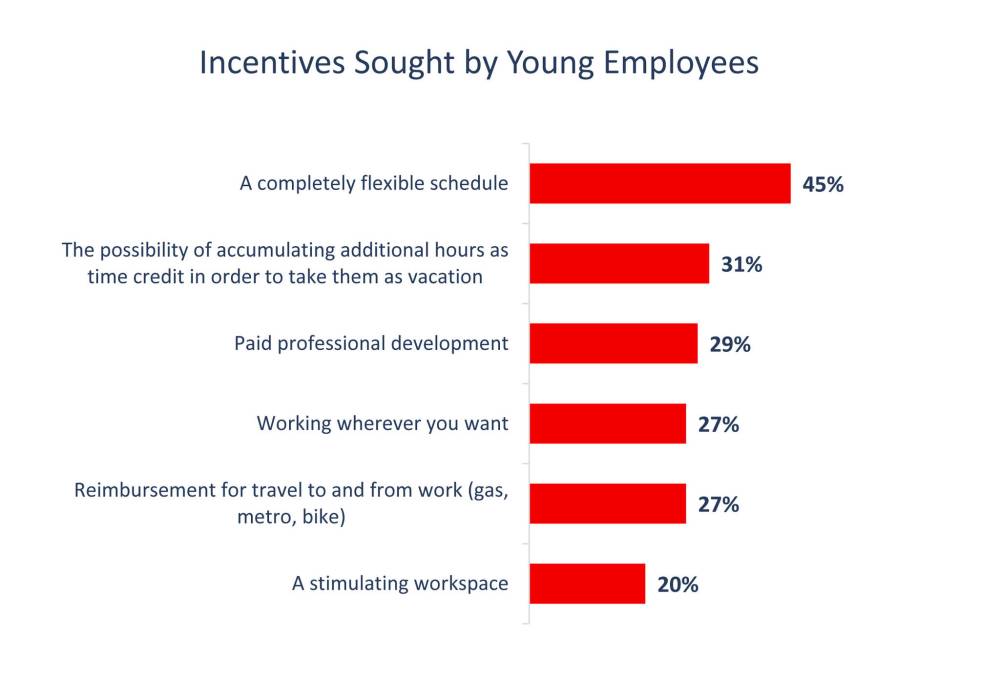
The poll, which surveyed 3,015 Canadians between the ages of 15 and 39, found 57 per cent of respondents sought a flexible schedule in their career.
Stevenson graduated from Red River College Polytechnic’s Creative Communications program in 2020. Since then, she’s worked at two different companies — one remotely, one in office. It’s led her to believe a balance is best.
“A lot of people in this age group are saying that the 40-hour, five-day work week is becoming outdated,” she said. “It may be something that has to change.”
There were a range of responses about what flexibility could look like, according to Allison Watson, a senior research director with Leger. Some might work during the day with breaks in between and finish in the evening.
“There were even some that were like, ‘Let’s take away the eight-hour day completely. Say I have my 37.5 hours I need to work in a week, and I’ll make those hours up wherever I’m going to make them up,’” Watson said.
Being clear on how much flexibility a company can provide may be necessary when recruiting future hires, as some industries don’t lend themselves to such schedules, Watson said.
Leger’s survey — conducted from Oct. 19 through Nov. 10 — found 25 per cent of young workers said they want to leave their job within a year. It’s higher than previous years due to widespread labour shortages, according to the published results.

Sixty-six per cent of respondents said they thought they’d find a new employer easily; 64 per cent answered they thought their employer is more dependent on them than they are on the employer.
“Canadian youth workers are really seeing and kind of grabbing onto that shift of power,” Watson said. “They really feel that they’re in the position now that they’re of more value to an employer than an employer is to them.”
Julie Guard, a professor of history and labour studies at the University of Manitoba, interpreted the results differently.
“I don’t think that young people have really got much opportunity to negotiate with their employers,” she said. “If they could negotiate better with their employers, they wouldn’t be leaving their jobs.”
Uprooting and job hunting is inconvenient and goes against the ideal of starting with a company young and climbing the organization’s hierarchical ladder, Guard said.
“(If) they’re not going to get loyalty from their employer, they don’t want to give loyalty back,” she said, adding she thinks young workers see employment “almost entirely in transactional terms.”
During the pandemic, grocery store clerks and restaurant staff have been deemed front-line workers despite largely being paid minimum wage. Some must work several jobs to pay bills, Guard said.
“While our employers bemoan the fact that young people seem to have too much sense of entitlement, I think we should actually have more sense of entitlement,” she said, adding living wage, job security and flexibility are necessary for people.

Stevenson switched her communications job because she wanted a challenge and a pivot from fully remote work.
A good wage is also important, she said.
“If I can’t afford to keep a roof over my head and feed the people and the pets in my household, and put clothes on my back, then why am I working?” she said.
A good salary was the most sought-after benefit from respondents — with 75 per cent saying it’s enticing — followed by job security and benefits at 64 per cent.
Job satisfaction has been decreasing since the 1970s, according to Guard. It wasn’t on respondents’ radar in the survey, she noted — only 10 per cent gave import to seeking a company whose values align with their own.
However, workers want to make positive change, according to Leger’s Watson.
“They want to know they’re making a difference within whatever job they’re in,” Watson said, adding it’s beneficial for businesses to inform employees of how they’re helping support causes through their work.
Thirty-six per cent of respondents said they sought a healthy and supportive work environment.

“They want to be challenged, they want to grow, they want to know that there’s an opportunity for them to advance in an organization,” Watson said.
Fifty-seven per cent of Leger’s respondents said their employer pays them what they’re worth. Fifty-eight per cent said they’d consider pursuing a career with their current employer, and 75 per cent said they liked their jobs.
Fifty-five per cent of respondents said they don’t believe their personal finances will improve next year.
The survey results don’t have a margin of error because it was an online study, according to Watson.
gabrielle.piche@winnipegfreepress.com
Gabrielle Piché reports on business for the Free Press. She interned at the Free Press and worked for its sister outlet, Canstar Community News, before entering the business beat in 2021. Read more about Gabrielle.
Every piece of reporting Gabrielle produces is reviewed by an editing team before it is posted online or published in print — part of the Free Press‘s tradition, since 1872, of producing reliable independent journalism. Read more about Free Press’s history and mandate, and learn how our newsroom operates.
Our newsroom depends on a growing audience of readers to power our journalism. If you are not a paid reader, please consider becoming a subscriber.
Our newsroom depends on its audience of readers to power our journalism. Thank you for your support.
Consumerism statistics from Leger’s survey
According to Leger’s 2021 Youth Study, in-store shopping is here to stay. Sixty-five per cent of gen Z and millennial respondents said they’d purchased a product or service in a brick-and-mortar storefront within the past week. Forty-nine per cent said they’d bought online in the same time period.
Reviews from other buyers topped the list of places to look when buying something important, with 41 per cent saying they use the comments. Family came second, with 26 per cent, and friends came third with 16 per cent. Five per cent of respondents said they factor influencers’ posts into their decisions.
Price was the main consideration when buying for 56 per cent of respondents.
Nationally, 66 per cent of respondents said they don’t believe the general economic situation will improve in 2022.
Gabrielle Piché reports on business for the Free Press. She interned at the Free Press and worked for its sister outlet, Canstar Community News, before entering the business beat in 2021. Read more about Gabrielle.
Every piece of reporting Gabrielle produces is reviewed by an editing team before it is posted online or published in print — part of the Free Press‘s tradition, since 1872, of producing reliable independent journalism. Read more about Free Press’s history and mandate, and learn how our newsroom operates.
Our newsroom depends on a growing audience of readers to power our journalism. If you are not a paid reader, please consider becoming a subscriber.
Our newsroom depends on its audience of readers to power our journalism. Thank you for your support.
Advertisement Advertise With Us
Advertisement Advertise With Us