

Last call?
Building sold, leaving Royal Canadian Legion Branch #141 searching for a new home

Advertisement
Read this article for free:
or
Already have an account? Log in here »
To continue reading, please subscribe:

Digital Subscription
One year of digital access for only $205*
- Enjoy unlimited reading on winnipegfreepress.com
- Read the E-Edition, our digital replica newspaper
- Access News Break, our award-winning app
- Play interactive puzzles
*First annual payment billed as $205.00 + GST for one year. This annual subscription will automatically renew at $233.00 + GST every 52 weeks (10% off the regular annual price of $259.35). Offer available to new and qualified returning subscribers only. Cancel any time.
To continue reading, please subscribe:
Add Free Press access to your Brandon Sun subscription for only an additional
$1 for the first 4 weeks*
- Enjoy unlimited reading on winnipegfreepress.com
- Read the E-Edition, our digital replica newspaper
- Access News Break, our award-winning app
- Play interactive puzzles
*Your next Brandon Sun subscription payment will increase by $1.00 and you will be charged $17.95 plus GST for four weeks. After four weeks, your payment will increase to $24.95 plus GST every four weeks.
Read unlimited articles for free today:
or
Already have an account? Log in here »
Hey there, time traveller!
This article was published 28/03/2022 (1633 days ago), so information in it may no longer be current.
The Royal Canadian Legion Branch building on Selkirk Avenue has been sold, with members citing dwindling membership and rising maintenance costs as reasons for the change in ownership.
For over 70 years, the Ukrainian Canadian Veterans Branch was a social hub on Selkirk Avenue, with thousands of members, veterans and acquaintances visiting the facility annually for events or just to enjoy the company of others. When Pope John Paul II visited the city in the 1980s, he made a stop at the legion to say hello.
“It truly was a second home for us,” said JoAnne Barkley, the branch’s acting president, a few days after the hall hosted an open house for community members to say goodbye.
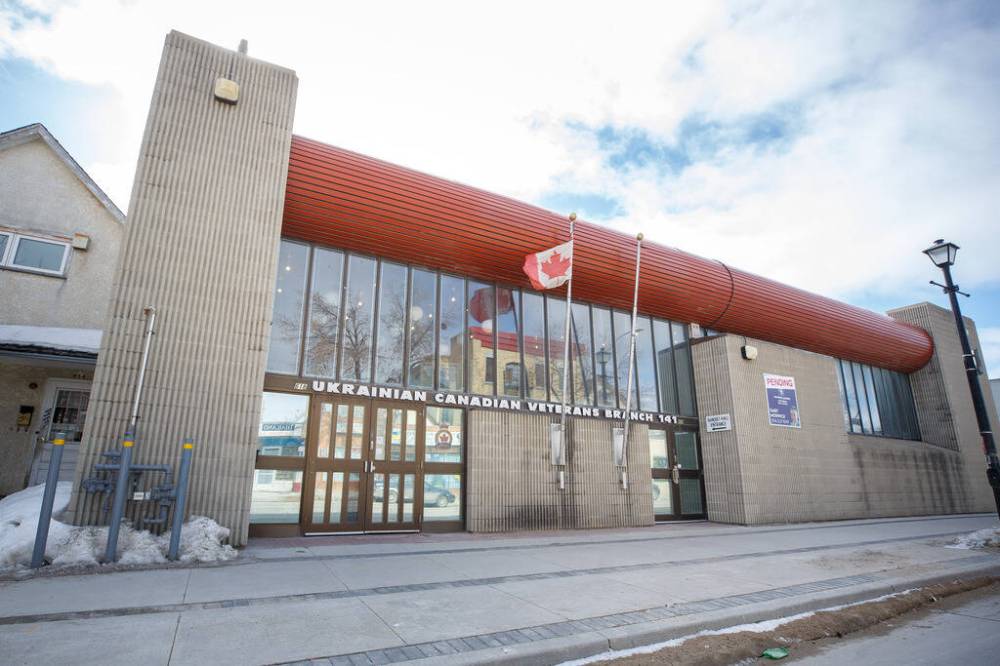
But the membership, which once numbered in the hundreds, has fallen, while upkeep became expensive, forcing the legion’s leadership to consider and accept a sale of the building amid what has been a difficult stretch for legions Canada-wide.
Barkley said the buyer of the 50-year-old building intends to keep the building standing, though is unsure what it will be used for once the change of possession occurs on Apr. 15. There were a number of rumours of what the building might become next, but members felt it too soon to speculate publicly. Barkley said the legion plans to retain its charter and look for a smaller venue for future events, and has already received offers from nearby branches to use their facilities in the meantime.
Throughout the pandemic and across the country, legions have had to contend with the prospect of closure, with some choosing to shut down. It was not unexpected: with restrictions in place for long periods of time, attendance was down, while memberships were also already on the decline. “We had to shut down for two years,” Barkley said.
And while pandemic restrictions are easing up, the two-year wallop is still being felt by branches nationwide: last week, CBC reported that the legion in Fort Smith, N.W.T., was relying on a nest-egg to stay afloat, with hopes patrons would return to help stave off a closure.
“If we don’t have people in, we’ll die off just like any other small business,” the president of the Fort Smith executive committee said. “We’ll probably survive, maybe six months to a year if we’re lucky.”
Royal Canadian Legion spokesperson Nujma Bond said that across the country, there are 1,350 branches, many of which are considered the hubs of their communities. “Our members and volunteers work hard to keep their locations alive and well, but sometimes external forces make it challenging,” Bond said. “Since the beginning of the pandemic, over 20 branches have closed across the country. More recently, we’ve become aware of a few others that are struggling and we hope they pull through.”
“As pandemic rules have started to change, close to 90 per cent of our branches report they are open again with varying hours, and we know they are looking forward to fully ramping up operations,” Bond added. New members are always welcome to help support veterans, veterans’ families, and communities across the country, she added.
While legions contribute positively to their communities through charity and goodwill — #141 sponsored everything from baseball teams, to air cadets, to medical supply drives — they also occupy a significant chunk of real estate in Canadian cities, including in Winnipeg. And like restaurants, salons, gyms, or other businesses which have been hit hard by the COVID-19 pandemic, the closure or sale of Legion branches represents the possibility of major turnover in the neighbourhoods in which they operate. The past decade has seen the closure and sale of at least two North End branches: the General Monash #115, on Main Street and the General Sam Steele #117, on Salter Street.
In many cases, including that of #141, legion branches have operated out of the same location for generations; before the current building was in use, #141 operated out of a smaller building adjacent. The movement or closure of legions, though untimely and unfortunate, will undoubtedly create a change in those neighbourhoods’ fabrics, for better or worse.
Last year, the Fort Garry branch, which had operated out of its Pembina Highway headquarters since 1949, signed a lease for a former Pizza Hut location further down the road. With the branch demolished, work is underway for an 82-unit apartment block on the old Legion’s former site.
A legion’s closure doesn’t always mean demolition, as the buildings can be reused for other purposes. The large building on Selkirk Avenue, though no longer an operational branch, has the potential to remain a space that contributes positively to the community, Barkley said.

Meanwhile, with the charter retained, the branch will look elsewhere for its future operations, hoping to find a smaller location, also located in the city’s North End. The West Kildonan branch has offered up a hall to rent for events and storage while #141 figures out next steps. “Legions stick together in times like this,” Barkley said.
Barkley said it would be difficult for people who’d grown attached to the building to no longer have it be home to the Legion: Christmas parties, countless wedding socials and dances made it a place filled with memories. But ultimately, the building was too large and too costly to be maintained, and selling was the wisest option.
“There’s a lot we’re going to miss,” she said. “It breaks your heart … As my dad (#141’s former sergeant-at-arms John Wachniak) would say, ‘Eveything comes to an end whether we want it to or not.’ Unfortunately this is one of those moments.”
“But Branch #141 is going to continue,” she said. It will just do so elsewhere.
ben.waldman@winnipegfreepress.com
Ben Waldman is a National Newspaper Award-nominated reporter on the Arts & Life desk at the Free Press. Born and raised in Winnipeg, Ben completed three internships with the Free Press while earning his degree at Ryerson University’s (now Toronto Metropolitan University’s) School of Journalism before joining the newsroom full-time in 2019. Read more about Ben.
Every piece of reporting Ben produces is reviewed by an editing team before it is posted online or published in print — part of the Free Press‘s tradition, since 1872, of producing reliable independent journalism. Read more about Free Press’s history and mandate, and learn how our newsroom operates.
Our newsroom depends on a growing audience of readers to power our journalism. If you are not a paid reader, please consider becoming a subscriber.
Our newsroom depends on its audience of readers to power our journalism. Thank you for your support.
Ben Waldman is a National Newspaper Award-nominated reporter on the Arts & Life desk at the Free Press. Born and raised in Winnipeg, Ben completed three internships with the Free Press while earning his degree at Ryerson University’s (now Toronto Metropolitan University’s) School of Journalism before joining the newsroom full-time in 2019. Read more about Ben.
Every piece of reporting Ben produces is reviewed by an editing team before it is posted online or published in print — part of the Free Press‘s tradition, since 1872, of producing reliable independent journalism. Read more about Free Press’s history and mandate, and learn how our newsroom operates.
Our newsroom depends on a growing audience of readers to power our journalism. If you are not a paid reader, please consider becoming a subscriber.
Our newsroom depends on its audience of readers to power our journalism. Thank you for your support.
Advertisement Advertise With Us
Advertisement Advertise With Us