

Meeting tomorrow’s challenges today
Local tech company gets $1-million grant for prototype to manage 5G network signals
Advertisement
Read this article for free:
or
Already have an account? Log in here »
To continue reading, please subscribe:
Digital Subscription
One year of digital access for only $1.44 a week*
- Enjoy unlimited reading on winnipegfreepress.com
- Read the E-Edition, our digital replica newspaper
- Access News Break, our award-winning app
- Play interactive puzzles
*Billed as $5.77 plus GST every four weeks. After 52 weeks, price increases to the regular rate of $19.95 plus GST every four weeks. Offer available to new and qualified returning subscribers only. Cancel any time.
To continue reading, please subscribe:
Add Free Press access to your Brandon Sun subscription for only an additional
$1 for the first 4 weeks*
- Enjoy unlimited reading on winnipegfreepress.com
- Read the E-Edition, our digital replica newspaper
- Access News Break, our award-winning app
- Play interactive puzzles
*Your next Brandon Sun subscription payment will increase by $1.00 and you will be charged $17.95 plus GST for four weeks. After four weeks, your payment will increase to $24.95 plus GST every four weeks.
Read unlimited articles for free today:
or
Already have an account? Log in here »
Hey there, time traveller!
This article was published 10/07/2019 (2660 days ago), so information in it may no longer be current.
A Winnipeg company is the first in the country to be awarded $1 million in a federal government program to develop innovative solutions to public-sector challenges.
Last year, CEMWorks was successful in the first phase of the competitive process, receiving $150,000 from the federal government’s Innovative Solutions Canada program to develop a proof of concept for technology to find a novel solution to a challenge related to connected vehicles and engineered surfaces.
With the $1-million award, it now has two years to develop a working prototype.
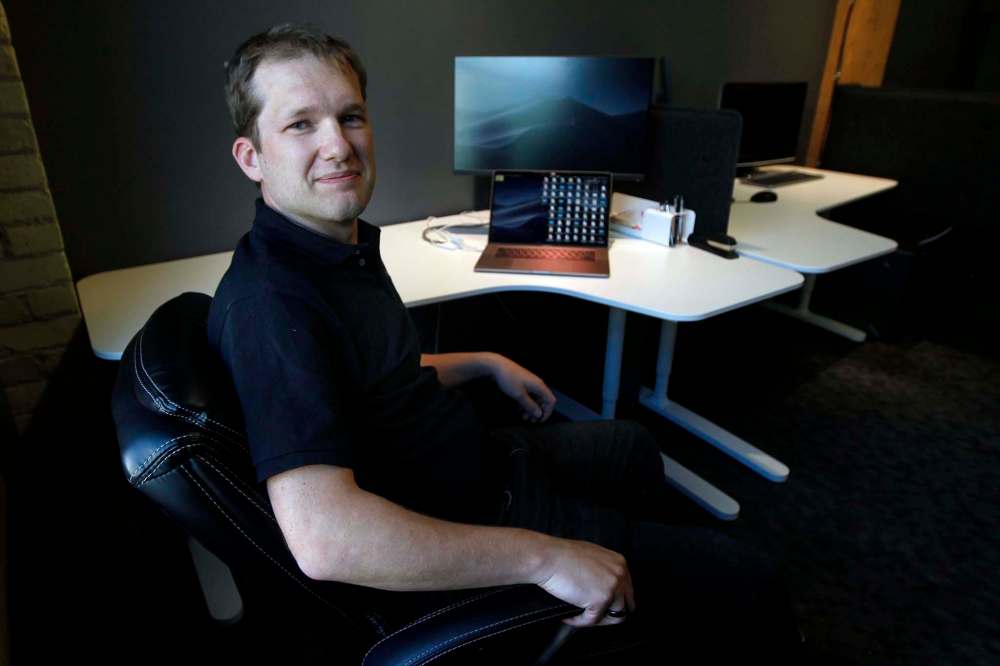
Jonatan Aronsson, founder and president of the company, said it has been keeping a low profile through the competitive process.
So far, the company employs seven people, including at least two who have moved to Winnipeg to work on the project.
Aronsson’s company was formed to do next-generation virtual electromagnetic prototyping, but after successfully winning the first part of the award, the firm started to focus on building a 3D model that incorporates frequency selected engineered surfaces (FSES) technology into connected vehicle design.
The idea is that with an increasingly connected world, this would be a tool to manage interference emanating from vehicles into other vehicles and into the overall urban environment.
“All cities around the world will need a tool like this when the true 5G networks come online to properly plan the cities for 5G,” he said. “Frequency selective surfaces can be used to direct where the signals go.”
This technology will help manage radio interference coming from other vehicles and the surrounding area, including buildings, making connected cars safer and more reliable for Canadians.
CEMWorks is the first recipient of the $1-million award, out of all the submissions received across the country. The submissions each addressed one of the 44 specific challenges posted by the program, including: a cost-effective and innovative method of stabilizing coal-mine tailings; advanced decision support for first-responder command and control; innovations that will improve robot interactions with either humans or changing environments; and a technological solution to prevent unauthorized use of wireless communication devices to prevent inmates from conducting illegal activities using such devices.
The fact that CEMWorks was the first past the post is testimony to the work it has done and also possibly to the critical importance of the technology.
“Demand for this particular application for 5G does not exist yet,” Aronsson said. “But it definitely will exist in the near future. They want to have Canadian expertise in this area rather than have to have it developed in China or the U.S.”
Marshall Ring, CEO of Manitoba Technology Accelerator (MTA), where CEMWorks is based, said it is the kind of technology that will help drive the applications the 5G network will make possible.
“Railcars need a railroad to run on. Autonomous driving vehicles need a railroad to run on and that will be the 5G network,” he said.
“That’s why this has such critical importance to national security. It is the infrastructure that the Internet of Things will run on. Now that 5G is being deployed, you’re going to start seeing applications that can take advantage of a thicker, more robust data pipe.”
Aronsson said it’s too early for the company to start interacting with other potential commercial partners.
But while the research capital will be crucial for the firm to continue to develop the technology, the fact that the federal government will effectively be the first customer will probably be a big boost in allowing the company to scale up after the prototype has been completed.

“The primary go-to-market strategy was to win the Innovative Solutions Canada program,” Ring said. “Now the company has a marquee customer who will fund the development and big-brother alliance that will validate the product offering in the marketplace, and once we have that as a customer, it will give them the ability to roll it out for scale.”
CEMWorks was in competition with a company from Waterloo, a technology hotbed, for the $1-million research grant.
“Each of them were supposed to do best efforts with the original $150,000 and the one with most progress got the $1 million,” Ring said. “That process shows that a tech startup in Winnipeg can compete against those positioned anywhere in Canada, and favourably so.”
martin.cash@freepress.mb.ca