

Monsanto tackles ‘evil’ reputation
Advertisement
Read this article for free:
or
Already have an account? Log in here »
To continue reading, please subscribe:

Digital Subscription
One year of digital access for only $205*
- Enjoy unlimited reading on winnipegfreepress.com
- Read the E-Edition, our digital replica newspaper
- Access News Break, our award-winning app
- Play interactive puzzles
*First annual payment billed as $205.00 + GST for one year. This annual subscription will automatically renew at $233.00 + GST every 52 weeks (10% off the regular annual price of $259.35). Offer available to new and qualified returning subscribers only. Cancel any time.
To continue reading, please subscribe:
Add Free Press access to your Brandon Sun subscription for only an additional
$1 for the first 4 weeks*
- Enjoy unlimited reading on winnipegfreepress.com
- Read the E-Edition, our digital replica newspaper
- Access News Break, our award-winning app
- Play interactive puzzles
*Your next Brandon Sun subscription payment will increase by $1.00 and you will be charged $17.95 plus GST for four weeks. After four weeks, your payment will increase to $24.95 plus GST every four weeks.
Read unlimited articles for free today:
or
Already have an account? Log in here »
Hey there, time traveller!
This article was published 14/04/2016 (3816 days ago), so information in it may no longer be current.
For several days now, access has been denied to the website of the Global Crop Symposium that was taking place this week in Winnipeg.
If you tried to open the site, the only thing you would see was a pop-up message reading in part, “The web page is on the list of websites with potentially dangerous content.”
This is a conference organized by the Canada Grains Council that included technical and policy presentations by the likes of the Flax Council of Canada, Pulse Canada and some of the largest agri-food companies in North America.
As one conference organizer said of the contents of the website, “It couldn’t be more benign.”
One rumour was the site had been hacked or disrupted by mischief-makers looking to poke Monsanto in the eye.
After all, Monsanto is the most obvious and easiest target for anyone dissatisfied with the industrialization of food production and the introduction of genetically modified organisms (GMOs) into mainstream crop production.
Monsanto is the leader of the “frankenfood” sector. It is probably the corporate entity that most often gets the adjective “evil” attached to it.
It’s also a corporate entity with US$15 billion in revenue last year and US$2.3 billion in profits, which was down from the year before.
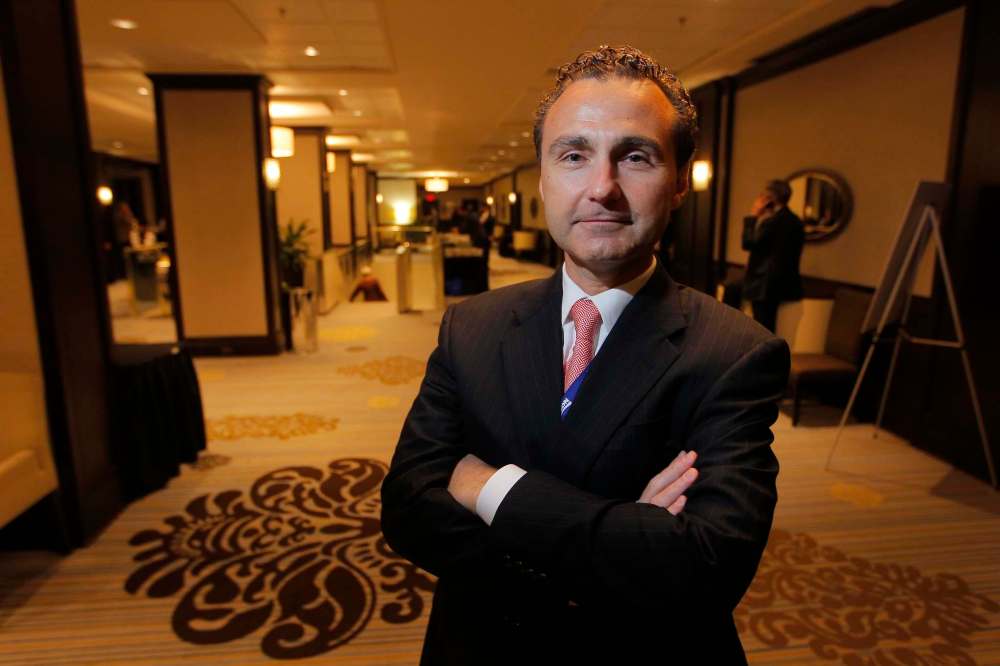
Jésus Madrazo, a Monsanto executive based at its St. Louis headquarters, was at the conference. His title with the company is global corporate engagement lead. For the past 2 1/2 years, his job has been to show the world Monsanto is not evil and to help effect a shift in corporate culture at the company.
“Two and a half years ago we realized we needed to do things differently at Monsanto,” Madrazo said in an interview. “We spend a lot of time talking to the same people at the same tables, and we realized we missed recognizing a growing interest from consumers at large about food and how the food is produced and how it gets to the table.”
Madrazo peppers his conversation with references to technology and innovation as the driving force behind the work the company does. He regularly makes the point demographers predict the world’s population will increase by 2.5 billion people by 2050, and Monsanto is working to create the means by which to feed that growing cohort by then.
He didn’t make reference to it, but a couple of years ago a former Google executive, David Friedberg, who founded a precision farming business Monsanto bought for $1 billion, penned a love letter of sorts to the company as a response to the emotional backlash he received from his family, friends and associates for selling to Monsanto.
“Calling a company evil is easy. And if you do it enough times it can become the ‘reality’ — because reality is just the most common perception,” he wrote. “Perhaps Monsanto should have adopted the mantra… introduced at Google in 2000 — ‘don’t be evil.’ Just saying that was their mantra has helped Google countless times avoid the evil designation that so many people have tried to hurl their way over the years. It has worked… Google sues more of its customers each year than Monsanto does? Google spends three times as much as Monsanto on federal lobbying?”
That’s not necessarily a proof against evilness, but it does underline an interesting dynamic.
Among other things, Madrazo told the conference the company is committed to becoming carbon-neutral by 2021, and this year, Winnipeg-based Monsanto Canada was named one of the country’s best diversity employers.

Madrazo said the company is acknowledging its “evil” reputation and getting out there and facing it head-on. It is not about to forsake its profit motive, but considering the manner in which its products are used — to produce food — it has the material available to create a pretty strong narrative.
Of course it will be seen by some as self-serving when he references the company’s foray into precision farming and the kind of role it will eventually play in the reduction of greenhouse-gas emissions. (Madrazo said by achieving carbon-neutral corn production in the U.S. Midwest alone, it is estimated it will save about 230 million barrels of oil per year, equivalent to about two weeks’ consumption of oil in the U.S.)
This year marks the 20th anniversary of the introduction of Monsanto’s first GMO, a herbicide-resistant soybean seed.
The debate about the relative safety of GMOs will likely carry on for many years to come. But time is likely on Monsanto’s side, because the more time that passes without conclusive evidence it is harmful, the less evil Monsanto will become.
martin.cash@freepress.mb.ca
History
Updated on Thursday, April 14, 2016 10:51 AM CDT: Fixed typo.