NASA looks at Louisiana delta system, eyes global forecasts

Advertisement

Advertise with us

MIKE ISLAND, La. (AP) — Erosion, sinking land and sea rise from climate change have killed the Louisiana woods where a 41-year-old Native American chief played as a child. Not far away in the Mississippi River delta system, middle-school students can stand on islands that emerged the year they were born.

Read this article for free:

or

Already have an account? Log in here »

To continue reading, please subscribe:

Subscribe and receive a limited-edition Free Press branded hat or tote.

Digital Subscription

One year of digital access for only $205*

  • Enjoy unlimited reading on winnipegfreepress.com
  • Read the E-Edition, our digital replica newspaper
  • Access News Break, our award-winning app
  • Play interactive puzzles

*First annual payment billed as $205.00 + GST for one year. This annual subscription will automatically renew at $233.00 + GST every 52 weeks (10% off the regular annual price of $259.35). Offer available to new and qualified returning subscribers only. Cancel any time.

To continue reading, please subscribe:

Add Free Press access to your Brandon Sun subscription for only an additional

$1 for the first 4 weeks*

  • Enjoy unlimited reading on winnipegfreepress.com
  • Read the E-Edition, our digital replica newspaper
  • Access News Break, our award-winning app
  • Play interactive puzzles
Start now

*Your next Brandon Sun subscription payment will increase by $1.00 and you will be charged $17.95 plus GST for four weeks. After four weeks, your payment will increase to $24.95 plus GST every four weeks.

Hey there, time traveller!
This article was published 29/06/2021 (1841 days ago), so information in it may no longer be current.

MIKE ISLAND, La. (AP) — Erosion, sinking land and sea rise from climate change have killed the Louisiana woods where a 41-year-old Native American chief played as a child. Not far away in the Mississippi River delta system, middle-school students can stand on islands that emerged the year they were born.

NASA is using high-tech airborne systems along with boats and mud-slogging work on islands for a $15 million, five-year study of these adjacent areas of Louisiana. One is hitched to a river and growing; the other is disconnected and dying.

Scientists from NASA and a half-dozen universities from Boston to California aim to create computer models that can be used with satellite data to let countries around the world learn which parts of their dwindling deltas can be shored up and which are past hope.
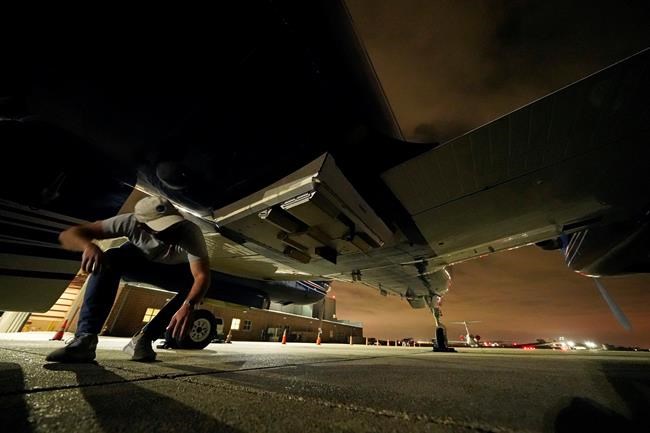
Jack Bush, electrical engineer and radar operator for the NASA Jet Propulsion Laboratory, checks the antennas of a K-band phenomenology airborne radar (Air SWOT), underneath a King Air twin engine airplane, before one of many flights over the Atchafalaya River delta to measure surface water velocity, at New Orleans Lakefront Airport, in New Orleans on Wednesday, April 7, 2021. (AP Photo/Gerald Herbert)

“If you have to choose between saving an area and losing another instead of losing everything, you want to know where to put your resources to work to save the livelihood of all the people who live there,” said lead scientist Marc Simard of NASA’s Jet Propulsion Laboratory.

While oceans rise because of climate change, the world’s river deltas — home to seafood nurseries and more than 300 million people — are sinking and shrinking.

To figure out where to shore up dying deltas, NASA is studying water flowing in and out of Louisiana’s Atchafalaya and Terrebonne basins, sediment carried by it, and plants that can slow the flow, trap sediment and pull carbon from the air.

Louisiana holds 40% of the nation’s wetlands, but they’re disappearing fast — about 2,000 square miles (5,180 square kilometers) of the state have been lost since the 1930s. That’s about 80% of the nation’s wetland losses, according to the U.S. Geological Survey.

Using two kinds of radar and a spectrometer that measures more colors than the human eye can distinguish, high-altitude NASA airplanes have been collecting information such as water height, slope, sediment, and the types and density of plants. Some measurements are as precise as a couple of centimeters (less than an inch).

On boats and islands, scientists and students from across the country take samples and measure everything from currents to diameters of trees. Their findings will be used to calibrate the airborne instruments.

“I’ve been working here 15 years, and one of the toughest parts about working in a delta is you can only touch one little piece of it at any one time and understand one little piece of it at one time,” said Robert Twilley, a professor of oceanography and coastal sciences at Louisiana State University. “Now we have the capability of working with NASA to understand the entire delta.”

The Mississippi River drains 41% of the continental United States, collecting 150 million tons (130 million metric tons) of sediment per year. But, largely because of flood-prevention levees, most sediment shoots into the Gulf of Mexico rather than settling in wetlands.
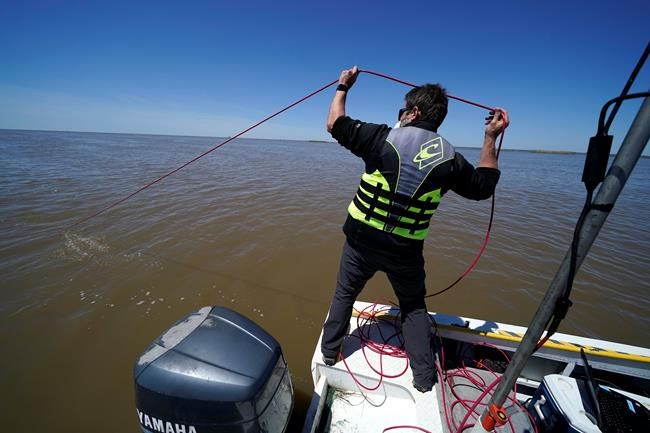
Cedric Fichot, Boston University assistant professor Department of Earth and Environment drops a compact optical profiling system, measuring light and particle density, into the Wax Lake Delta in the Atchafalaya Basin, in St. Mary Parish, La., Friday, April 2, 2021. NASA is using high-tech airborne systems along with boats and mud-slogging work on islands for a $15 million study of these two parts of Louisiana's river delta system. (AP Photo/Gerald Herbert)

“Deltas are the babies of the geological timescale. They are very young and fragile, in a delicate balance of sinking and growing,” NASA states on the Delta-X project website.

In geological time, young means thousands of years. On that scale, Louisiana’s Wax Lake Delta is taking its first breaths. It dates to 1942, when the Army Corps of Engineers dug an outlet from the lake to reduce flood threats to Morgan City, about 20 miles (32 kilometers) away. Sediment from the Atchafalaya River filled the lake, then began creating islands in the Gulf.

The new islands are thick with black willows and, in spring, thigh-high butterweed topped with small yellow flowers.

Older wetlands in areas surveyed by Delta-X aircraft are more diverse, their soil rich with humus from generations of plants. Along nearby Hog Bayou, blue buntings and scarlet tanagers dart through magnolia branches and skinks skitter up trees. In swamps, ospreys nest atop bald cypresses and alligators float in the water below.

In addition to working at LSU, Twilley has spent about nine years as executive director of Louisiana Sea Grant College Program, which uses the Wax Lake Delta as a classroom for middle- and high-school students.

“We take kids and make them stand on land that was formed the year they were born.” Twilley said.

In contrast, the adjacent Terrebonne Basin is shrinking so rapidly that the government is paying to move the Isle de Jean Charles band of Biloxi-Chitimacha-Choctaw Indians from a vanishing island to higher ground.

That band isn’t the only Native American group losing ground.
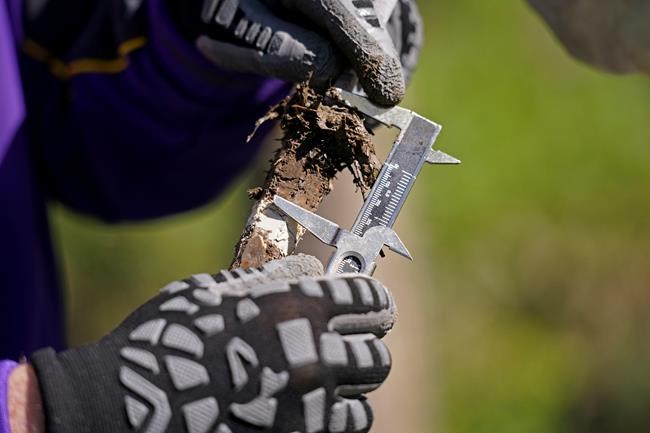
Robert Twilley, an LSU scientist and co-lead investigator of the Delta X research project, examines a quick-frozen sample of earth to learn how much sediment has been added to the ground at Mike Island part of the Wax Lake Delta in the Atchafalaya Basin, in St. Mary Parish, La., Friday, April 2, 2021. NASA is using high-tech airborne systems along with boats and mud-slogging work on islands for a $15 million study of these two parts of Louisiana's river delta system. (AP Photo/Gerald Herbert)

“The wooded areas we used to run through as children — they’re dead,” said Chief Shirell Parfait-Dardar of the Grand Caillou/Dulac Band of Biloxi-Chitimacha Indians, based less than 50 miles (80 kilometers) from the Wax Lake Delta.

“Ghost forests” are common in degrading deltas where salt water intrudes as land sinks and erodes, LSU’s Twilley said.

Louisiana is considering two projects that would divert Atchafalaya River sediment to build land in the Terrebonne Basin, but a decision is more than a year away, according to the state Coastal Restoration and Preservation Authority.

Delta-X’s study gets downright granular. A California Institute of Technology team that studies how sediment moves and is deposited on Earth and other planets will analyze the amounts of sediment in high- and low-tide water samples, breaking the particles down into about 100 sizes.

One way LSU researchers measure how much land has been formed by sediment involves sprinkling white feldspar dust on the ground.

They return to see how deeply it’s buried by new sediment. They do that by injecting liquid nitrogen into hollow tubes to freeze the dirt and muck around them. When the tubes are pulled up, the frozen “popsicles” show a white ring. They measure from there to the top.

In the Terrebonne Basin, such sedimentation can’t keep up with subsidence and sea level rise. “Thus the wetlands basically drown,” Twilley said.

Planes and boats went out in March and April and will go out again in fall for a second set of measurements. And two international satellites are scheduled for launch next year, each carrying one of the two kinds of radar used over Louisiana.
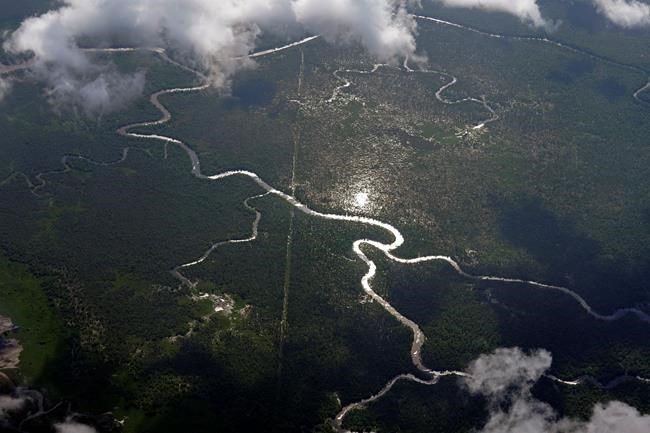
Hog Bayou, part of the Wax Lake Delta in the Atchafalaya Basin, is seen from a plane in St. Mary Parish, La., Tuesday, May 25, 2021. In geological time, young means thousands of years. On that scale, Louisiana's Wax Lake Delta is taking its first breaths. (AP Photo/Gerald Herbert)

To gauge how plants affect water movement, long-wavelengths of L-band radar can measure water level changes in open and vegetated channels, NASA’s Simard said. And high-frequency Ka-band radar can measure surface height of open water, showing how it slopes — and where it’s moving.

“All of the tools they’re bringing to bear is really impressive,” said Indiana University sedimentary geologist Douglas Edmonds, who is not part of the project but has worked with many of the researchers.

“The project itself is putting a finger on a really essential question for a lot of deltas around the world — how this deltaic land is formed and what processes take it away,” he said.

___

Follow Janet McConnaughey on Twitter: @JanetMcCinNO
Report Error Submit a Tip

More Stories

Letters, July 14

7 minute read Preview

Letters, July 14

7 minute read 2:01 AM CDT

I commend James Wilt on his column on Manitoba Hydro’s options for increased electrical generation. For years Manitoba Hydro has put too many eggs in one basket by relying almost entirely on water power for electricity.

Read
2:01 AM CDT

Today’s horoscope

Georgia Nicols 4 minute read Preview

Today’s horoscope

Georgia Nicols 4 minute read 2:01 AM CDT

MOON ALERT: Caution! Avoid shopping (except food and gas) and important decisions from 4:15 a.m. until 6 p.m. today. After that, the new moon in Cancer moves into Leo.

ARIES (March 21-April 19)

Be aware of the limitations of the moon alert. Nevertheless, this can be a warm and happy day, especially with family members. This is the only new moon all year that offers you a chance to think how to improve your home and relations with family.

TAURUS (April 20-May 20)

Read
2:01 AM CDT

Artist Bistyek enjoys the freedom of living a creative life in full colour

Ben Waldman 7 minute read Preview

Artist Bistyek enjoys the freedom of living a creative life in full colour

Ben Waldman 7 minute read Updated: 1:25 PM CDT

In pants nearly as wide at the ankle as a downtown sidewalk, Bistyek cuts a striking silhouette on his daily marches through the Exchange District, an area the painter has made his muse since arriving in Winnipeg nine years ago.

He likes it here, loves it even, but as he’s established himself as one of the city’s most vibrant visual artists — with a street-honed style that pays homage to both Japanese anime series Dragon Ball Z and graffiti-inspired American painter Jean-Michel Basquiat — Bistyek won’t forget where he came from: he can’t.

Though the 30-year-old has built an enviable life here, he’s eminently aware that his circumstances are defined as much by sheer luck as they are by determination or talent. When he was growing up in Afrin, a village in Syria, his family was torn apart by civil war and discrimination against the Kurdish minority under the rule of dictator Bashar al Assad.

“I was living in Lebanon as a refugee for seven years, with a big group of friends, but day after day they started to cross the sea from Turkey or Greece. Some of them made it, some of them did not,” says the artist born Ormeya Zagros. “I turned to Mom and said, ‘I want to go across the sea. I cannot stay here. I don’t see a future here. I don’t see opportunities. There is so much discrimination and racism. I cannot build a life.’”

Read
Updated: 1:25 PM CDT

Man armed with ‘edged weapon’ dies after dispute in Linden Woods home

Scott Billeck 6 minute read Preview

Man armed with ‘edged weapon’ dies after dispute in Linden Woods home

Scott Billeck 6 minute read Updated: 4:21 PM CDT

The family of a 42-year-old Winnipeg man shot and killed by police in Linden Woods on Monday night says the incident raises troubling questions about how officers respond to people in mental-health crisis.

“Their reaction to mental health is my concern,” said the man’s sister-in-law, Erica Smith, who spoke outside her brother-in-law’s Avon Gate home on Tuesday. She said her brother-in-law struggled with his mental health.

“It didn’t have to end like this,” she said, fighting back tears. “It could have ended differently.”

Police said officers encountered the man armed with an “edged weapon” at the home when they arrived shortly before 10:30 p.m.

Read
Updated: 4:21 PM CDT

Would-be mayors respond to extreme heat

Marsha McLeod 3 minute read Preview

Would-be mayors respond to extreme heat

Marsha McLeod 3 minute read Yesterday at 7:00 AM CDT

With Winnipeg in the midst of an intense heat wave, the city has yet to introduce maximum heat legislation for rental housing.

In 2023, the Free Press and the Narwhal reported on calls by tenants and environmental advocates to enact a law that would require indoor temperatures in rental units not exceed 26 C. It would be similar to how Winnipeg landlords, under the city’s neighbourhood livability bylaw, must maintain a minimum daytime temperature of 21 C during cold weather.

On Sunday, the Free Press emailed all nine registered mayoral candidates asking for their policy plans to tackle the dangers of extreme heat, and specifically, whether they would support a change to the city’s bylaw to create heat protections for renters.

Eight candidates responded, and of them, six — Noah Redden, Don Woodstock, Mazher Alam, Christopher Clacio, Michael Vogiatzakis and Umar Hayat — said they would support (or support exploring) a bylaw amendment to establish a maximum indoor temperature threshold.

Read
Yesterday at 7:00 AM CDT

Winnipeg Fringe Festival: 2026 show reviews

Winnipeg Free Press 1 minute read Preview

Winnipeg Fringe Festival: 2026 show reviews

Winnipeg Free Press 1 minute read 1:40 PM CDT

Not sure what to see at this year's Winnipeg Fringe Theatre Festival? All of the Free Press’s reviews will be published here.  Find a show and click to read its review.

Read
1:40 PM CDT