

No layoffs planned for Winnipeg’s Boeing plant
Advertisement
Read this article for free:
or
Already have an account? Log in here »
To continue reading, please subscribe:
Monthly Digital Subscription
$1 per week for 24 weeks*
- Enjoy unlimited reading on winnipegfreepress.com
- Read the E-Edition, our digital replica newspaper
- Access News Break, our award-winning app
- Play interactive puzzles
*Billed as $4.00 plus GST every four weeks. After 24 weeks, price increases to the regular rate of $19.95 plus GST every four weeks. Offer available to new and qualified returning subscribers only. Cancel any time.
Monthly Digital Subscription
$4.99/week*
- Enjoy unlimited reading on winnipegfreepress.com
- Read the E-Edition, our digital replica newspaper
- Access News Break, our award-winning app
- Play interactive puzzles
*Billed as $19.95 plus GST every four weeks. Cancel any time.
To continue reading, please subscribe:
Add Free Press access to your Brandon Sun subscription for only an additional
$1 for the first 4 weeks*
*Your next subscription payment will increase by $1.00 and you will be charged $16.99 plus GST for four weeks. After four weeks, your payment will increase to $23.99 plus GST every four weeks.
Read unlimited articles for free today:
or
Already have an account? Log in here »
Hey there, time traveller!
This article was published 19/12/2019 (2283 days ago), so information in it may no longer be current.
Boeing’s composites part plant in Winnipeg, its largest Canadian production plant by far, is expected to operate under the same marching orders as the rest of Boeing’s corporatelyowned supply chain after the aircraft manufacturer said it would suspend production of the troubled 737 Max airliner.
That is — no layoffs as a result of the suspension of production of the 737 Max beginning January 2020.
In 2013, the Winnipeg plant underwent its largest expansion since the mid-’80s when it built a 150,000-square-foot addition specifically designed to build parts for the 737 Max, including a one-piece composite acoustic inner barrel on the engine inlet. The company had said it was the first time Boeing has built this particular part in-house as opposed to outsourcing production.
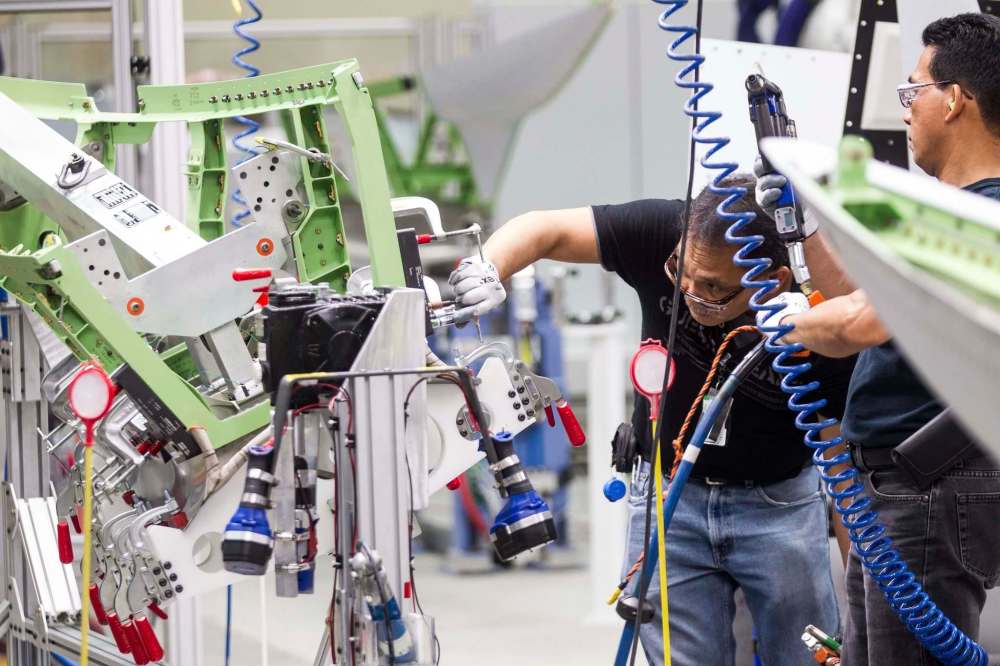
Earlier this week, the company released a statement saying, “during this time (suspension of production of the model), it is our plan that affected employees will continue 737-related work, or be temporarily assigned to other teams in Puget Sound.”
Peter Pedraza, a company spokesman out of its Chicago headquarters, said that applies to its Winnipeg plant as well.
In addition to the work it does on the 737 Max, the Winnipeg plant also makes dozens of other parts for just about every other commercial jetliner model that Boeing produces.
“We will work with our suppliers to minimize operational disruption. Our objective continues to be ensuring supply chain health and production system stability, including preparedness for seamless transition in the future,” Pedraza said.
Boeing’s workforce in Winnipeg is between 1,500 and 1,600 people, by far its largest Canadian operation.
An official from Unifor, the union that represents the bulk of Boeing’s Winnipeg workforce, said it had no information that was contrary to what the company said.
Ken Stuart, Unifor’s aerospace director, said the union is still working through all the issues about how it might affect operations.
“All I know is they (Boeing) have indicated they don’t plan to do any layoffs,” he said “How long that holds, who knows.”

Wendell Wiebe, the CEO of Manitoba Aerospace Inc., the provincial industry association, said given the information the company has provided, they are not concerned about layoffs at this point.
Wiebe said that there are no other Manitoba companies that make or ship parts to Boeing’s production facilities in Seattle, so it is not anticipated that there will be any third-party disruption in the Manitoba marketplace as a result of the suspension of production of the new 737 model.
Since the aircraft has been grounded by regulators after crashes in Indonesia and Ethiopia, Boeing continued to build new airplanes. There are now approximately 400 completed planes sitting on Boeing tarmacs in Seattle unable to be flown to customers.
Boeing’s official statement this week said, “We have previously stated that we would continually evaluate our production plans should the Max grounding continue longer than we expected. As a result of this ongoing evaluation, we have decided to prioritize the delivery of stored aircraft and temporarily suspend production on the 737 program beginning next month (January 2020).”
martin.cash@freepress.mb.ca