Nobel in chemistry honors ‘greener’ way to build molecules

Advertisement

Advertise with us

STOCKHOLM (AP) — Two scientists won the Nobel Prize in chemistry Wednesday for finding an ingenious and environmentally cleaner way to build molecules — an approach now used to make a variety of compounds, including medicines and pesticides.

Read this article for free:


or

Already have an account? Log in here »

To continue reading, please subscribe:

Subscribe and receive a limited-edition Free Press branded hat or tote.

Digital Subscription

One year of digital access for only $205*

  • Enjoy unlimited reading on winnipegfreepress.com
  • Read the E-Edition, our digital replica newspaper
  • Access News Break, our award-winning app
  • Play interactive puzzles

*First annual payment billed as $205.00 + GST for one year. This annual subscription will automatically renew at $233.00 + GST every 52 weeks (10% off the regular annual price of $259.35). Offer available to new and qualified returning subscribers only. Cancel any time.

To continue reading, please subscribe:

Add Free Press access to your Brandon Sun subscription for only an additional

$1 for the first 4 weeks*

  • Enjoy unlimited reading on winnipegfreepress.com
  • Read the E-Edition, our digital replica newspaper
  • Access News Break, our award-winning app
  • Play interactive puzzles
Start now

*Your next Brandon Sun subscription payment will increase by $1.00 and you will be charged $17.95 plus GST for four weeks. After four weeks, your payment will increase to $24.95 plus GST every four weeks.

Hey there, time traveller!
This article was published 06/10/2021 (1833 days ago), so information in it may no longer be current.

STOCKHOLM (AP) — Two scientists won the Nobel Prize in chemistry Wednesday for finding an ingenious and environmentally cleaner way to build molecules — an approach now used to make a variety of compounds, including medicines and pesticides.

The work of Benjamin List and David W.C. MacMillan has allowed scientists to produce those molecules more cheaply, efficiently, safely and with significantly less hazardous waste.

“It’s already benefiting humankind greatly,” said Pernilla Wittung-Stafshede, a member of the Nobel panel.
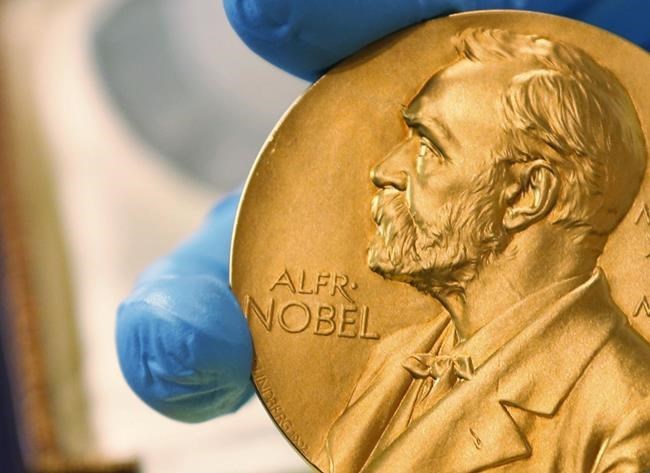
FILE - A April 17, 2015 file photo shows a gold Nobel Prize medal. The Nobel Prize for Chemistry will be announced on Wednesday Oct. 6, 2021. (AP Photo/Fernando Vergara, File)

It was the second day in a row that a Nobel rewarded work that had environmental implications. The physics prize honored developments that expanded our understanding of climate change, just weeks before the start of global climate negotiations in Scotland.

The chemistry prize focused on the making of molecules. That requires linking atoms together in specific arrangements, an often difficult and slow task. Until the beginning of the millennium, chemists had only two methods — or catalysts — to speed up the process, using either complicated enzymes or metal catalysts.

That all changed when List, of the Max Planck Institute in Germany, and MacMillan, of Princeton University in New Jersey, independently reported that small organic molecules can be used to do the job. The new tools have been important for developing medicines and minimizing drug manufacturing glitches, including problems that can cause harmful side effects.

Johan Åqvist, chair of the Nobel panel, called the method as “simple as it is ingenious.”

“The fact is that many people have wondered why we didn’t think of it earlier,” he added.

MacMillan said that winning the prize left him “stunned, shocked, happy, very proud.”

“I grew up in Scotland, a working-class kid. My dad’s a steelworker. My mom was a home help. … I was lucky enough to get a chance to come to America, to do my Ph.D.,” he said.

In fact, he said at a news conference in Princeton, he was planning to follow his older brother into physics, but the physics classes in college were at 8 a.m. in a cold and leaky classroom in rainy Scotland, while the chemistry courses were two hours later in warmer, drier spaces. As he told that story, he said he could hear his wife pleading with him not to share it.

His said the inspiration for his Nobel-winning work came when thinking about the dirty process of making chemicals — one that requires precautions he likened to those taken at nuclear power plants.

If he could devise a way of making medicines faster by completely different means that didn’t require vats of metal catalysts, the process would be safer for both workers and the planet, he reasoned.

List said he did not initially know MacMillan was working on the same subject and figured his own hunch might just be a “stupid idea” — until it worked. At that eureka moment, “I did feel that this could be something big,” the 53-year-old said.
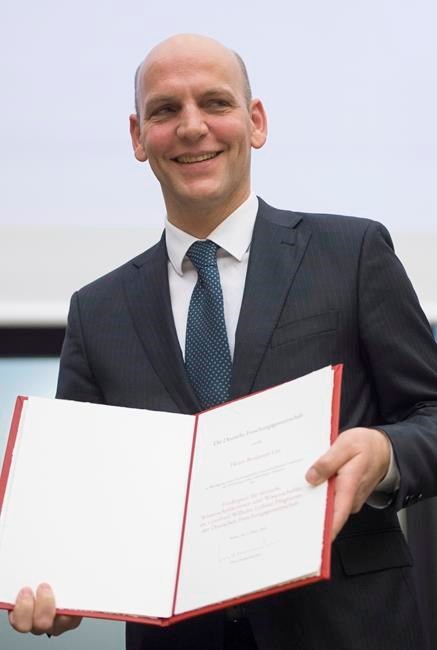
FILE - In this March 3, 2016 file photo Benjamin List, of the Max Planck Institute, smiles during an event in Berlin, Germany. Two scientists have won the Nobel Prize for chemistry for finding an “ingenious” new way to build molecules that can be used to make everything from medicines to food flavorings. Benjamin List of Germany and Scotland-born David W.C. MacMillan developed “asymmetric organocatalysis.” (Soeren Stache/dpa via AP, file)

H.N. Cheng, president of the American Chemical Society, said the laureates developed “new magic wands.”

Before the their work, “the standard catalysts frequently used were metals, which frequently have environmental downsides,” Cheng said. “They accumulate, they leach, they may be hazardous.”

The catalysts that MacMillan and List pioneered “are organic, so they will degrade faster, and they are also cheaper,” he said.

The Nobel panel noted that their contributions made the production of key drugs easier, including an antiviral and an anti-anxiety medication.

“One way to look at their work is like molecular carpentry,” said John Lorsch, director of the National Institute of General Medical Sciences at the U.S. National Institutes of Health.

“They’ve found ways to not only speed up the chemical joining,” he said, “but to make sure it only goes in either the right-handed or left-handed direction.”

The ability to control the orientation in which new atoms are added to molecules is important. Failing to do so can result in side effects in drugs, the Nobel panel explained, citing the catastrophic example of thalidomide, which caused severe birth defects in children.

Since the scientists’ discovery, the tool has been further refined, making it many times more efficient.

Peter Somfai, another member of the committee, stressed the importance of the discovery for the world economy.

“It has been estimated that catalysis is responsible for about 35% of the world’s GDP, which is a pretty impressive figure,” he said. “If we have a more environmentally friendly alternative, it’s expected that that will make a difference.”

The NIH supported List’s research with a grant in 2002. MacMillan’s work has received funding from NIH since 2000, for a total of around $14.5 million to date.
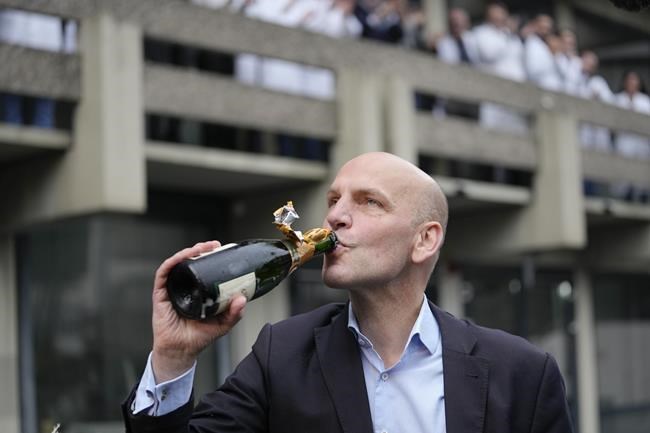
German scientist Benjamin List drinks champagne as arrives at the Max-Planck-Institute for Coal Research in Muelheim, Germany, Wednesday, Oct. 6, 2021. Two scientists have won the Nobel Prize for chemistry for finding an
German scientist Benjamin List drinks champagne as arrives at the Max-Planck-Institute for Coal Research in Muelheim, Germany, Wednesday, Oct. 6, 2021. Two scientists have won the Nobel Prize for chemistry for finding an "ingenious" new way to build molecules that can be used to make everything from medicines to food flavorings. Benjamin List of Germany and Scotland-born David W.C. MacMillan developed "asymmetric organocatalysis." (AP Photo/Martin Meissner)

“It’s a great example of supporting basic science that you don’t necessarily know where it’s going to go” but can have major impact, said Francis Collins, NIH director.

The Nobel comes with a gold medal and 10 million Swedish kronor,, or more than $1.14 million. The money comes from a bequest left by the prize’s creator, Swedish inventor Alfred Nobel, who died in 1895.

Over the coming days, Nobels will be awarded in literature, peace and economics.

___

Jordans reported from Berlin and Larson from Washington. Associated Press journalists Mike Corder in Amsterdam and Ted Shaffrey in Princeton, New Jersey, contributed.

___

Read more stories about Nobel Prizes past and present at https://www.apnews.com/NobelPrizes.

Report Error Submit a Tip

More Stories

Former Oilers teammates square off for first time

Ken Wiebe 7 minute read Preview

Former Oilers teammates square off for first time

Ken Wiebe 7 minute read 4:41 PM CDT

Calvin Pickard has been many things to Stuart Skinner.

An ally, sounding board, confidante and most importantly, a close friend.

They were a goalie tandem for parts of three seasons with the Edmonton Oilers, making two trips to the Stanley Cup final, combining for 29 playoff wins, but falling just short of achieving the ultimate goal on both of those occasions.

They were opponents just once last season when the Oilers and Pittsburgh Penguins met for the first time since the trade that shipped Skinner to Pennsylvania, but it was Tristan Jarry – the guy he was traded for – standing at the opposite side of the rink.

Read
4:41 PM CDT

Today’s horoscope

Georgia Nicols 4 minute read Preview

Today’s horoscope

Georgia Nicols 4 minute read 2:00 AM CDT

MOON ALERT: There are no restrictions to shopping or important decisions. The moon is in Scorpio.

ARIES (March 21-April 19)

Tread carefully as it’s easy to get into an argument, especially with your kids or even a romantic partner. Very likely the dispute will be about mutual expenses, shared property or perhaps differing values. Do what you can to keep the peace.

TAURUS (April 20-May 20)

Read
2:00 AM CDT

Riding the Unity Bus to rally support for Canada in Alberta

Melissa Martin 8 minute read Preview

Riding the Unity Bus to rally support for Canada in Alberta

Melissa Martin 8 minute read Updated: 9:57 PM CDT

WAINWRIGHT, Alta. — The Unity Bus arrives right on time, pulling into a parking lot on the edge of this town of about 6,600 people close to the Alberta-Saskatchewan border. As the vehicle slows to a halt, resplendent in its patriotic red-and-white paint, a small group of supporters stand waiting, decked in their own maple leaf garb.

The Unity Bus’s doors open and former Alberta deputy premier Thomas Lukaszuk bounds to the ground. The supporters, volunteers with Lukaszuk’s Forever Canadian campaign, welcome him with applause; he greets them with open arms. He knows many by name, having been to Wainwright four times; some of them fondly call him “the boss.”

“Do you need some stickers?” he asks. “Do you need some swag to give away?”

It’s a chilly Thanksgiving Monday morning on the eastern edge of Alberta. A sharp wind nips at exposed skin and drab grey clouds hang low in the sky. Such weather does not encourage high spirits, but Lukaszuk and these volunteers can’t afford to let theirs falter: in just one week, on Oct. 19, Albertans will vote on a historic question on whether to remain in Canada.

Read
Updated: 9:57 PM CDT

Manitoba e-scooter legislation changes set to impose speed limit, age restrictions, sidewalk ban

Matthew Frank 5 minute read Preview

Manitoba e-scooter legislation changes set to impose speed limit, age restrictions, sidewalk ban

Matthew Frank 5 minute read Updated: Yesterday at 5:14 PM CDT

People riding e-scooters and other personal electric vehicles in Manitoba will have to strap on a helmet, stay off sidewalks and follow new age limits once new provincial rules for the devices take effect next year.

The vehicles, which also include electric skateboards, hoverboards and unicycles, will fall under The Highway Traffic Act starting in 2027, according to the province’s website. E-bikes are excluded from the new rules, according to the province’s frequently-asked-questions page.

All riders must be at least 16 years old and wear properly fitting helmets — that goes for passengers, too, the province said.

The proposed new legislation sets a speed limit of 25 km/h and would prohibit personal electric vehicles from sidewalks unless signs specifically allow sidewalk use. Riders would be using shared paths or roads with speed limits of 50 km/hr or less. They won’t be allowed to operate the vehicles under the influence of alcohol or drugs and they must use hand signals and obey traffic signs.

Read
Updated: Yesterday at 5:14 PM CDT

Backstreet Boys extend Toronto residency to 11 nights

The Canadian Press 2 minute read Preview

Backstreet Boys extend Toronto residency to 11 nights

The Canadian Press 2 minute read Yesterday at 2:11 PM CDT

TORONTO - Hit '90s boyband The Backstreet Boys are adding more tour dates to their Toronto residency.

What was first announced as a four-night run at Rogers Centre has swelled to 11 shows, with the band's recent announcement they're adding concerts on March 5 and 6.

The band says on its website the new dates were added "due to overwhelming demand."

Dubbed “Into the Millennium – Homecoming: Live in Canada,” the residency will kick off on Feb. 12.

Read
Yesterday at 2:11 PM CDT

What's open, what's closed, what's up on Thanksgiving

Free Press staff 3 minute read Preview

What's open, what's closed, what's up on Thanksgiving

Free Press staff 3 minute read Friday, Oct. 9, 2026

Here's a round-up of things to do and hours of business for services on Thanksgiving Day 2026.

Read
Friday, Oct. 9, 2026