Oregon officials ask public help to find killers of 8 wolves

Advertisement

Advertise with us

Officials in Oregon are asking for public assistance to locate the person or persons responsible for poisoning eight wolves in the eastern part of the state earlier this year.

Read this article for free:


or

Already have an account? Log in here »

To continue reading, please subscribe:

Subscribe and receive a limited-edition Free Press branded hat or tote.

Digital Subscription

One year of digital access for only $205*

  • Enjoy unlimited reading on winnipegfreepress.com
  • Read the E-Edition, our digital replica newspaper
  • Access News Break, our award-winning app
  • Play interactive puzzles

*First annual payment billed as $205.00 + GST for one year. This annual subscription will automatically renew at $233.00 + GST every 52 weeks (10% off the regular annual price of $259.35). Offer available to new and qualified returning subscribers only. Cancel any time.

To continue reading, please subscribe:

Add Free Press access to your Brandon Sun subscription for only an additional

$1 for the first 4 weeks*

  • Enjoy unlimited reading on winnipegfreepress.com
  • Read the E-Edition, our digital replica newspaper
  • Access News Break, our award-winning app
  • Play interactive puzzles
Start now

*Your next Brandon Sun subscription payment will increase by $1.00 and you will be charged $17.95 plus GST for four weeks. After four weeks, your payment will increase to $24.95 plus GST every four weeks.

Hey there, time traveller!
This article was published 02/12/2021 (1748 days ago), so information in it may no longer be current.

Officials in Oregon are asking for public assistance to locate the person or persons responsible for poisoning eight wolves in the eastern part of the state earlier this year.

The Oregon State Police has been investigating the killing of all five members of the Catherine Pack in Union County, plus three other wolves from other packs, the agency said in a news release Thursday.

“To my knowledge this is the first wolf pack to be killed by poison in Oregon,” said Capt. Stephanie Bigman of the OSP in Salem. “To my knowledge there are no suspects. All investigative leads have been exhausted and that is why we are reaching out to the public for assistance.”
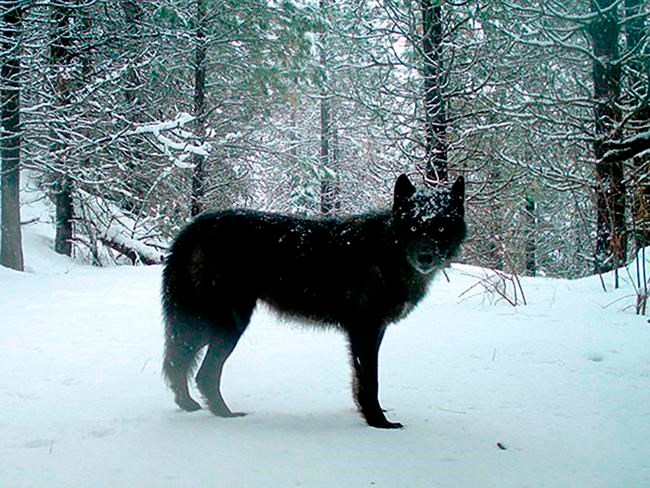
FILE - This Feb., 2017, file photo provided by the Oregon Department of Fish and Wildlife shows a gray wolf in Oregon's northern Wallowa County. Officials in Oregon are asking for help locating the person or persons responsible for poisoning an entire wolf pack in the eastern part of the state earlier this year. The Oregon State Police said Thursday, Dec. 2, 2021, it has been investigating the killing of all five members of the Catherine Pack in Union County, plus three other wolves from other packs. (Oregon Department of Fish and Wildlife via AP, File)

Wolf advocates were stunned by the news.

“This is horrific,” said Sristi Kamal of Defenders of Wildlife in Portland. “This is quite clearly an intentional and repeat offense.”

Oregon has only about 170 wolves within its borders, and the loss of eight “is so egregious,” Kamal said.

“The poisoning of the Catherine wolf pack is tragic and disgusting” said Sophia Ressler, a staff attorney at the Center for Biological Diversity. “No wolf should have to suffer such a fate. Awful events like this show how much more work is needed for us to coexist with these vitally important animals.”

A group of conservation and animal protection groups late Thursday said they were offering a combined $26,000 in rewards for information leading to a conviction in the poisonings. The rewards were offered by the Center for Biological Diversity, Cascadia Wildlands, Defenders of Wildlife, The Humane Society of the United States, Northeast Oregon Ecosystems, Oregon Wild, Predator Defense and WildEarth Guardians.

Wolves once ranged most of the U.S. but were wiped out in most places by the 1930s under government-sponsored poisoning and trapping campaigns.

More than 2,000 wolves occupy six states in the Northern Rockies and Pacific Northwest after animals from Canada were reintroduced in Idaho and Yellowstone National Park starting in 1995.

However, wolves remain absent across most of their historical range. Wildlife advocates argue that continued protections are needed so they can continue to expand in California, Colorado, Oregon and other states.

The Fish and Wildlife Division of the Oregon State Police was alerted on Feb. 9 that a collared wolf from the Catherine Pack was possibly deceased.

Troopers responded and located five deceased wolves, three males, and two females. The wolves were located southeast of Mount Harris, within Union County. Investigators also found a dead magpie in the vicinity of the dead wolves, the agency said.

The animals were sent to the U.S. Fish and Wildlife Service forensics lab in Ashland to determine the cause of death.

On March 11, State Police were told a mortality signal from an additional wolf collar had been received in the same general location. Searchers found a deceased female wolf, a skunk, and a magpie all very close to the scene. The female wolf was determined to be a member of the Keating Pack.

In April, the federal lab released findings consistent with poisoning as the cause of death for all six wolves, the skunk, and two magpies.

In addition, two more collared wolves were found deceased in Union County after the initial incidents. In April, a deceased adult male wolf from the Five Points Pack was located west of Elgin, and in July a young female wolf from the Clark Creek Pack was located northeast of La Grande, the county seat.

Toxicology reports confirmed the presence of differing types of poison in both those wolves, the OSP said.


Report Error Submit a Tip

More Stories

Staying away to keep the heat on

Editorial 4 minute read Preview

Staying away to keep the heat on

Editorial 4 minute read 2:00 AM CDT

It’s a tough sell these days for U.S. tourism groups seeking to attract Canadian visitors as tension, tariffs and traded verbal barbs continue to rise between the two countries.

Read
2:00 AM CDT

Drug recovery centre opens office in ‘heart of the city’

Morgan Modjeski 4 minute read Preview

Drug recovery centre opens office in ‘heart of the city’

Morgan Modjeski 4 minute read Saturday, Sep. 12, 2026

Richard Halverson found his freedom from addiction through Adult & Teen Challenge and, six years later, he hopes a new Winnipeg location will bring hope to the city.

Read
Saturday, Sep. 12, 2026

Northern style: WAG-Qaumajuq, CBC series partner for runway show

AV Kitching 8 minute read Preview

Northern style: WAG-Qaumajuq, CBC series partner for runway show

AV Kitching 8 minute read 6:10 PM CDT

Award-winning TV series North of North by Inuit filmmakers Stacey Aglok MacDonald (Qanurli, The Grizzlies) and Alethea Arnaquq-Baril (Angry Inuk, The Grizzlies) made a return to the small screen last week on APTN, CBC Gem and CBC TV with its second season première.

North of North is partnering with the Winnipeg Art Gallery-Qaumajuq to celebrate the way it has propelled authentic northern fashion into the global spotlight at the gallery’s special edition of Crafted on the Catwalk Tuesday night, featuring fashion and design from Manitoba, Nunavut, the Northwest Territories, Nunatsiavut and Nunavik.

Arnaquq-Baril and series stars Anna Lambe and Zorga Qaunaq spoke to the Free Press ahead of Tuesday’s catwalk show.

Free Press: The fashion in Season 1 set the bar so high. We’re barely into Season 2 and have already seen so many covetable, stunning looks. What story do the clothes tell the viewers?

Read
6:10 PM CDT

Winnipeg venues saying no to AI-made advertisements

Sheldon Birnie 8 minute read Preview

Winnipeg venues saying no to AI-made advertisements

Sheldon Birnie 8 minute read Updated: 10:22 AM CDT

Although the days when telephone poles and notice boards across the city were thick with gig posters, either slopped up with wheat paste or wrapped tight with packing tape, are behind us, the art of making an appealing visual ad for live music events is still a vital part of the local creative scene.

However, a widespread backlash against a new kind of slop — the use of generative AI images — has been building, especially among creatives when it comes to promoting live music.

“Live music is and always has been a DIY type of scene, especially locally,” says Evan Simpson, who has been working as a graphic designer for nearly a decade.

“For years people have been making their own flyers, or if they have the budget, hiring a designer or artist to come up with some artwork for their flyers. It’s a whole ecosystem, a scene supporting itself. If you take away the visual side of it, the spark, individuality and uniqueness of each gig poster is lost. What a sad world it would be if all art were made by AI.”

Read
Updated: 10:22 AM CDT

Puzzles Palace

1 minute read Monday, Jul. 27, 2026

To solve our puzzles, please subscribe with this special offer: |

Port of Churchill expansion could chase belugas away, U of M researcher says

Nicole Buffie 4 minute read Preview

Port of Churchill expansion could chase belugas away, U of M researcher says

Nicole Buffie 4 minute read Yesterday at 9:07 AM CDT

As plans to expand the Port of Churchill into a four-season trade corridor gathers momentum, a University of Manitoba researcher has published a report on what ship traffic could mean for the beluga whales that gather in the Churchill River estuary each summer.

Veronica Coppolaro said more vessels in the waterways bring a risk that belugas will stop using the estuary for migration, which would impact the ecological landscape, tourism and communities that rely on the animals for food and cultural purposes.

“There are studies showing that (noises) change the way they swim, they change the way (the whales) are vocalizing, they change their main activity, and so this (expansion) can have consequences at different levels,” she said.

The Churchill river estuary is a marine habitat where the Churchill River empties into Hudson Bay. During the summer months belugas gather in the area to feed and give birth.

Read
Yesterday at 9:07 AM CDT