Pension fund that owns Revera faces pressure to divest the for-profit care home chain

Advertisement

Advertise with us

TORONTO - A public sector union is reiterating a call for its pension investment manager to divest its ownership in Revera Inc. over the company's safety record during the COVID-19 pandemic, saying the fund should "pull out of the business of long-term care" altogether.

Read this article for free:


or

Already have an account? Log in here »

To continue reading, please subscribe:

Subscribe and receive a limited-edition Free Press branded hat or tote.

Digital Subscription

One year of digital access for only $205*

  • Enjoy unlimited reading on winnipegfreepress.com
  • Read the E-Edition, our digital replica newspaper
  • Access News Break, our award-winning app
  • Play interactive puzzles

*First annual payment billed as $205.00 + GST for one year. This annual subscription will automatically renew at $233.00 + GST every 52 weeks (10% off the regular annual price of $259.35). Offer available to new and qualified returning subscribers only. Cancel any time.

To continue reading, please subscribe:

Add Free Press access to your Brandon Sun subscription for only an additional

$1 for the first 4 weeks*

  • Enjoy unlimited reading on winnipegfreepress.com
  • Read the E-Edition, our digital replica newspaper
  • Access News Break, our award-winning app
  • Play interactive puzzles
Start now

*Your next Brandon Sun subscription payment will increase by $1.00 and you will be charged $17.95 plus GST for four weeks. After four weeks, your payment will increase to $24.95 plus GST every four weeks.

Hey there, time traveller!
This article was published 09/12/2020 (2133 days ago), so information in it may no longer be current.

TORONTO – A public sector union is reiterating a call for its pension investment manager to divest its ownership in Revera Inc. over the company’s safety record during the COVID-19 pandemic, saying the fund should “pull out of the business of long-term care” altogether.

The Public Service Alliance of Canada, which represents 140,000 public sector pension plan members, first said in May that for-profit long-term care homes run by Revera should no longer be wholly owned by Public Sector Pension Investment, the Crown corporation managing public servants’ pensions. Instead, the union says the homes should be managed by the public sector in order to protect both residents and pension funds.

After outbreaks at several of its facilities earlier this year, Revera on Monday released a report on how it had handled the first wave of COVID-19. The findings included shortcomings from public health officials, doctors, hospitals and workforce shortages as some of the reasons the novel coronavirus spread in its homes.
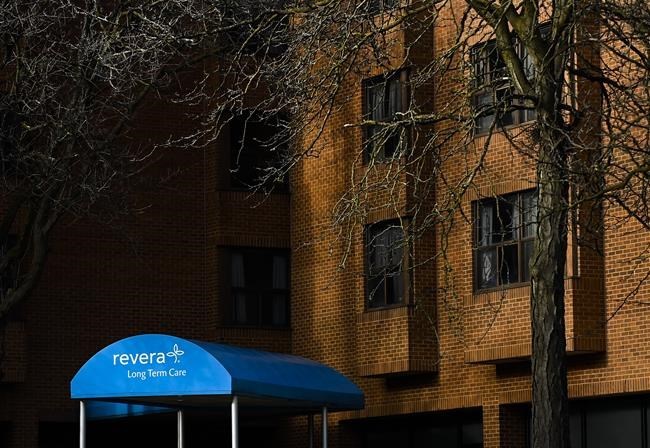
The Revera Westside Long Term Care Home is pictured in Toronto on Monday, Dec. 7, 2020. A union that represents 140,000 pension plan members says that for-profit long-term care homes run by Revera Inc. should no longer be wholly owned by the Crown corporation managing public servants' pensions. THE CANADIAN PRESS/Nathan Denette

Calling the report a “slick corporate public relations exercise,” PSAC National President Chris Aylward says his members remain concerned by their pension plan’s ownership of Revera and “reiterate their call for the federal government to facilitate the transition of Revera to public hands as a first step toward a national, fully publicly funded long term care system.”

Revera has 74 long-term care homes with about 9,400 residents across four provinces.Between March and September, COVID-19 infected 874 Revera residents and killed 266, and the company has reported several additional outbreaks this fall. Since September, more than 40 Revera homes have reported outbreaks, according to its website.

The company is privately held and does not disclose any financial information.

Revera’s focus is “squarely on caring for our residents and containing the spread of the virus,” said Revera vice-president of corporate affairs Susan Schutta.

“Since March, our emergency recruitment program has hired almost 4,000 new staff to support our residents,” said Schutta, in an email. “We have introduced additional infection control support at all of our homes, have invested tens of millions in additionally staffing and non-staffing support, and have rolled out a privately-funded surveillance testing program for our staff and residents in markets where public health units do not provide this service.”

Union attendees at a town hall earlier this year questioned Revera’s handling of the pandemic. Christine Collins said at the online event that her brother was infected with COVID-19 at Revera-owned Carlingview Manor, but she received “little to no communication” from staff.

“Maybe you can imagine how very angry and horrified I am to find out that my pension plan, that I paid into for 37 years, owns Carlingview Manor as part of the Revera chain,” Collins said during the town hall.

Aylward says shifting the business model isthe union’s preferred way for PSP — which administers pensions for public servants, Crown corporation employees, Canadian Forces members, the RCMP and Reserve Forces — to divest from Revera, rather than see it sold to another for-profit company, a move he says “would do absolutely nothing to improve the care of seniors in Revera facilities.”

Ed Cashman, an Ottawa-based retired public servant and PSP pension recipient, wonders if the second wave of COVID-19 would have played out differently if PSP had listened to the union’s concerns about Revera earlier.

“When I find out that these homes are being operated in such poor conditions … that raises a whole ethical question,” said Cashman in an interview. “How can they allow Revera to be pulling out profits from long-term care?”

In May, Aylward wrote a letter to the chief executive of PSP stating that continuing business as usual “would not only be detrimental to the residents and employees of Revera Inc. but could also pose long-term consequences for the contributors and beneficiaries” of the pension plan.

Cashman also raised concerns about Revera during PSP’s annual general meeting earlier this year, asking chief executive Neil Cunningham if PSP should consider divesting in Revera “before things get worse.”

Revera faces two proposed class actions over its handling of the COVID-19 virus, with claims totalling $125 million.Cunningham said at the meeting that PSP doesn’t believe the suits have merit, and that theywere not reason enough to consider divesting from the long-term care business.

Cunningham said at the meeting that PSP would exit the investment in the future if it wasn’t “proud” of the care provided in long-term care homes, but said that PSP’s governance of Revera was robust.

Although PSP has a presence on Revera’s board, the long-term care company said it is independently operated and does not ask PSP for funding or input on management.

The PSB investment board said it remains committed to Revera’s board and leadership team. A statement provided by PSP said that it is watching Revera’s management of the pandemic closely, but that the pension fund’s confidence in staff has not been shaken.

Cashman questioned why the minister that oversees PSP — Treasury Board President Jean-Yves Duclos — can’t do more.

The Treasury Board of Canada Secretariat said in a statement that PSP’s investment board operates at arm’s length from the federal government.

PSP said it is committed to working with all levels of government to “find the right solution for the long-term care industry and discuss lessons learned from the pandemic.”

But, Aylward says, “it doesn’t look very good when a federal Crown corporation that manages the pension plan for federal public sector workers owns a lot of these long-term care homes across the country.”

This report by The Canadian Press was first published Dec. 9, 2020.

Report Error Submit a Tip

More Stories

Piece of Winnipeg’s magic history disappears

Kelly-Anne Riess 5 minute read Preview

Piece of Winnipeg’s magic history disappears

Kelly-Anne Riess 5 minute read Saturday, Oct. 10, 2026

A piece of Winnipeg’s magic history has vanished, and internationally renowned escape artist Dean Gunnarson is offering a $500 reward to anyone who can make it reappear.

The plaque marked the birthplace of what has become the world’s largest organization of professional and amateur magicians, the International Brotherhood of Magicians, which was founded in Winnipeg more than a century ago.

Gunnarson said fellow magician and local magic historian Bruce Thompson discovered the disappearance Tuesday while on his way to work.

Thompson returned to inspect the site and found what appeared to be evidence it had been forcibly removed.

Read
Saturday, Oct. 10, 2026

Manitoba e-scooter legislation changes set to impose speed limit, age restrictions, sidewalk ban

Matthew Frank 5 minute read Preview

Manitoba e-scooter legislation changes set to impose speed limit, age restrictions, sidewalk ban

Matthew Frank 5 minute read Updated: Yesterday at 5:14 PM CDT

People riding e-scooters and other personal electric vehicles in Manitoba will have to strap on a helmet, stay off sidewalks and follow new age limits once new provincial rules for the devices take effect next year.

The vehicles, which also include electric skateboards, hoverboards and unicycles, will fall under The Highway Traffic Act starting in 2027, according to the province’s website. E-bikes are excluded from the new rules, according to the province’s frequently-asked-questions page.

All riders must be at least 16 years old and wear properly fitting helmets — that goes for passengers, too, the province said.

The proposed new legislation sets a speed limit of 25 km/h and would prohibit personal electric vehicles from sidewalks unless signs specifically allow sidewalk use. Riders would be using shared paths or roads with speed limits of 50 km/hr or less. They won’t be allowed to operate the vehicles under the influence of alcohol or drugs and they must use hand signals and obey traffic signs.

Read
Updated: Yesterday at 5:14 PM CDT

Person killed in workplace accident at Fairmont construction site

Morgan Modjeski 3 minute read Preview

Person killed in workplace accident at Fairmont construction site

Morgan Modjeski 3 minute read Friday, Oct. 9, 2026

Emergency responders were on scene and Manitoba Workplace Safety and Health is investigating after a worker died following an incident at a Winnipeg construction site Thursday.

Little information about the worker killed was provided, but the fatal incident happened at the Fairmont Winnipeg, located at 2 Lombard Place, with police responding around 5 p.m.

The hotel is currently closed and is an active construction site. The person killed has not been identified by name.

Information from a provincial spokesperson said the deceased was working for Kepsco Construction when they were fatally injured after a “portion of an overhead canopy collapsed during asbestos abatement work.”

Read
Friday, Oct. 9, 2026

A Life's Story: Writer built bridges with genuine curiosity, compassion for diversity of religious practices

Janine LeGal 6 minute read Preview

A Life's Story: Writer built bridges with genuine curiosity, compassion for diversity of religious practices

Janine LeGal 6 minute read Saturday, Oct. 10, 2026

Brenda Suderman knew how to make people feel comfortable. For a journalist, that character trait is a real strength, and it made people trust and appreciate her.

Whether covering musicals, worship spaces, the effects of pandemic shutdowns, death rituals and practices of different traditions, the discovery of the burial of 2,284 infants in unmarked graves, or any other of the countless topics she wrote about in her four- decade career, Suderman did it with genuine interest and care.

Born and raised in Winkler, Suderman grew up on a farm. Much of her childhood was spent in gardens and sugar beet fields.

Baptized at 16, she became a member of the Winkler Bergthaler Mennonite Church. The restrictions against women at the time contributed to planting the seeds of Suderman’s feminist perspective.

Read
Saturday, Oct. 10, 2026

Pressure mounts for pension fund that owns Revera

Anita Balakrishnan, The Canadian Press 6 minute read Preview

Pressure mounts for pension fund that owns Revera

Anita Balakrishnan, The Canadian Press 6 minute read Wednesday, Dec. 9, 2020

TORONTO - A public sector union is reiterating a call for its pension investment manager to divest its ownership in Revera Inc. over the company's safety record during the COVID-19 pandemic, saying the fund should "pull out of the business of long-term care" altogether.

The Public Service Alliance of Canada, which represents 140,000 public sector pension plan members, first said in May that for-profit long-term care homes run by Revera should no longer be wholly owned by Public Sector Pension Investment, the Crown corporation managing public servants' pensions. Instead, the union says the homes should be managed by the public sector in order to protect both residents and pension funds.

After outbreaks at several of its facilities earlier this year, Revera on Monday released a report on how it had handled the first wave of COVID-19. The findings included shortcomings from public health officials, doctors, hospitals and workforce shortages as some of the reasons the novel coronavirus spread in its homes.

Calling the report a "slick corporate public relations exercise," PSAC National President Chris Aylward says his members remain concerned by their pension plan's ownership of Revera and "reiterate their call for the federal government to facilitate the transition of Revera to public hands as a first step toward a national, fully publicly funded long term care system."

Read
Wednesday, Dec. 9, 2020

Business in brief: Kinew, Canadian ambassador to U.S. discuss trade

Free Press staff 2 minute read Saturday, Oct. 10, 2026

Canada’s ambassador to the United States met Manitoba Premier Wab Kinew and local business leaders during a visit to Winnipeg this week.

Mark Wiseman and Kinew spoke about trade uncertainty with the United States and opportunities for Manitoba businesses, a government news release says.

The provincial U.S. Trade Council, the Business Council of Manitoba and part of the Premier’s Business and Jobs Council spoke to Wiseman about the impacts of trade uncertainty.

Province down 4,400 jobsEmployment dropped 0.6 per cent in Manitoba in September, Statistics Canada reported Friday.