

Raising Kane: biotech on rebound
After rocky period, firm making money
Advertisement
Read this article for free:
or
Already have an account? Log in here »
To continue reading, please subscribe:
Digital Subscription
One year of digital access for only $75*
- Enjoy unlimited reading on winnipegfreepress.com
- Read the E-Edition, our digital replica newspaper
- Access News Break, our award-winning app
- Play interactive puzzles
*Billed as $5.77 plus GST every four weeks. After 52 weeks, price increases to the regular rate of $19.95 plus GST every four weeks. Offer available to new and qualified returning subscribers only. Cancel any time.
Monthly Digital Subscription
$4.99/week*
- Enjoy unlimited reading on winnipegfreepress.com
- Read the E-Edition, our digital replica newspaper
- Access News Break, our award-winning app
- Play interactive puzzles
*Billed as $19.95 plus GST every four weeks. Cancel any time.
To continue reading, please subscribe:
Add Free Press access to your Brandon Sun subscription for only an additional
$1 for the first 4 weeks*
- Enjoy unlimited reading on winnipegfreepress.com
- Read the E-Edition, our digital replica newspaper
- Access News Break, our award-winning app
- Play interactive puzzles
*Your next Brandon Sun subscription payment will increase by $1.00 and you will be charged $17.95 plus GST for four weeks. After four weeks, your payment will increase to $24.95 plus GST every four weeks.
Read unlimited articles for free today:
or
Already have an account? Log in here »
Hey there, time traveller!
This article was published 15/01/2020 (2323 days ago), so information in it may no longer be current.
When Marc Edwards took the job of CEO of Kane Biotech in September 2018, he became the Winnipeg company’s third CEO in less than five years, not really a sign of growth or stability.
The company has about 70 patents, primarily to address the prevention and removal of microbial biofilms. It’s an unmet need, yet the 19-year-old company had been unable to break into the market despite a series of high-profile research partnerships over the years.
That started to change at the beginning of 2019.
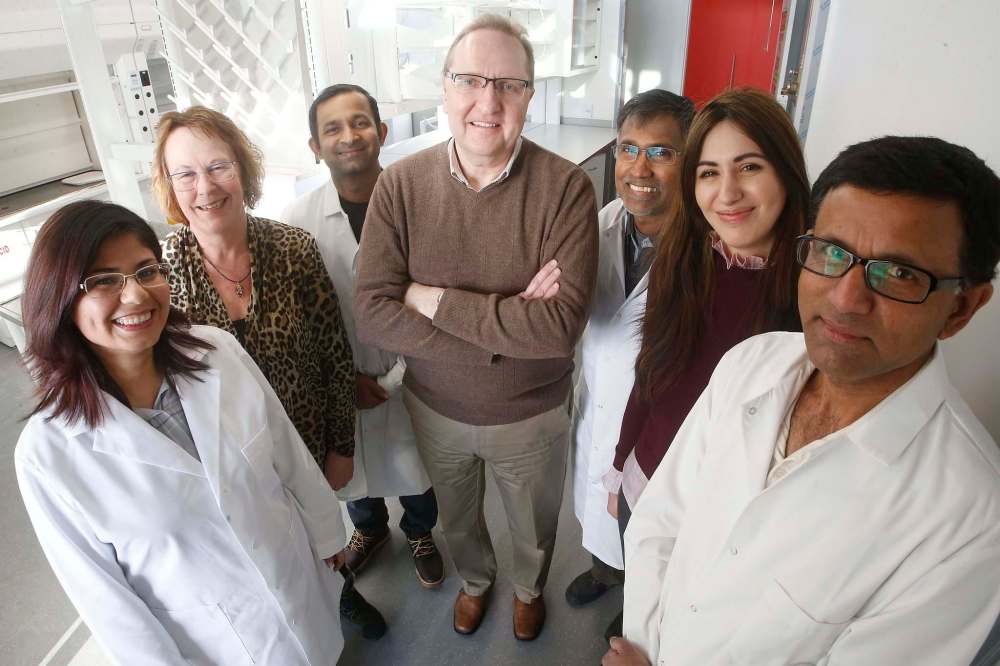
It began with a large order of its commercial oral pet-care product by a large national retail chain. The company beefed up its senior management and governance with its first scientific advisory board and a new chief scientific officer who’d just left Proctor and Gamble after 25 years.
Jaws dropped in the summer when it received a $3.8-million interest-free loan from Western Economic Diversification to commercialize a gel treatment for wounds for humans. It’s something the company had been trying to do for most of its history.
At the time, Ray Dupuis, Kane’s chief financial officer, said, “This is huge for us. It’s transformational for the company.”
Last month, the company announced it had received a $3.4-million grant from an unnamed public-sector funder (likely an American government agency) to work on the same type of project.
At the same time, its new scientific advisers urged the company to re-embark on efforts to get regulatory approval of that technology from the U.S. Food and Drug Administration.
Edwards said it had received guidance in the past that it could apply as a medical device rather than a drug, which would dramatically reduce the time and expense of the regulatory approval process.
In December, it raised $2.5 million in a private placement and expects to raise another $1 million in new equity.
Its third-quarter results noted a $2.7-million gain from the settlement of a lawsuit, likely the one with Nestlé of which the details are confidential.
“We have had an incredible year,” Edwards said.
“When I came on board 15 months ago, we needed to do half-a-dozen things and we wanted to do another half-dozen things. We accomplished everything and more.”
The expectation is that the momentum is going to carry into this year. Among other things, it will start the process to get regulatory approval for its wound-care gel and to have the product on the market by the end of the year.
“It has been interesting speaking to investment bankers,” Edwards said from San Francisco, where he is attending the J.P. Morgan Healthcare Conference.
“Most of them thought we were dead and gone. Initially, when I was reaching out to these guys, they would not take a meeting. The company had been blowing a lot of hot air for a long time. Everyone was knocked on their behind when they heard what we were doing.”
With a $14-million market cap, Kane is only just presenting as a revenue-making company.
For the first nine months of 2019, it generated $1.13 million in revenue, almost 2 1/2 times better than the previous year.
Edwards and his management team have been aggressively buying shares and have contributed to the private placement offering, something that would typically bring favour from the capital markets.
“I’ve bought close to 2.5 million shares in Kane since I came on, most on the public market. Our new chief scientific officer has reinvested just about 100 per cent of his salary in equity in Kane, and Ray (Dupuis, the CFO), has continuously participated in our fundraising and has bought shares on the open market,” Edwards said.
“The fact that insiders believe so strongly in the company is a good indication of where this thing is going.”
While it works towards getting the final touches on its wound-care formulation — a global market expected to be worth about US$22 billion by 2022 — Kane has developed a number of new products for the US$5.2 billion pet-care market.

Among those products is the first canine shampoo formulated into an aerosol dispenser that is to be released in the next few weeks via a Kickstarter campaign.
“We’ll have good first-mover advantage on this and we’re looking to use that and really dominate the pet shampoo market,” Edwards said.
Its North American distributor for its veterinary line of pet-care products has expanded to South America, and the company is in discussions to expand it into Europe.
The company and its 15 Winnipeg staff members are in the process of moving into a new lab and offices in the newly opened Smartpark Innovation Hub.
martin.cash@freepress.mb.ca