

Report details life on minimum wage
Calls to end 'chronic exploitation' of workers increase
Advertisement
Read this article for free:
or
Already have an account? Log in here »
To continue reading, please subscribe:
Monthly Digital Subscription
$1 per week for 24 weeks*
- Enjoy unlimited reading on winnipegfreepress.com
- Read the E-Edition, our digital replica newspaper
- Access News Break, our award-winning app
- Play interactive puzzles
*Billed as $4.00 plus GST every four weeks. After 24 weeks, price increases to the regular rate of $19.95 plus GST every four weeks. Offer available to new and qualified returning subscribers only. Cancel any time.
Monthly Digital Subscription
$4.99/week*
- Enjoy unlimited reading on winnipegfreepress.com
- Read the E-Edition, our digital replica newspaper
- Access News Break, our award-winning app
- Play interactive puzzles
*Billed as $19.95 plus GST every four weeks. Cancel any time.
To continue reading, please subscribe:
Add Free Press access to your Brandon Sun subscription for only an additional
$1 for the first 4 weeks*
*Your next subscription payment will increase by $1.00 and you will be charged $16.99 plus GST for four weeks. After four weeks, your payment will increase to $23.99 plus GST every four weeks.
Read unlimited articles for free today:
or
Already have an account? Log in here »
Hey there, time traveller!
This article was published 27/08/2020 (2070 days ago), so information in it may no longer be current.
It was around the time Mike’s father walked out on his family when the 16-year-old began working his first minimum wage job.
High school was already difficult for him, but now he had to juggle the time put towards making decent grades to get to college while working his new job at the local grocery store.
Fairly quickly, money became an issue.
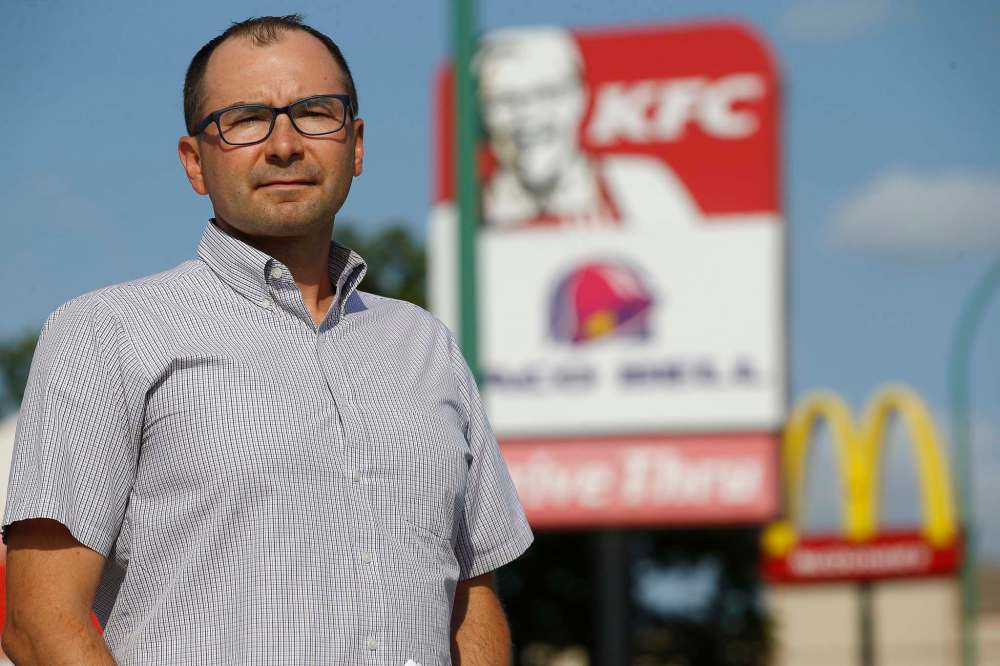
A year later, his grades started to falter as he started taking up more hours at his job. Then, he realized, the $11.65 per hour he was making just wasn’t going to cut it anymore.
At 17, the Winnipeg teen began to work construction jobs like heavy industrial building and roofing or renovation work — almost all without training, paid mostly in cash under the table and completely off the books because he was underage.
But every single one of those jobs paid more than he would ever make at a grocery store or in retail across Manitoba, and so he continued working away, one minor injury at a time.
He’d saved up enough money from those gigs to move out and go to Red River College. He even made the Dean’s List in his first semester.
But now, Mike couldn’t work those jobs any longer — there just wasn’t enough time. And so, he started working a minimum wage job again at a retail store.
Month after month, the 21-year-old would worry about making rent, paying for school and his food. He’d go hungry for days and gave up on health medications altogether.
“Even after all the crazy hours I’d put in to make ends meet, I couldn’t afford my phone plan either and gave that up too,” said Mike, who asked the Free Press not to publish his real name so he could speak freely about his experiences.
That’s when he quit school and went back to working in construction. And Mike’s not the only one who’s had to make those difficult choices.
Ahead of a wide release today, the Canadian Centre for Policy Alternatives exclusively shared a new report with the Free Press that documents the lived experiences of Manitoba’s minimum wage workers.
Highlighting the concerns of 42 workers in Brandon, Winnipeg and rural areas, the report’s authors cite statistics, research and policy solutions all pointing to a dire need to increase the province’s minimum wage — currently among the lowest in Canada.
It reports countless anecdotes about precarious work, housing crises, “addiction traps,” raging hunger, unlivable conditions and other problems related to respondents’ minimum wage earnings which keeps them below the poverty line.
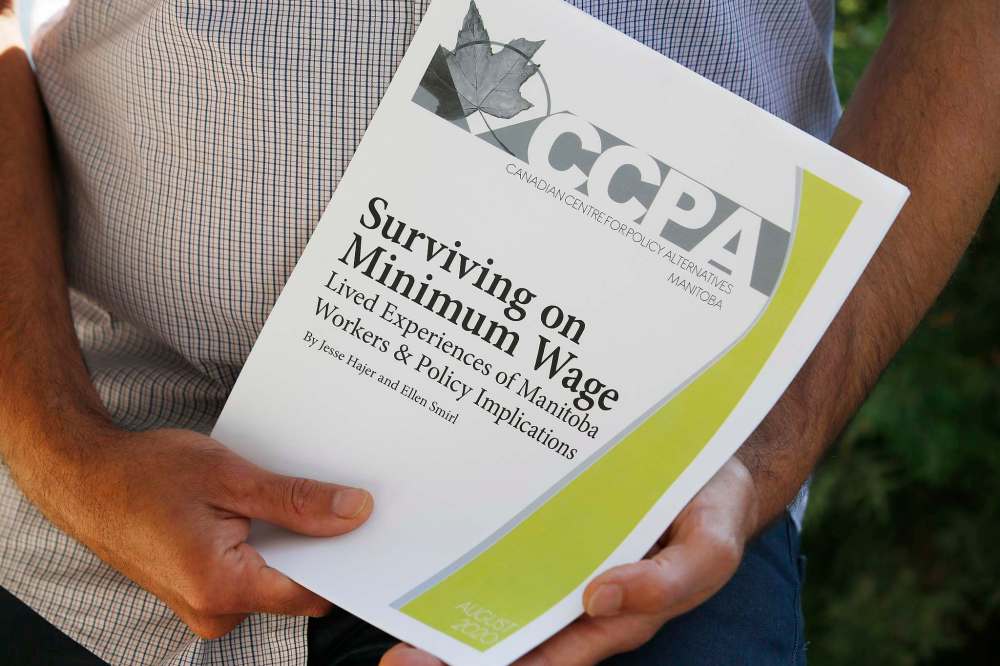
Lead researcher Jesse Hajer calls it “chronic exploitation,” and says the problem has only exacerbated since the onset of the COVID-19 pandemic.
“It’s interesting to us that people who were left to the back and made the lowest earnings in our society quickly became front-line workers and were starting to be called heroes,” he said. “But while their safety concerns were put on the forefront with all us of praising their work, change has yet to be made.”
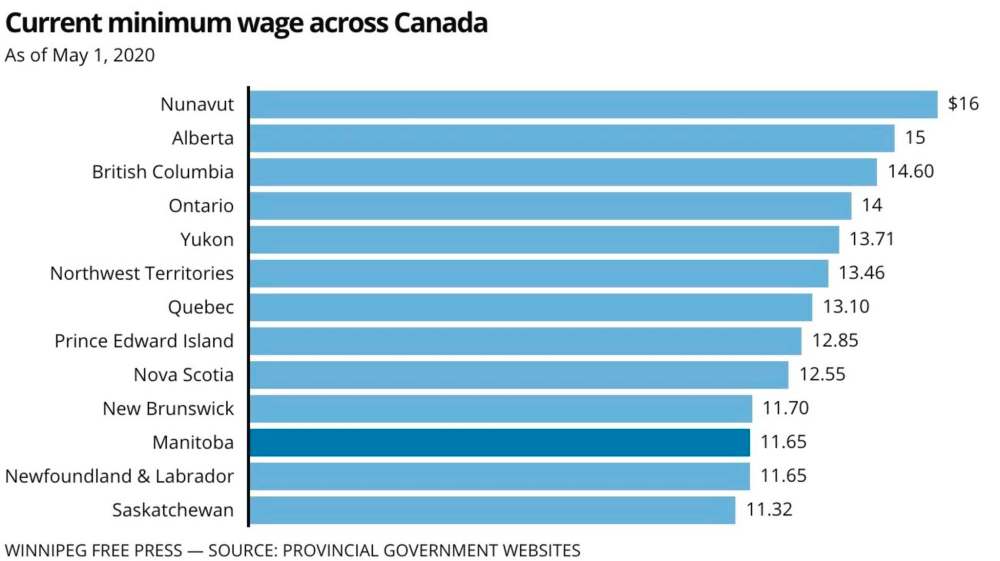
Second only to Saskatchewan (at $11.32 per hour) and tied with Newfoundland and Labrador, minimum wage earners in Manitoba make $11.65 following a 30-cent increase last year.
With Alberta at $15 per hour and Ontario at $14, Hajer says there’s no reason why Manitoba couldn’t do the same.
“There’s also an increased public awareness about the need for these workers now,” he said. “We now know how much we rely on them for a functioning society and that means it couldn’t be a more perfect time to make those changes.”
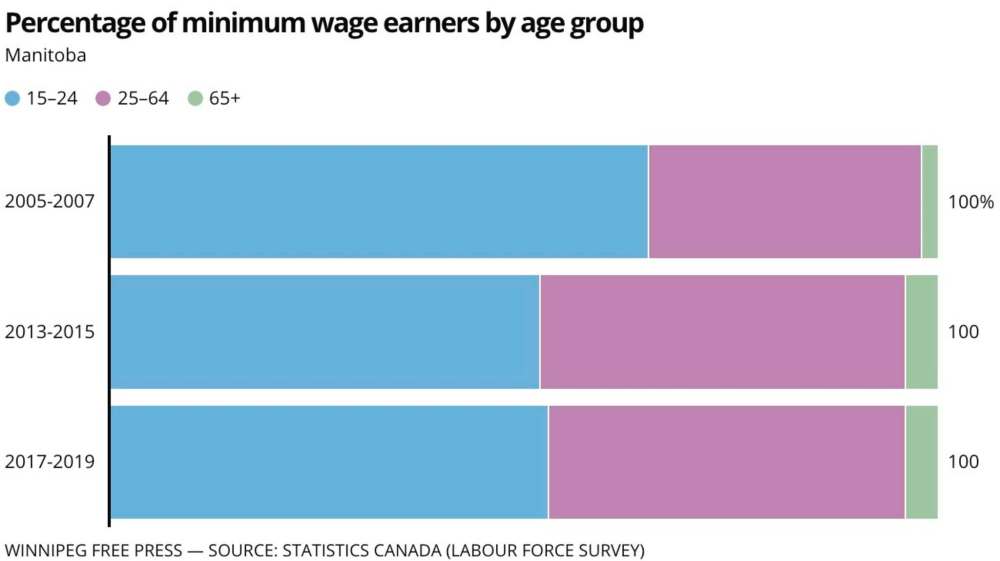
An annual average of about 31,000 workers earned minimum wage in the province between 2016 and 2018, according to Statistics Canada. Almost half of them were aged 25 or older and more likely female than male.
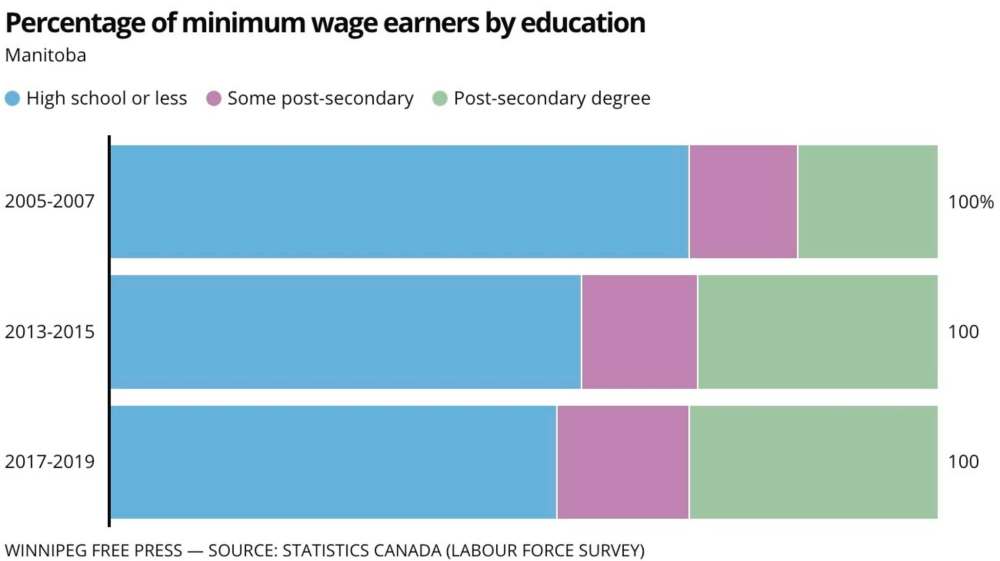
Since the mid-2000s, the education level of workers has also substantially shifted. The amount of minimum wage earners holding post-secondary degrees has doubled as of last year, representing about 30 per cent of all workers.
Hajer says those statistics are exactly why politicians who stereotype minimum wage earners to be “young and in a transitory stage of their career are completely wrong.”
“In some ways, those stereotypes were never true and they’ve only become even lesser true over time,” he said. “They’re arguments that have been used by policy-makers to eradicate the need to increase living wages.”
Meantime, Statistics Canada says about half of all minimum wage workers in Manitoba have stayed at the same job for over a year, with 44 per cent working full time. Earners are also much more likely now to live with a spouse than being single compared to 15 years ago.
Those numbers “couldn’t be more accurate” for workers Sarah and Crystal, who the Free Press is not naming out of fear of retaliation at their current non-unionized, minimum wage jobs.
A single mother of two, Crystal works as a full-time server making minimum wage plus tips. She says she can’t afford a place for her kids and so has to stay with her relatives under cramped conditions that put a strain on her familial relationships.
Last year, she asked her boss for a raise after working there for four years. Even after regular customers said she deserved one, she has yet to receive the raise.
Single mother Sarah works two jobs as a seasonal bookkeeper and telemarketer, living with her in-laws to make ends meet. She says she can’t put food on the table and get gas for her car even though she lives in a rural area.

Hajer said putting a spotlight on stories like Sarah and Crystal’s will allow for change.
“Their stories are exactly why we believe in this increase,” said Hajer. “At the very least, we want people to have a livable life.
“That shouldn’t be too much to ask.”
Twitter: @temurdur
Temur.Durrani@freepress.mb.ca
Related Articles
'Perfect time' to hike minimum wage
Advertisement Advertise With Us
Advertisement Advertise With Us