

Being their own bosses
Interest is growing in employee-share ownership plans, where workers own their companies
Advertisement
Read this article for free:
or
Already have an account? Log in here »
To continue reading, please subscribe:
Digital Subscription
One year of digital access for only $1.44 a week*
- Enjoy unlimited reading on winnipegfreepress.com
- Read the E-Edition, our digital replica newspaper
- Access News Break, our award-winning app
- Play interactive puzzles
*Billed as $5.77 plus GST every four weeks. After 52 weeks, price increases to the regular rate of $19.95 plus GST every four weeks. Offer available to new and qualified returning subscribers only. Cancel any time.
To continue reading, please subscribe:
Add Free Press access to your Brandon Sun subscription for only an additional
$1 for the first 4 weeks*
- Enjoy unlimited reading on winnipegfreepress.com
- Read the E-Edition, our digital replica newspaper
- Access News Break, our award-winning app
- Play interactive puzzles
*Your next Brandon Sun subscription payment will increase by $1.00 and you will be charged $17.95 plus GST for four weeks. After four weeks, your payment will increase to $24.95 plus GST every four weeks.
Read unlimited articles for free today:
or
Already have an account? Log in here »
Hey there, time traveller!
This article was published 30/05/2015 (4040 days ago), so information in it may no longer be current.
Judy Spackman started working as a receptionist at Cando Rail Services Ltd. in Brandon 18 years ago and now she owns the company.
Granted, she does have a few partners — about 280 — and all of them are employees of the company.
But she also has a sizable nest egg thanks to the growth of the company and the wisdom of Cando’s founder, Gord Peters, who implemented an employee share ownership plan (ESOP) in 1996.
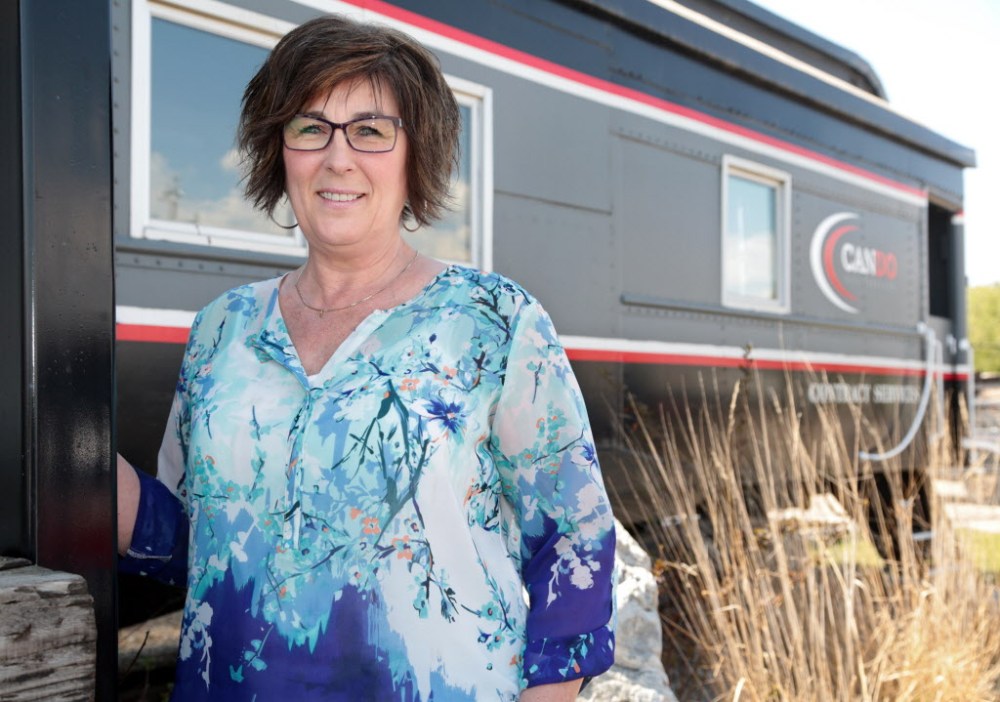
“We all know we’re in the real world and there is a chance of decline,” she said. “It’s not guaranteed, we know that. But you have to start somewhere.”
ESOPs have never been as popular in Canada as they are in the U.S., the U.K., Australia or Germany where there are tax incentives for company owners to sell into an employee trust and other mechanisms to encourage such plans.
But there is currently enough renewed interest across the country for the ESOP Association of Canada to hold it first national conference in more than 10 years (June 3-5 in Winnipeg).
Cando’s own experience in employee ownership might be similar to the narrative of pros and cons surrounding ESOPs in general.
“The first 10 years, it did nothing,” Peters said. “But the last five years, it’s exploded.”
For one thing, ESOPs can be complicated and it takes time for employees to fully grasp them.
But once they do and the benefits to the company become apparent, it can snowball.
In 1996, shares in Cando were worth $2.74 under a valuation formula using a multiple of book value that has not changed much. About 10 years ago, they were worth $10 each.
They are worth $40 now.
Peters said there is a slogan at Cando: Think job, think career, think ownership.
“It takes about five years to sink in for many employees,” he said.
Perry Phillips, an ESOP consultant in the Toronto area and one of the organizers of the conference, has been helping businesses set up ESOPs for 20 years.
“When we started it was a desert out there,” he said.
“People would roll their eyes and say it as only in the U.S. People don’t do it here. There was a lot of misinformation and myths about it.”
But it’s not a myth to say ESOPs are complicated or they are a different kind of animal.
That means many professional services providers to business owners (such as lawyers and accountants) are negatively predisposed to ESOPs.
“But over the years there has been a lot more people looking actively at them,” Phillips said. “I think it’s because of demographics. Baby boomers are looking at transitioning their companies and many are not happy with selling and other alternatives that are out there.”
Curwin Friesen, the CEO of Friesens Corp. in Altona is not part of the Friesen family the company is named after. In fact, none of the founding Friesen family are still owners of the company. The entire company is now owned by an employee trust which is controlled for the benefit of all.
“No model is perfect,” Friesen said.
“The original Friesen family was committed to employee ownership since as far back as the 1960s. Our model has evolved. There used to be a combination of direct and indirect share ownership. Now is it entirely indirect share ownership with the trust controlling 99 per cent of the shares.”
Whereas at Cando employees actually invest in the company and then benefit from any capital appreciation that occurs, at Friesens, employees do not buy the shares — so they don’t have the chance to sell them either — but they do benefit in the form of dividend distributions.
“If the company does well, the dividend goes to the trust,” Friesen said. “The staff hopes the company does well because if the company does well there will be a dividend. And that does not go to Wall Street or Bay Street, it goes to ‘Altona Street.’ “
The trust borrowed money to buy the company’s shares in the first place so it has some financial obligations, but the rest of the profits are distributed to employees.
And at Friesens, there has been profit-sharing cheques sent out to employees for 20 consecutive years.
The ideal results of participation in an ESOP comes from a recognition that everybody’s interests are aligned.
“It’s not managers versus staff or owners versus staff, everyone is an owner indirectly,” Friesen said. “Whatever is good for the company that increases its success and viability… if a dividend is to be paid not going to the president alone or the owners alone… it’s going to all of us.”
Phillips said all the key metrics go up: higher sales per employee, higher productivity, higher profitability and much better retention rates.
Friesen and Peters both say for it to work it requires a lot of communication, and on-going communication, with employees.
Phillips, whose business is consulting with companies who want to establish ESOPs, admits the process can be complicated. Even the incentives can be difficult to convey.
Employee Share Purchase Tax Credit legislation was passed in Manitoba last June, including tax credits of as much as 45 per cent of the amount employees might invest in their company.
But there has not yet been any takers.
Richard Groen, assistant deputy minister of Manitoba Finance, is looking forward to the ESOP conference in June as a way for the province to promote its tax credits.
“ESOPs as a rule of thumb are not generally used,” Groen said. “I don’t know the reason for that. It’s a bit of mixed bag in terms of why they are successful and why they’re not.”

One reason may be the imperative that everyone — owners, management and employees — have to be equally engaged and committed to doing it.
Phillips says they have to be 120 per cent committed.
“We have had situations where multiple owners, say four out of five of the ownership group, support it… well, that’s not going to go,” he said.
“You’re asking employees to trust you, become partners with you. Unless you are really supportive and have no ulterior reasons for doing it, it can cause real problems.”
martin.cash@freepress.mb.ca
History
Updated on Saturday, May 30, 2015 7:49 AM CDT: Replaces photo, formats fact box.