

Truckers want to keep on trucking
Industry fears cross-border vaccine mandates will ‘have a huge impact for the supply chain’
Advertisement
Read this article for free:
or
Already have an account? Log in here »
To continue reading, please subscribe:
Digital Subscription
One year of digital access for only $1.44 a week*
- Enjoy unlimited reading on winnipegfreepress.com
- Read the E-Edition, our digital replica newspaper
- Access News Break, our award-winning app
- Play interactive puzzles
*Billed as $5.77 plus GST every four weeks. After 52 weeks, price increases to the regular rate of $19.95 plus GST every four weeks. Offer available to new and qualified returning subscribers only. Cancel any time.
To continue reading, please subscribe:
Add Free Press access to your Brandon Sun subscription for only an additional
$1 for the first 4 weeks*
- Enjoy unlimited reading on winnipegfreepress.com
- Read the E-Edition, our digital replica newspaper
- Access News Break, our award-winning app
- Play interactive puzzles
*Your next Brandon Sun subscription payment will increase by $1.00 and you will be charged $17.95 plus GST for four weeks. After four weeks, your payment will increase to $24.95 plus GST every four weeks.
Read unlimited articles for free today:
or
Already have an account? Log in here »
Hey there, time traveller!
This article was published 16/12/2021 (1773 days ago), so information in it may no longer be current.
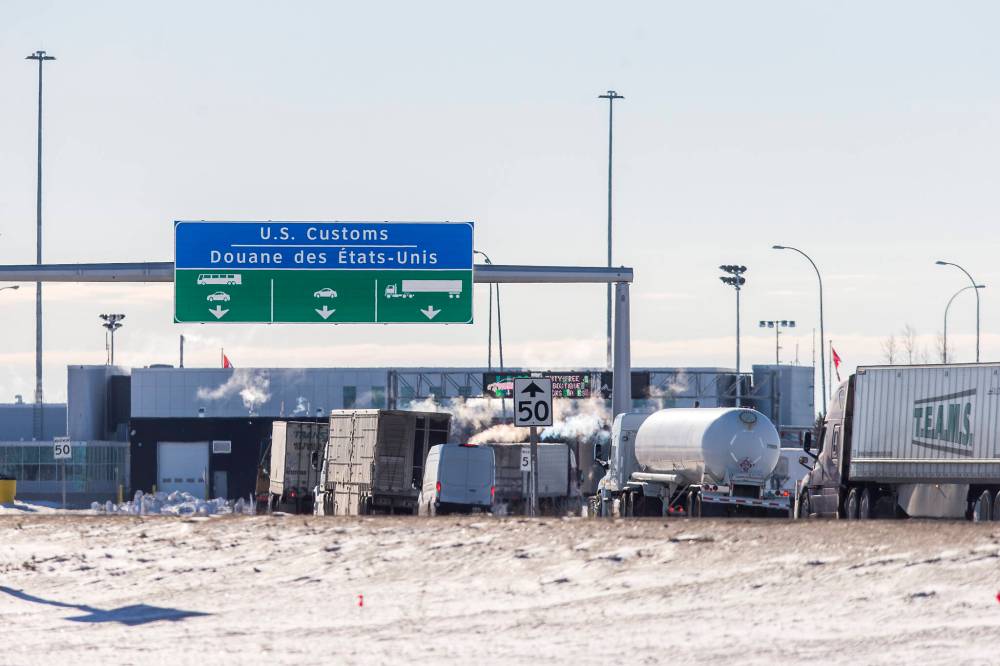
The trucking industry — and its customers — are girding for another bout of disruptions as both Canadian and U.S. governments are mandating anyone crossing the border either way be fully vaccinated.
Not only is cross border travel the issue, but the federal government has proposed regulations last week to make vaccinations mandatory in federally regulated workplaces. That includes the trucking industry.
“It is of great concern,” said Aaron Dolyniuk, acting executive director of the Manitoba Trucking Association.
Dolyniuk is quick to point out the industry is supportive of vaccines and believes its workforce vaccination rates are likely no different than national rates.
The U.S. government will require anyone entering the U.S. to be vaccinated as of Jan 1, 2022, and the Canadian government’s cross-border vaccination deadline is Jan. 15.
There is no date set yet for the federal regulated workplaces.
The Canadian Trucking Alliance, of which the MTA is a member, is appealing to the federal government for exemptions.
Industry officials point to the inflationary pressures that existing supply chain problems have caused and worry that limiting the number of truck drivers allowed to be on the roads will exacerbate that.
Dolyniuk said it may impact as much as 20 per cent of the driver cohort.
“That will have a huge impact for the supply chain,” he said. “Our industry believes vaccines work and we encourage the uptake of them, but not all drivers are vaccinated… nor are all Canadians.
Cam Dahl, the general manager of Manitoba Pork, said, “This is a big issue.”
Unlike packaged goods the pork industry requires timely logistics. He said he knows of Manitoba hog producers who are already taking steps to acquire extra deliveries this month of nutritional supplements that can only be sourced in the U.S.
“If we put another weight on that stack and start limiting the number or truckers who can carry goods across the border it will have a significant impact,” he said.
Bernie Driedger, owner of Portage Transport in Portage la Prairie, said about 99 per cent of his 170-person workforce is vaccinated. But he knows of a handful of his workers who are adamant about not getting vaccinated.
He’s not sure what responsibility he will have to lay them off, whether they would need to be paid severance and many other questions.
“It is the government’s mandate that my employees might not agree to, but then it becomes my problem,” he said.
Roughly 332,000 truck drivers worked Canada’s highways in October, roughly in line with pre-pandemic levels. There were 18,000 vacancies in recent months as young drivers, women and retirement-age workers left, according to Trucking HR Canada. Some 55,000 job vacancies are projected for 2023.
Enforcement of vaccine mandates for traffic across the Canada-U.S. border may not be a challenge, but Driedger, who is also president of the MTA, wonders who will enforce the mandate for federally regulated workplaces.
“Are we going to have RCMP at the provincial borders?” he wondered.
In southern Manitoba, where vaccine hesitancy has been a concern for some time, the trucking industry may be hit hard. One industry official said that some firms are considering closing their doors. Driedger said he knows someone with a small firm in Winkler where none of the drivers are vaccinated.
The industry claims that it has operated responsibly since the beginning of the pandemic, when its equipment kept rolling while the rest of us were sheltering in place.
Dolyniuk said it would not be unreasonable to look at the trucking industry a little differently than the common traveller.
“The industry has operated professionally throughout the pandemic,” he said. “And the nature of the business is that typically truck drivers are alone in the truck. Yes they have to stop to eat and get services but as long as safety procedures are in place they keep themselves safe.”
The Canadian Trucking Alliance wants the government to uphold the exemption it granted truckers when vaccines became available earlier this year, until the country resolves its supply chain issues.

However, health experts say that exemption would be unfair because other industries are facing worker shortages too and not being granted an exception.
They say making allowances for a highly mobile group like unvaccinated truckers could be dangerous because the virus could spread even further, and that these workers have had enough time to get their shots.
“Everybody admires the hard working truck driver and that all through the pandemic they have been barrelling through with their loads of food for the supermarkets… but the vaccines are available and they’ve been available for the best part of a year now,” said Timothy Sly, an epidemiologist and professor emeritus at Ryerson University’s School of Occupational and Public Health.
— with files from The Canadian Press
martin.cash@freepress.mb.ca