U.S. proposal could change the way oil companies report their carbon footprint
Advertisement
Read this article for free:
or
Already have an account? Log in here »
To continue reading, please subscribe:

Digital Subscription
One year of digital access for only $205*
- Enjoy unlimited reading on winnipegfreepress.com
- Read the E-Edition, our digital replica newspaper
- Access News Break, our award-winning app
- Play interactive puzzles
*First annual payment billed as $205.00 + GST for one year. This annual subscription will automatically renew at $233.00 + GST every 52 weeks (10% off the regular annual price of $259.35). Offer available to new and qualified returning subscribers only. Cancel any time.
To continue reading, please subscribe:
Add Free Press access to your Brandon Sun subscription for only an additional
$1 for the first 4 weeks*
- Enjoy unlimited reading on winnipegfreepress.com
- Read the E-Edition, our digital replica newspaper
- Access News Break, our award-winning app
- Play interactive puzzles
*Your next Brandon Sun subscription payment will increase by $1.00 and you will be charged $17.95 plus GST for four weeks. After four weeks, your payment will increase to $24.95 plus GST every four weeks.
Read unlimited articles for free today:
or
Already have an account? Log in here »
Hey there, time traveller!
This article was published 29/05/2022 (1576 days ago), so information in it may no longer be current.
CALGARY – The officially disclosed carbon footprints of Canada’s largest oil companies could balloon in size if tough new climate rules proposed earlier this year by a U.S. regulator come into effect.
The U.S. Securities and Exchange Commission’s proposal — which at this point has not been enacted and faces stiff opposition from industry groups and conservative lawmakers — would require publicly listed companies to account for their total “life-cycle” greenhouse gas emissions.
The rules would apply not only to publicly listed companies south of the border, but also to the more than 230 Canadian companies that are listed on U.S. stock exchanges. (Among these are Canadian energy giants like Enbridge Inc., Suncor Energy Inc., Imperial Oil Ltd. and Canadian Natural Resources Ltd.)
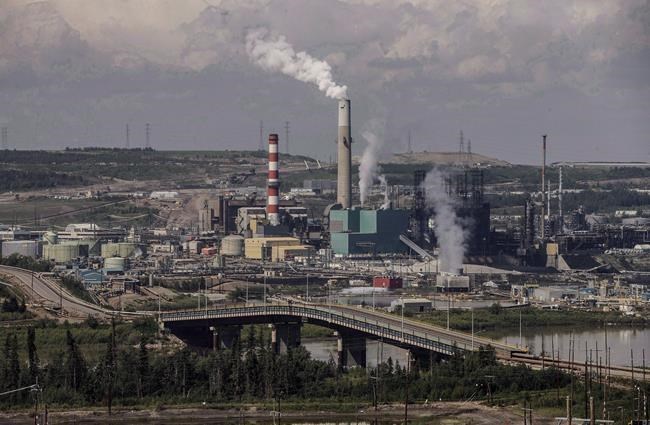
Under the new proposal, companies would have to disclose their Scope One and Scope Two emissions (terms that encompass the greenhouse gases produced directly by a company’s operations, as well as indirectly through the generation of energy the company purchases such as electricity to power the business).
But they would also have to publicly account for their Scope Three emissions, meaning all the other greenhouse gases they produce indirectly, including emissions produced by customers when they use a company’s product.
In other words, for oil producers, Scope One and Two emissions are the emissions the company makes itself (the methane emitted directly from a well, for example, or the electricity an oilsands producer uses to power its massive facilities). Scope Three emissions are the emissions an oil company causes when it sells its product (when a driver burns gasoline in a car, for example).
“The moment we ask companies to report Scope Three, we’re now focusing on the carbon intensity of the product itself,” said Tima Bansal, Canada research chair in business sustainability at the University of Western Ontario’s Ivey Business School.”It’s not the carbon intensity of their process – which they can reduce and can reduce quite substantially — it’s the carbon intensity of their product.”
Many Canadian energy producers have begun reporting their Scope One and Scope Two emissions in the years since the 2015 U.N. Paris agreement on climate change.
These numbers often form the basis of some of the industry’s own aggressive emissions reduction targets, such as Pathways to Net Zero — an alliance of the country’s biggest oilsands producers that have jointly set the goal of reaching net-zero carbon emissions by 2050.
The companies behind that initiative (Suncor, Cenovus, CNRL, Imperial, MEG Energy, and ConocoPhillips Canada) have laid out a road map to net-zero that includes the large-scale deployment of carbon capture and storage technology, and they’re asking for government support to help do it.
However, their plan only addresses Scope One and Two emissions. In fact, the oil and gas industry as whole has been very reluctant to talk about the emissions produced by the combustion of its product itself.
“Reporting Scope 3 emissions continues to be a challenge at this time and will prove difficult to provide in a timely manner, if at all,” wrote the Canadian Association of Petroleum Producers in a recent submission to the Canadian Securities Administrators. (The CSA is currently mulling its own set of proposed climate disclosure rules, though the Canadian version would allow companies to opt out of Scope 2 and 3 disclosures as long as they explain their reason for doing so.)
“We believe this (Scope 3 disclosure) would not only add additional burden to industry, but is also not practical in that upstream oil and gas producers don’t have knowledge or control over the end use of their sales products,” the industry lobby group wrote.
While only a very small minority of Canadian oil and gas firms are even attempting to report Scope 3 emissions right now, it’s already apparent that having to disclose these numbers would massively increase the size of the carbon footprint that companies must report to investors and the public.
For example, Cenovus Energy — which began disclosing its estimated Scope Three emissions in 2020 — says its Scope One and Two emissions in 2019 amounted to 23.94 million tonnes of C02. But Scope Three emissions, generated by the final use of the company’s products by customers, amounted to an estimated 113 million tonnes.
Duncan Kenyon, director of corporate engagement with climate change activist group Investors for Paris Compliance, said more than 80 per cent of emissions from fossil fuels fall under the umbrella of Scope Three — that is, they’re produced when the product is consumed.
“I hear it all the time from (oil companies), that Scope Three is ‘not our problem, it’s the consumers choice,’ ” Kenyon said. “But you can’t be a Paris-aligned, climate believer if you’re going to say that 80 per cent is someone else’s problem.”
“It also undermines the claims that ‘oh well, if we capture it all and put it underground, we’ll be OK for 2050,’ ” he added. “Because no, you won’t.”
Oil and gas companies have been returning major dividends to shareholders in the past year thanks to surging global energy demand, so it’s easy to question why investors would care about the Scope Three issue at all.
But Kenyon said ESG (environmental, social and governance) focused investors view climate change as a real business risk, and want to know how prepared a company is to adapt to what is coming. For example, an energy company actively working to reduce its Scope Three emissions would aim to increase the percentage of renewables in its portfolio.
“If you do bring in Scope Three disclosure, it becomes apparent really fast where your company is in the decarbonization game,” he said. “And then you have to decide what kind of a company you want to be in five years, 10 years or 25 years.”
In issuing the regulator’s proposal in March, SEC chair Gary Gensler said greenhouse gas emissions have become a commonly used metric to assess a company’s exposure to climate-related risks that are reasonably likely to have a material impact on its business.
“Investors get to decide which risks to take, as long as public companies provide full and fair disclosure and are truthful in those disclosures,” Gensler said in a news release. “Today, investors representing literally tens of trillions of dollars support climate-related disclosures because they recognize that climate risks can pose significant financial risks to companies, and investors need reliable information about climate risks to make informed investment decisions.”
This report by The Canadian Press was first published May 29, 2022.
Companies in this story: (TSX:SU, TSX:CVE, TSX:IMO, TSX:CNQ, TSX:MEG, TSX:ENB)