Experts urge caution in reading rapid tests as variants drive sixth wave
Advertisement
Read this article for free:
or
Already have an account? Log in here »
To continue reading, please subscribe:

Digital Subscription
One year of digital access for only $205*
- Enjoy unlimited reading on winnipegfreepress.com
- Read the E-Edition, our digital replica newspaper
- Access News Break, our award-winning app
- Play interactive puzzles
*First annual payment billed as $205.00 + GST for one year. This annual subscription will automatically renew at $233.00 + GST every 52 weeks (10% off the regular annual price of $259.35). Offer available to new and qualified returning subscribers only. Cancel any time.
To continue reading, please subscribe:
Add Free Press access to your Brandon Sun subscription for only an additional
$1 for the first 4 weeks*
- Enjoy unlimited reading on winnipegfreepress.com
- Read the E-Edition, our digital replica newspaper
- Access News Break, our award-winning app
- Play interactive puzzles
*Your next Brandon Sun subscription payment will increase by $1.00 and you will be charged $17.95 plus GST for four weeks. After four weeks, your payment will increase to $24.95 plus GST every four weeks.
Read unlimited articles for free today:
or
Already have an account? Log in here »
Hey there, time traveller!
This article was published 07/04/2022 (1624 days ago), so information in it may no longer be current.
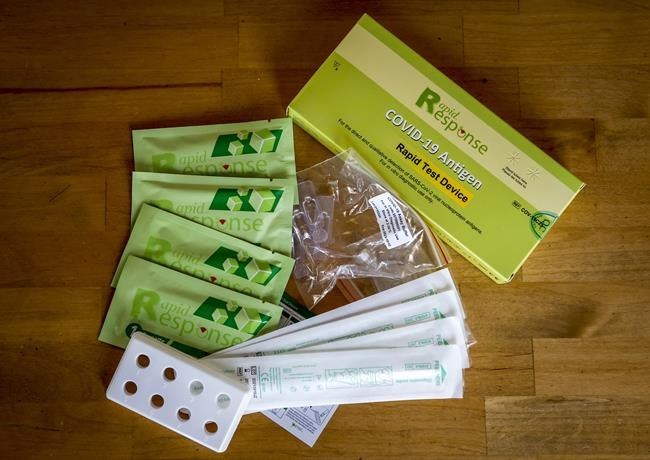
Rapid antigen tests have become Canada’s primary tool to detect COVID-19 as mounting signs point toward a sixth wave, but experts warn that results should be read with caution as the spread of variants raises questions about diagnostic accuracy.
The head of Ontario’s science advisory panel forecasted a COVID-19 “tidal wave” as wastewater monitoring suggests that the province is seeing between 100,000 and 120,000 new infections each day.
That’s a far cry from the 4,224 cases officially reported Thursday because of limited PCR testing.
Hospitalizations in Ontario are up 40 per cent week over week, with 1,126 people reported hospitalized with the virus and 159 in intensive care.
Meanwhile, Quebec health officials reported 3,777 new COVID-19 cases based on PCR testing, and 1,582 people in hospital with the disease.
Ontario and Quebec are among the provinces that have been reporting artificially low confirmed case counts since restricting access to PCR testing during the first Omicron wave.
While rapid antigen tests were hard to come by during the variant’s initial rise, supply has increased as Omicron’s more contagious sibling, the BA.2 subvariant, seems to fuel another surge.
Health Canada said 261 million rapid tests were distributed from Dec. 4 to Feb. 28, compared to nearly 90 million in the previous two months.
While rapid tests can help Canadians make safer decisions about how to navigate this rise in infections amid loosening of public health measures, experts warn that they can also provide a false sense of security.
Dr. Christopher Labos, a Montreal cardiologist with a degree in epidemiology, said it takes more than one rapid test to rule out infection because of high rates of false negatives.
Potential sources of inaccuracy include improper technique and testing too early in the illness for viral levels to be detectable, said Labos.
There are studies that suggest repeated rapid testing at frequent intervals can improve detection, said Labos. So if your first rapid test comes back negative, test again, he suggested.
“Now that we’re into the ‘judge your own risk’ phase of the pandemic … I think people need to realize that the risk of false negatives with rapid tests is very real,” Labos said, noting that evidence suggests the rate of false positives is fairly low.
“If you take your negative result as a license to return to normal, you might be inadvertently infecting other people, so I would continue to isolate, repeat the testing and make very sure you don’t have COVID.”
There are also questions about whether rapid tests are less sensitive to Omicron subvariants.
Health Canada said it’s monitoring emerging variants closely and current evidence suggests agency-approved tests continue to be effective. Also, it said, manufacturers must notify Health Canada if their tests are affected by a variant.
In February, the Ontario COVID-19 Science Advisory Table published findings from an analysis of preprint studies suggesting that the pooled sensitivity of rapid antigen tests for detecting Omicron infections is about 37 per cent, compared to 81 per cent for the Delta variant.
The science table’s director, Dr. Peter Juni, said he hadn’t looked into whether rapid test sensitivity differs between the two Omicron subvariants, but he expects more data will soon emerge.
He offered a rule of thumb for interpreting a rapid test result: if it’s positive, believe you have COVID-19, but it takes at least two negative tests roughly 48 hours apart to confirm you’re in the clear.
While many rapid test kits direct users to only take a nasal sample, Juni said swabbing the cheeks and the back of the throat beforehand may lead to more reliable results.
But Omar Khan, a professor of biomedical engineering and immunology at the University of Toronto, strongly discouraged veering from the test kit’s instructions, noting that the devices were designed and approved based on the recommended method of use.
Khan said rapid tests are an important, if imperfect, tool to guide individual behaviour, but their public policy applications are limited.
Many provinces don’t have systems to collect rapid test results, and those that do rely on voluntary reporting, which skews the data.
Khan said authorities need to bolster their efforts to track how COVID-19 is spreading and mutating because as the virus continues to evolve, our current screening methods could become less effective.
“The targets of these rapid tests are no longer valid (if) genetically it’s changed too much. And that’s going to be important because we want to make sure we have the right tools for surveillance and detection of the pathogen.”
Juni said limits on PCR testing make it unclear how long this wave will last because we don’t know how many people have been infected so far and may have an extra bit of immunity.
His comments come as all three of Ontario’s opposition parties called on the government to reinstate or continue several public health measures, including mandatory masking and greater access to PCR testing.
Ontario Health Minister Christine Elliott, citing the province’s chief medical officer of health, Dr. Kieran Moore, said the province need not reintroduce mask mandates because a rise in cases was expected.
On the East Coast, Nova Scotia officials also said there were no immediate plans to re-introduce measures such as mandatory masking, despite a significant jump in confirmed COVID-19 cases.
Alberta health officials cautioned that COVID-19 transmission appears to be on the rise with positivity rates and wastewater data trending upward. Health Minister Jason Copping said the province is not considering bringing back public health measures.
Saskatchewan’s top doctor said the province is experiencing a resurgence of cases that could last until mid-May or early June before cases start to level off.
Meanwhile, Manitoba’s chief public health officer said there are signs of increasing COVID-19 transmission, but severe outcomes have plateaued.
— With files from Nicole Thompson in Toronto, Keith Doucette in Halifax and Steve Lambert in Winnipeg
This report by The Canadian Press was first published April 7, 2022.