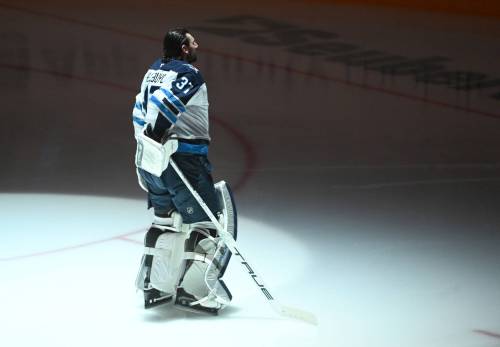
Arniel chosen to pilot Jets Associate bench boss promoted to head coach
Read this article for free:
or
Already have an account? Log in here »
To continue reading, please subscribe:
Digital Subscription
One year of digital access for only $1.44 a week*
- Enjoy unlimited reading on winnipegfreepress.com
- Read the E-Edition, our digital replica newspaper
- Access News Break, our award-winning app
- Play interactive puzzles
*Billed as $5.77 plus GST every four weeks. After 52 weeks, price increases to the regular rate of $19.95 plus GST every four weeks. Offer available to new and qualified returning subscribers only. Cancel any time.
To continue reading, please subscribe:
Add Free Press access to your Brandon Sun subscription for only an additional
$1 for the first 4 weeks*
- Enjoy unlimited reading on winnipegfreepress.com
- Read the E-Edition, our digital replica newspaper
- Access News Break, our award-winning app
- Play interactive puzzles
*Your next Brandon Sun subscription payment will increase by $1.00 and you will be charged $17.95 plus GST for four weeks. After four weeks, your payment will increase to $24.95 plus GST every four weeks.
Read unlimited articles for free today:
or
Already have an account? Log in here »
Hey there, time traveller!
This article was published 24/05/2024 (885 days ago), so information in it may no longer be current.
Scott Arniel has worn many hats with the Winnipeg Jets organization over his career. Now, he has a new one: head coach.
The 61-year-old, who served as associate coach for the past two seasons, was named late Friday afternoon as the successor to the retiring Rick Bowness.
Arniel is the fourth bench boss since the club relocated from Atlanta to Winnipeg in 2011, after Bowness, Paul Maurice and Claude Noel. (Dave Lowry served as an interim coach between Maurice and Bowness). He is the ninth head coach in franchise history,
RUTH BONNEVILLE / FREE PRESS FILES Scott Arniel has been named head coach of the Winnipeg Jets.
There was no question Arniel was the favourite for the job, and that didn’t change after a search that included interviews with several other candidates, including Craig Berube, who was recently hired by the Toronto Maple Leafs, and Todd McLellan.
This will be Arniel’s second stint behind an NHL bench, having spent one-and-a-half seasons at the helm of the Columbus Blue Jackets in 2010-11 and 2011-12, compiling a 45-60-18 record.
“He has an overall great feel for the game. A great feel of the personnel that he’s coaching and the way he communicates with players and the connection that he builds, the relationship that he builds with them,” University of North Dakota Fighting Hawks head coach Brad Berry told the Free Press in a telephone interview.
JOHN WOODS / THE CANADIAN PRESS FILES Arniel, then associate coach (left) talks to new head coach Rick Bowness during opening day of their NHL training camp practice in Winnipeg in 2022.
Berry spent four years working with Arniel — two as an assistant to him with Columbus and two before that as an assistant with the Manitoba Moose.
“You know what? He’s grown exponentially,” said Berry, who has remained in close touch with Arniel over the years and believes those previous hardships were part of the growth process for him.
“Nothing replaces experience. As much as you prepare, going through those situations, that makes you grow. The best part for Arnie is that he took a lot of time thinking about his first time around being an (NHL) head coach, and ultimately, after that, through his different stops of coaching, he grew from those experiences,” he said.
“The coaches that have success are the ones that know you have to change and you have to adapt and you have to learn from your past experiences — and I think he’s done that. I feel he’s obviously ready to take the reins again, and I think he’ll do an outstanding job.”
UNIVERSITY OF MANITOBA ARCHIVES / KEN GIGLIOTTI / FREE PRESS FILES A Winnipeg Jets hockey program from 1982-83 season features Scott Arniel on the cover.
Although Arniel typically portrays plenty of calm on the bench and at the podium, there’s a fiery side Berry is quite familiar with, having been on his staff in multiple stops.
“He’s a guy that likes to take charge and run his own bench, and I know he’ll have a lot of passion and exuberance when he does that,” he said.
“That’s one of the things he learned, to have that calmness at the podium and to be unfazed during the different times of the season. But I know one thing: he’s honest and direct. Working with him in Manitoba and Columbus, he’s an honest and direct guy. He doesn’t sugarcoat things.
“Honesty and clarity is a big deal. Communication is huge in this day and age.”
Arniel got a bit of a dry run with the Jets over the past two years, stepping in for Bowness on three occasions during the past two seasons with a 15-7-3 record in the interim role.
The Scott Arniel file
• Age: 61
• Born in Kingston, Ont., resides in Winnipeg
• Chosen in the second round, 22nd overall, of the 1981 NHL Draft by the Winnipeg Jets
• Appeared in 764 NHL games, including the Stanley Cup playoffs, notching 152 goals, 192 assists and 344 points
• Age: 61
• Born in Kingston, Ont., resides in Winnipeg
• Chosen in the second round, 22nd overall, of the 1981 NHL Draft by the Winnipeg Jets
• Appeared in 764 NHL games, including the Stanley Cup playoffs, notching 152 goals, 192 assists and 344 points
• Spent seven seasons in the International Hockey League as a player, including three with the Manitoba Moose, and one more in the American Hockey League
• Spent 16 seasons in the NHL as a head coach, associate coach and assistant coach with the Jets, Washington Capitals, New York Rangers, Columbus Blue Jackets and Buffalo Sabres
• Spent four seasons as head coach of the Manitoba Moose, leading the team to Game 6 of the Calder Cup final in 2009, and two more seasons as an assistant coach with the organization
• Spent one season as the head coach of the Chicago Wolves of the AHL and one season as a player/assistant coach with the Houston Aeros of the IHL
• Helped the Cornwall Royals of the QMJHL capture consecutive Memorial Cup championship in 1980 and 1981, and suited up for Canada in two World Junior Hockey Championships (1981 and 1982).
“Right from the beginning, we talked about family, and not letting Rick and (his wife) Judy down,” an emotional Arniel said earlier this year. He had interviewed for the job that ultimately went to Bowness in 2022, and it seemed like he was the team’s coach-in-waiting.
“You always want that second chance to get a kick at it,” Arniel admitted. Keeping the good ship Winnipeg afloat while Bowness tended to health issues with himself and his family served to further fuel his fire.
The Jets are coming off a regular season in which they went 52-24-6 — fourth overall in the 32-team league — and won the Jennings Trophy, which is awarded to “the goaltender(s) having played a minimum of 25 games for the team with the fewest goals scored against it, based on regular-season play.
Arniel’s connection to the city goes back to 1981, when he was selected in the second round, 22nd overall, in the NHL draft by the first Jets franchise. His good friend and junior teammate Dale Hawerchuk was selected first overall by the Jets that year.
The Kingston, Ont., product played five years in Winnipeg before being traded to Buffalo, then returned for another season in 1990-91. He ultimately played 730 NHL games, with 338 points (149 goals, 189 assists).
“He’s more than paid his dues. Really happy for him and the Jets,” Eric Hawerchuk, the son of the Jets legend who died of cancer in 2020, told the Free Press. “Dad would be smiling.”
KEN GIGLIOTTI / FREE PRESS FILES Scott Arniel during his first seas as a Winnipeg Jet in 1981. 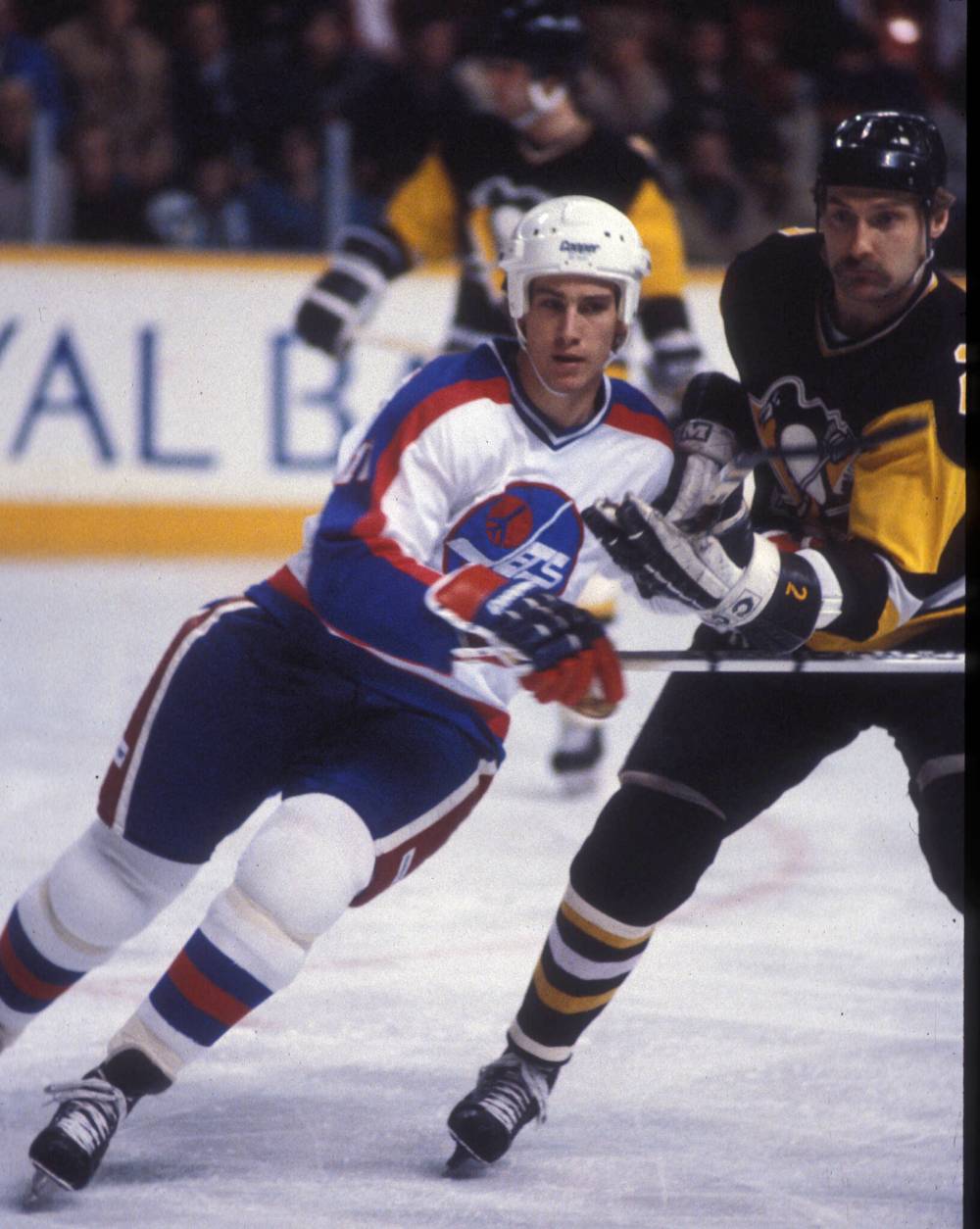
Arniel wrapped up his pro career by playing his final three seasons with the Manitoba Moose, retiring in 1999 to become an assistant coach for two years with the club. After joining the Buffalo Sabres as an assistant coach between 2002 and 2006, Arniel came back to Winnipeg as head coach of the Moose for four seasons, which included a 2009 appearance in the Calder Cup Final.
After being fired by the Blue Jackets midway through the 2012 season, Arniel took the head coach job with the Chicago Wolves of the AHL for the 2012-13 campaign, then returned to the NHL as an associate coach with the New York Rangers (five seasons) and Washington Capitals (four seasons) before he was brought in as part of Bowness’ staff.
Arniel and Jets general manager Kevin Cheveldayoff will speak with the media Monday morning. With Arniel moving up, that creates at least one associate/assistant opening, assuming both Brad Lauer and Marty Johnston continue in their existing roles.
mike.mcintyre@freepress.mb.ca
X: @mikemcintyrewpg
ken.wiebe@freepress.mb.ca
X: @WiebesWorld

Mike McIntyre grew up wanting to be a professional wrestler. But when that dream fizzled, he put all his brawn into becoming a professional writer.

Raised in the booming metropolis of Altona, Man., Ken Wiebe grew up wanting to play in the NHL, but after realizing his hands were more adept at typing than scoring, he shifted his attention to cover his favourite sport as a writer.
Our newsroom depends on a growing audience of readers to power our journalism. If you are not a paid reader, please consider becoming a subscriber.
Our newsroom depends on its audience of readers to power our journalism. Thank you for your support.





History
Updated on Friday, May 24, 2024 5:00 PM CDT: Writethru, adds byline and fact box
Updated on Friday, May 24, 2024 6:14 PM CDT: Adds quote from Eric Hawerchuk
Updated on Friday, May 24, 2024 8:25 PM CDT: Clarifies the Jennings trophy criteria