Hard work just beginning Arniel’s ascension to Jets head coach a decades-long journey
Read this article for free:
or
Already have an account? Log in here »
To continue reading, please subscribe:

Digital Subscription
One year of digital access for only $205*
- Enjoy unlimited reading on winnipegfreepress.com
- Read the E-Edition, our digital replica newspaper
- Access News Break, our award-winning app
- Play interactive puzzles
*First annual payment billed as $205.00 + GST for one year. This annual subscription will automatically renew at $233.00 + GST every 52 weeks (10% off the regular annual price of $259.35). Offer available to new and qualified returning subscribers only. Cancel any time.
To continue reading, please subscribe:
Add Free Press access to your Brandon Sun subscription for only an additional
$1 for the first 4 weeks*
- Enjoy unlimited reading on winnipegfreepress.com
- Read the E-Edition, our digital replica newspaper
- Access News Break, our award-winning app
- Play interactive puzzles
*Your next Brandon Sun subscription payment will increase by $1.00 and you will be charged $17.95 plus GST for four weeks. After four weeks, your payment will increase to $24.95 plus GST every four weeks.
Read unlimited articles for free today:
or
Already have an account? Log in here »
Hey there, time traveller!
This article was published 08/10/2024 (728 days ago), so information in it may no longer be current.
First, it was Ted Sator.
Then John Tortorella chimed in and finally, Rick Dudley shared a similar sentiment.
At the time, Scott Arniel was still a productive player with the Buffalo Sabres, nearly hitting 20 goals during consecutive seasons (1988-90).
In separate conversations with Sabres head coaches (Sator and Dudley) and an assistant (Tortorella), a familiar theme emerged and quite frankly, Arniel didn’t quite know what to make of it.
KEN GIGLIOTTI / FREE PRESS FILES Scott Arniel, left, was drafted by the Jets in the second round in 1981 and made the NHL club as an 18 year old.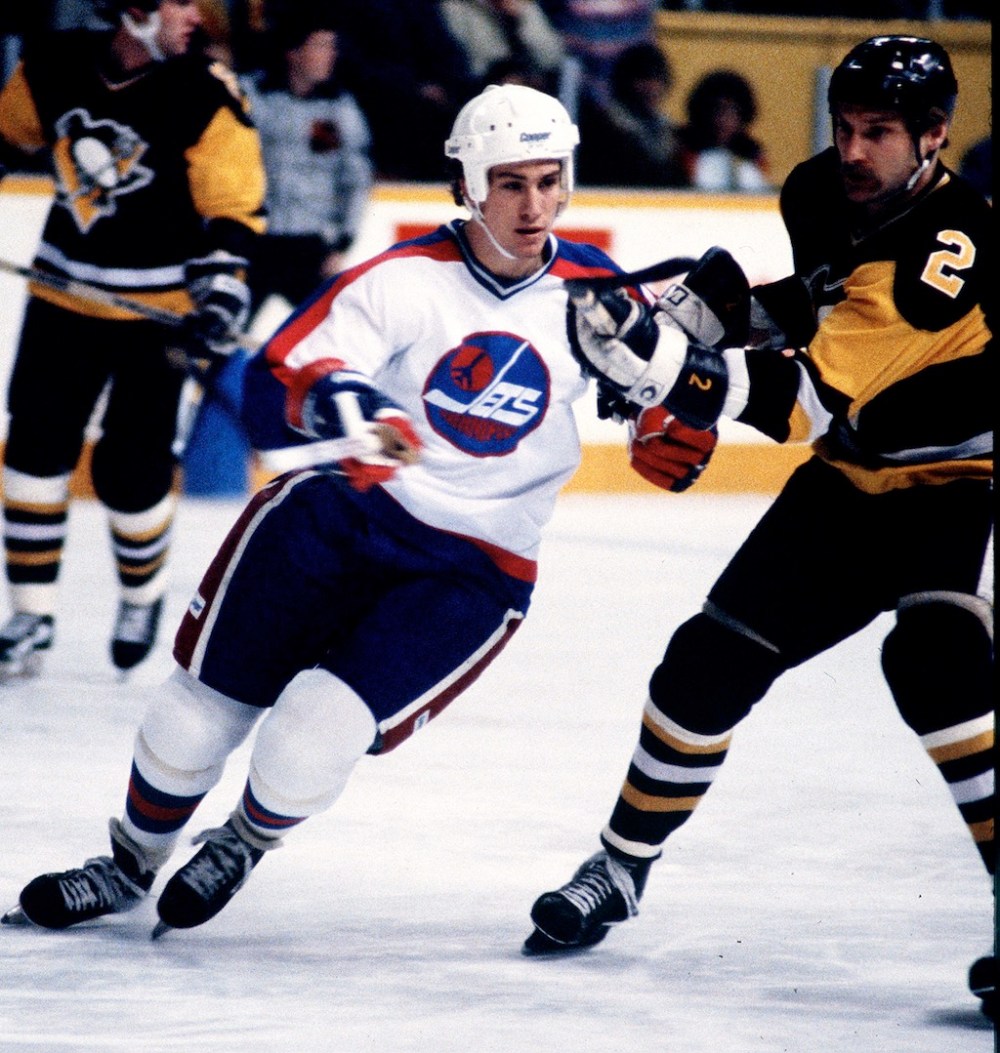
“They all said have you ever thought about coaching after you’re done playing? I wasn’t sure if it was a shot that I was no good anymore as a player,” Arniel said earlier this week. “But they all said to me, ‘You should think about it. You’d be a good coach when you’re done.’”
Although Arniel wasn’t ready for retirement, he took those words to heart and eventually made his way down the suggested path.
It’s been a long and winding road, but Arniel is set to embark on the latest chapter of the journey as head coach of the Winnipeg Jets, who visit the Edmonton Oilers on Wednesday in their 2024-25 regular season opener.
Arniel’s connection to Winnipeg has been well-documented. He was drafted by the 1.0 version of the Jets in the second round in 1981 and made the NHL club as an 18 year old along with his junior linemate and best friend Dale Hawerchuk.
That arrival coincided with Tom Watt being named head coach and one of Arniel’s first conversations with him is one that still resonates today.
“He said, ‘Son, how do you play 10 or 15 years in this league?’ And he proceeded to work with me to be able to do that,” said Arniel. “Myself, Dale (Hawerchuk), Brian Mullen, Jimmy Kyte, Dave Ellett. There were a whole pile of us. It was a young team that was going to be part of the future and he took great pride in teaching us how to play the whole game, not just one part of it. He taught me to be a complete player.”
BORIS MINKEVICH / FREE PRESS FILES Scott Arniel behind the bench as head coach of the Manitoba Moose.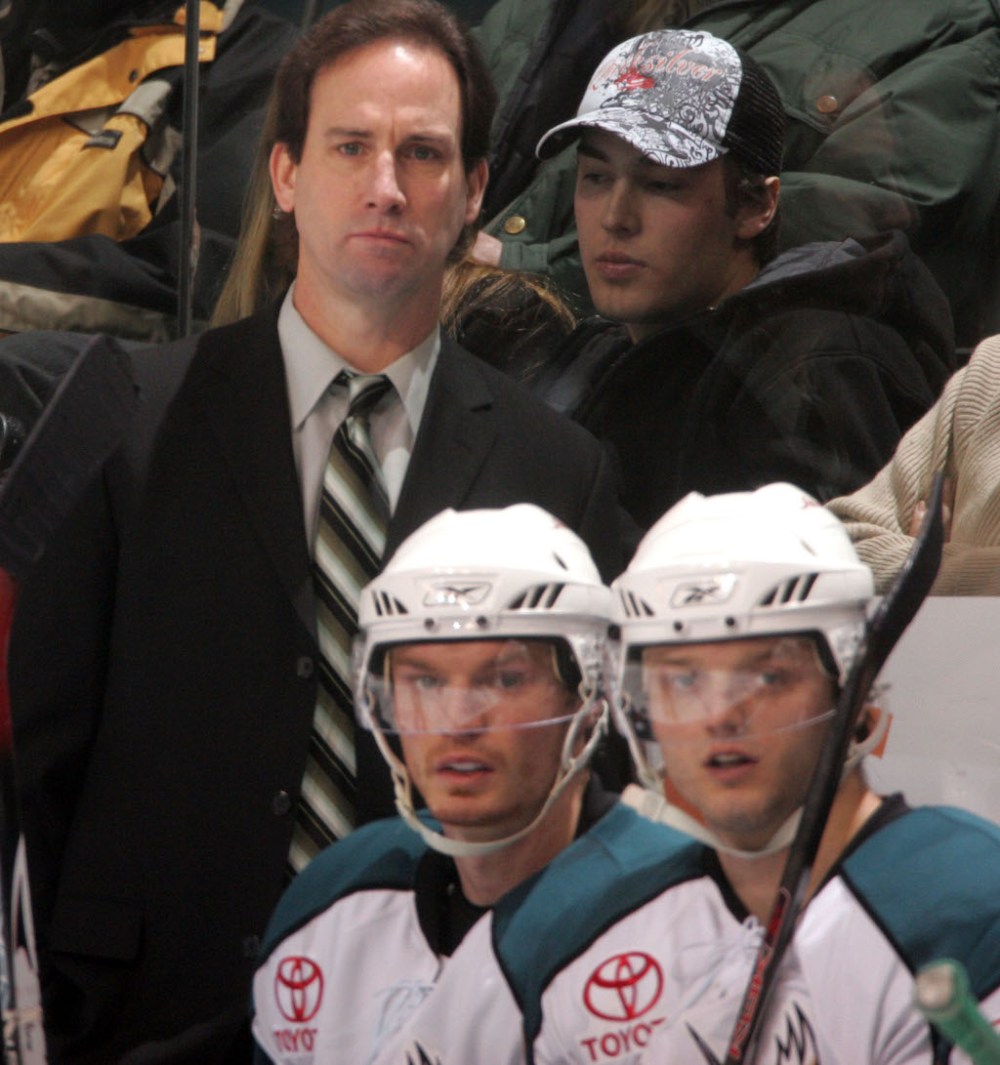
When Arniel was traded to the Sabres, he had the opportunity to play for legendary Scotty Bowman, who is considered by many to be the best to ever do the job.
Arniel still marvels at Bowman’s ability to work his magic in matching lines, something that’s far more prevalent today than it was back then.
“It’s unbelievable how dialed in he was, with who was coming over the boards for the opposition, what defence pair was on the ice,” said Arniel. “His bench management was probably one of the best things about him. He was an outside-the-box thinker all the time about the game and that’s why he lasted so long.”
The opportunity to be a player/coach with the International Hockey League’s Houston Aeros in 1995-96 laid the groundwork for coaching being a profession Arniel felt he could pursue.
“Then the bug really hit me. Designing practices, watching video, having your hands a little more involved in what the day-to-day business was. It just kind of grew from there,” Arniel said. “In the summertime, during the last three or four years I was still playing, I would go to coaching seminars and coaching clinics.
“Whatever it was, I wanted to be a sponge. To see what I’m missing and to see what else was out there. What else can I learn to get better?”
Late in that 1995-96 season, Arniel was traded to the Utah Grizzlies — whose assistant coach and assistant general manager was Kevin Cheveldayoff.
The Grizzlies captured the Turner Cup championship that spring and Arniel wondered if it might be time to pursue coaching.
Terry Gilliam / The Associated Press Files Arniel in 2010, during his only other tenure as an NHL head coach with the Columbus Blue Jackets.
Instead, he signed with the Manitoba Moose and played three seasons in the IHL before Randy Carlyle hired him to be an assistant coach with the organization.
“I was off and running. It worked out perfectly for me,” Arniel said. “That was my way of getting into this business. It keeps me close to the game. You’re not a player, but it’s the next best thing for me. You’re still in the heat of it, you’re in the heartbeat of what’s going on around you. Staying in hockey, the way I have, has been very rewarding.”
His NHL coaching odyssey has included assistant or associate coaching jobs with the Sabres, New York Rangers and Washington Capitals — where he worked with Lindy Ruff, Alain Vigneault and Peter Laviolette, among others.
He also spent time in the American Hockey League as a head coach with the Manitoba Moose (including a run to the Calder Cup final in 2009) and Chicago Wolves along with his season-and-a-half as bench boss of the Columbus Blue Jackets from 2010 to 2012.
“Everybody has an influence on you in different ways. You take bits and pieces,” said Arniel. “So, I can’t say it’s been one person. But it’s amazing how much you take from people.”

Working with Rick Bowness the past two seasons in Winnipeg is something Arniel won’t soon forget. Bowness, who spent more than three decades as either a head, associate or assistant coach in the NHL, stepped down as the Jets coach in the spring.
“I can’t be grateful enough or say enough for how much he mentored me the last couple of years to help get me ready for this,” he said.
When reached in Florida on Tuesday, Bowness reiterated his belief that Arniel was ready to take over the reins.
“Our first (head coaching) job is always the toughest,” said Bowness. “We all make mistakes. The important thing is to recognize them and then take the steps to correct them. Arnie has been working really hard at that.
“He knows the game, he knows the X’s and O’s. His communication skills are very good. He’s honest and that’s what the players want. For you to be up front with them.”
MIKE DEAL / FREE PRESS Scott Arniel (left) with Winnipeg Jets GM Kevin Cheveldayoff. Arniel has played for and learned his craft from some of the greatest coaches of all time.
Arniel recognizes how rare opportunities are to be an NHL head coach and he’s planning to make the most of his second chance.
Getting to do it in his adopted hometown is an obvious bonus, though he knows the hard work is just beginning.
“I didn’t take the job just to be a head coach. I took the job to win here,” said Arniel. “I know what this city has gone through, what the province has gone through. You see the Bombers having so much success and that’s awesome. You see how the city and the province rallies around them.
“I was around here a little bit in 2018 when (the Jets) went on their run (to the conference final) and it’s time for us to be one of those teams. Why can’t it be us?”
ken.wiebe@freepress.mb.ca
X: @WiebesWorld

Ken Wiebe is a sports reporter for the Free Press, with an emphasis on the Winnipeg Jets. He has covered hockey and provided analysis in this market since 2000 for the Winnipeg Sun, The Athletic, Sportsnet.ca and TSN. Ken was a summer intern at the Free Press in 1999 and returned to the Free Press in a full-time capacity in September of 2023. Read more about Ken.
Every piece of reporting Ken produces is reviewed by an editing team before it is posted online or published in print — part of the Free Press‘s tradition, since 1872, of producing reliable independent journalism. Read more about Free Press’s history and mandate, and learn how our newsroom operates.
Our newsroom depends on a growing audience of readers to power our journalism. If you are not a paid reader, please consider becoming a subscriber.
Our newsroom depends on its audience of readers to power our journalism. Thank you for your support.
Related Articles
Jets tap Comrie as backup goalie to Hellebuyck




History
Updated on Tuesday, October 8, 2024 6:13 PM CDT: Adds Bowness quotes