Learning on the land Public school educators take students outside, incorporate Indigenous culture, traditions in overall curriculum
Read this article for free:
or
Already have an account? Log in here »
To continue reading, please subscribe:

Digital Subscription
One year of digital access for only $205*
- Enjoy unlimited reading on winnipegfreepress.com
- Read the E-Edition, our digital replica newspaper
- Access News Break, our award-winning app
- Play interactive puzzles
*First annual payment billed as $205.00 + GST for one year. This annual subscription will automatically renew at $233.00 + GST every 52 weeks (10% off the regular annual price of $259.35). Offer available to new and qualified returning subscribers only. Cancel any time.
To continue reading, please subscribe:
Add Free Press access to your Brandon Sun subscription for only an additional
$1 for the first 4 weeks*
- Enjoy unlimited reading on winnipegfreepress.com
- Read the E-Edition, our digital replica newspaper
- Access News Break, our award-winning app
- Play interactive puzzles
*Your next Brandon Sun subscription payment will increase by $1.00 and you will be charged $17.95 plus GST for four weeks. After four weeks, your payment will increase to $24.95 plus GST every four weeks.
Read unlimited articles for free today:
or
Already have an account? Log in here »
Hey there, time traveller!
This article was published 01/11/2024 (686 days ago), so information in it may no longer be current.
Passersby would be forgiven for mistaking the rectangular green space at the corner of Flora Avenue and Salter Street as a typical school sports and recreation field.
And the grassy plot shared by Children of the Earth High School and Niji Mahkwa School is, indeed, that. But it is so much more.
The way cultural support teacher Connie West-Buck and her colleagues see it, the grounds are a sacred space.
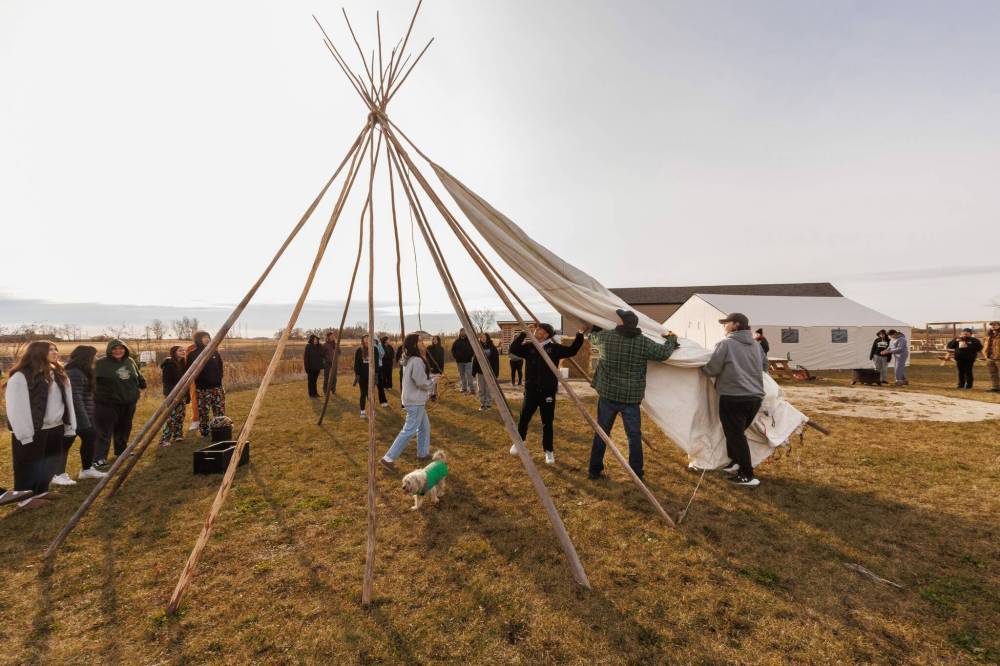
The teachers’ shared vision has laid the groundwork for a “learning lodge” to be erected in the field to facilitate more land-based education.
When high school principal Jen Donachuk pitched the project to West-Buck in June, she offered tobacco and requested her help to start consultations on it.

First Nations and Métis use tobacco for ceremony, healing and giving thanks. It is one of the four sacred medicines, along with cedar, sage and sweetgrass. Ceremonial tobacco isn’t smoked, except during special occasions, where it is burned in a pipe but not inhaled.
Ceremonial tobacco is also used for smudging; dried tobacco leaves are burned (often in combination with the other three plants) and the smoke is said to open the soul to allow the spirits to bring their healing powers and remove negative energy.
“It was the first time that I think that I’ve ever made Connie cry, because she said, ‘I’ve been waiting for more than 35 years to see this begin,’” said Donachuk, who is Red River Métis.
“And that’s what we’ve got; we’ve got a beginning.”
The Winnipeg School Division has set aside $3,000 for construction and fuel, tobacco and honorarium expenses.
The recipient high school, which opened in 1991, and the feeder school next door deliver holistic programs that embed Indigenous values and traditions into the Manitoba curriculum.
Despite focusing on language and culture, inner-city students have historically had to travel to participate in ceremonies.
The new initiative reflects the growing demand for lessons on the land and recognition of their important place in the province’s public school system.
Manitoba Education released Mamàhtawisiwin: The Wonder We Are Born With — a policy directive to guide Indigenous education and create culturally appropriate resources for First Nations, Métis and Inuit students — in 2022.
“From an Indigenous perspective, it is foundational that the human, natural and spiritual systems are interrelated; they are not separate systems. The Indigenous world view is one of relationality,” states an excerpt.
“Experiential, land-based learning provides opportunities for students to make these connections.”
The 73-page document outlines the province’s commitment to advancing the Truth and Reconciliation Commission’s 94 calls to action, specifically Nos. 62 and 63.
Those education-specific sections stress the need for curriculum development on Indigenous peoples’ historical and contemporary contributions to Canada, and “building capacity for intercultural understanding, empathy and mutual respect.”
The Education Department tapped a seasoned teacher to develop a specific curriculum framework for Indigenous land-based education in September. Wade Houle, who is Anishinaabe and Métis, has been seconded from Dauphin-based Mountain View School Division for a year to oversee the work.
In response, teachers have increasingly sought elders’ expertise and planned field trips to sites such as Ozhaawashkwaa Animikii-Bineshi Aki Onji Kinimaagae’ Inun (Blue Thunderbird Land-based Teachings Learning Centre), also known as the Aki Centre.
The West St. Paul centre spans 50 acres, much of which is undergoing restoration so the over-farmed grounds return to their original state as a tallgrass prairie and wetland.
The Seven Oaks School Division has facilitated rabbit snaring, moose and deer hide tanning and the harvesting of sage, sweetgrass and tobacco, since opening the centre in 2019.
More than 5,000 visitors stopped by the Grassmere Road site that houses vegetable and medicine gardens, a sweat lodge and a greenhouse in 2023-24. In doing so, they learned about ecosystems, treaties, conservation and related topics.
Sweat lodges house purification ceremonies during which participants pray in a circle around a fire pit.

“This restoration really helps to tie us to events of the past and to think about where we are today, and where we want to go in the future,” said Alexis Nazeravich, operations co-ordinator at the centre.
Since the new year began, Indigenous and non-Indigenous children have been taught how to identify plants, understand their life cycles and collect seeds that are replanted on the grounds.
Nazeravich said she and her colleagues are “relearning” how education can look with knowledge keepers’ guidance.
Elders helped design new Anishinaabemowin signage for the site.
“These are teachings that help us reflect on how to build a good life. They’re not bound to a religion or an ethnicity. They’re good human qualities and practices,” she said, adding all students learn how to be good neighbours to each other and their natural environment.
Sherri Denysuik, assistant superintendent of Indigenous excellence in education, said the centre has become a symbol of “land back” in Seven Oaks.
As far as the Anishinaabe educator is concerned, every division deserves a land-based education centre to support Indigenous community members’ well-being and self-determination.
“It’s good medicine. This learning is good medicine for all,” she said.
Denysuik added that more teachers have taken notice, given many have turned their schoolyards into outdoor classrooms.
Grade 7 and 8 students at Niji Mahkwa School took part in a bloody deer harvest in their inner-city field Monday.
Principal Reuben Boulette said he had anticipated more squeamishness as they watched a knowledge keeper and traditional hunter cut open a carcass on the lawn while delivering teachings on animals and honouring their sacrifice.
They were all deeply engaged and wanted to observe the process, which their school leader said involved “fur and a lot of red,” in full.
Boulette, who is Anishinaabe from Black River First Nation, said Indigenous students are typically naturalistic in their intelligence. “Since time immemorial, we’ve been on the land. That’s how we learn,” he said.
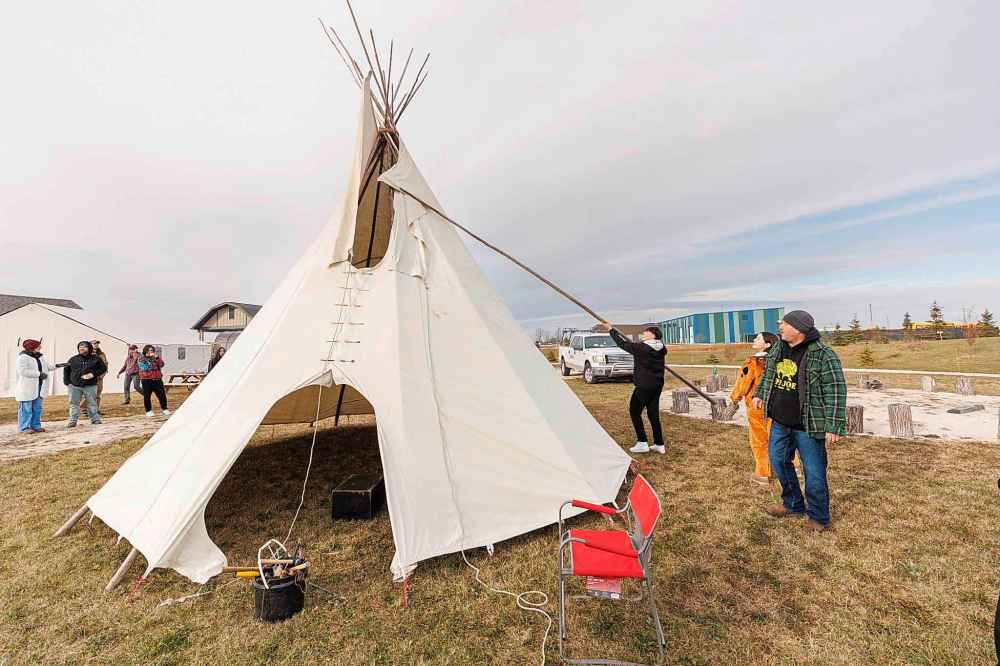
He’s been encouraging members of the Niji Mahkwa staff team to spend more time outside and take children on community walks in recent years. The schoolyard’s former baseball diamond is often used as a cultural meeting place.
“Not only are we making doctors, lawyers, teachers, politicians — some of our kids are going to go on to be lodge-keepers and they’re going to have pipes and they’re going to be spiritual leaders in their communities, so we want to provide that as part of their opportunity of learning, too,” Boulette said.
The school leader said a space for ceremony on the campus is “long overdue,” given spirituality is ingrained in everything Indigenous people do.
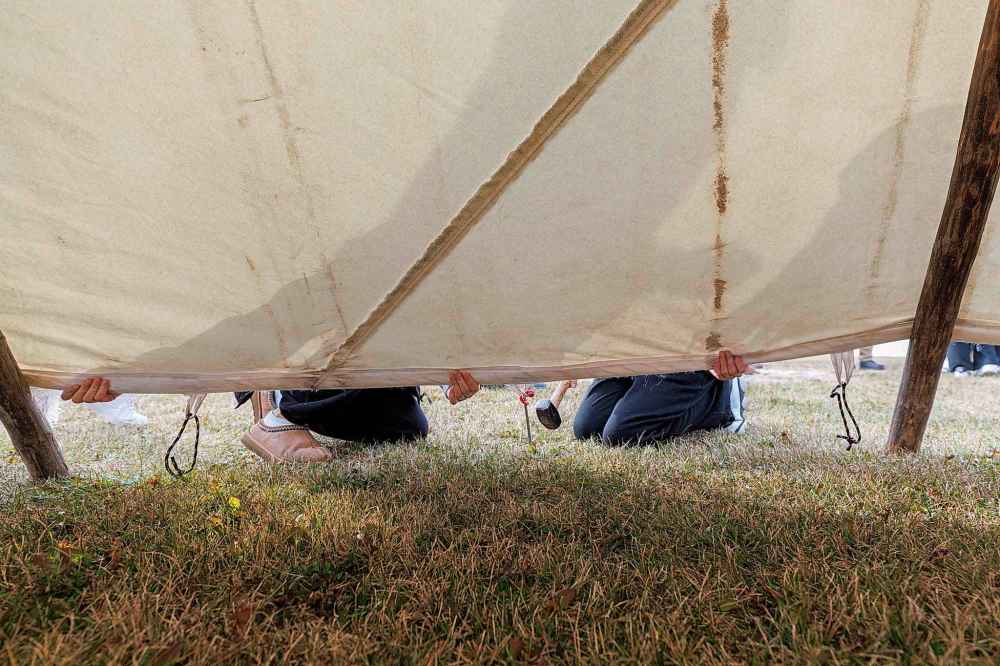
The learning lodge will be made “the traditional way” with willow and a fire-proof tarp, per a description of the project recently approved by the committee in charge of the Winnipeg School Division Children’s Heritage Education Endowment Fund.
Some schools have indoor rooms outfitted with ventilation systems to facilitate smudging, but West-Buck said getting outside connects students “to something bigger than themselves.”
Outings to Birds Hill Provincial Park and Brokenhead Wetland Interpretive Trail, among others, require busing arrangements and significant scheduling efforts.
“That’s my vision, that’s my hope, that’s my dream — that we have our own space,” said West-Buck, who is Ojibwa from Sandy Bay First Nation.
The cultural support teacher said she wants to hold sweat lodges for students and caregivers close to home.
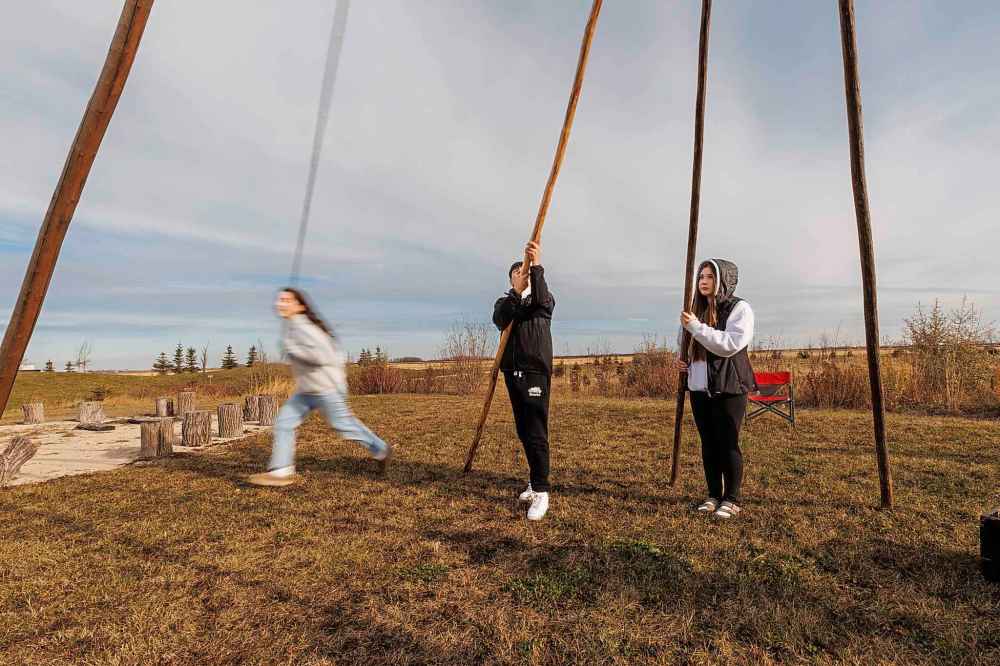
Consultations with community members and the division’s buildings authority are underway.
The principals involved in the project indicated many of the families whose children attend their schools rarely leave the inner-city, so they see the learning lodge as an important public service.
“We have the opportunity to help caregivers reconnect in that very traditional way, to support their spiritual growth and health across the quadrants of the medicine wheel (spiritual, emotional, physical and mental),” said Donachuk of Children of the Earth.
On a wider scale, the principal likened the growth of land-based learning across the province to re-entering the spirit that the treaties were signed in.

Boulette echoed those comments, saying the readiness to consider two different ideologies on education is encouraging.
Despite colonialism and historical attempts to erase Indigenous cultures, languages and ways of being, the Niji Mahkwa principal said many Indigenous people want to share their world view.
“We still very much believe that our ways are valuable for everybody to understand as a pathway in living in harmony with the rest of creation,” he said.
There are internal whispers about the Winnipeg School Division beginning to search for a property to conduct land-based learning for students outside of city limits.
For now, Boulette and his colleagues have found a fitting backdrop right behind their buildings.
maggie.macintosh@freepress.mb.ca

Maggie Macintosh
Education reporter
Maggie Macintosh reports on education for the Free Press. Originally from Hamilton, Ont., she first reported for the Free Press in 2017. Read more about Maggie.
Funding for the Free Press education reporter comes from the Government of Canada through the Local Journalism Initiative.
Every piece of reporting Maggie produces is reviewed by an editing team before it is posted online or published in print — part of the Free Press‘s tradition, since 1872, of producing reliable independent journalism. Read more about Free Press’s history and mandate, and learn how our newsroom operates.
Our newsroom depends on a growing audience of readers to power our journalism. If you are not a paid reader, please consider becoming a subscriber.
Our newsroom depends on its audience of readers to power our journalism. Thank you for your support.